Solar lentigines (age spots): causes and treatment
What solar lentigines are, how they differ from other pigmented spots, and what the evidence supports for lasers, IPL, cryotherapy, peels, and topical agents.
Dr. SangYoul Yun is a Korean Board-Certified Dermatologist with fellowship affiliation with the American Academy of Dermatology (AAD International Fellow), membership in the American Society for Laser Medicine and Surgery (ASLMS), and active membership in nine Korean dermatology societies. He previously served as a senior dermatologist at Banobagi.
What solar lentigines are, how they differ from other pigmented spots, and what the evidence supports for lasers, IPL, cryotherapy, peels, and topical agents.
What randomized trials and meta-analyses show about tranexamic acid for melasma, including efficacy by route (oral, topical, injected), safety, and who should avoid it.
How clinicians tell melasma, post-inflammatory hyperpigmentation, and solar lentigines apart, why it changes treatment and prognosis, and the evidence-based options for each.
What the evidence supports for male androgenetic alopecia: minoxidil, finasteride and dutasteride, adjunct options, and realistic expectations on results and risks.
A phenotype-based guide to rosacea: how flushing, persistent redness, papules and pustules, visible vessels, and eye involvement are treated, and why trigger control matters.
How topical retinoids work, how prescription tretinoin compares with retinaldehyde, retinol, and adapalene, and how to choose a tolerable option for aging or acne-prone skin.
How clinicians classify atrophic acne scars (ice-pick, boxcar, rolling) and what the evidence supports for subcision, fractional lasers, microneedling RF, and fillers.
What the evidence supports for treating common and plantar warts, why salicylic acid and cryotherapy are first-line, and when persistent warts need a different approach.

The World Federation for Ultrasound in Medicine and Biology (WFUMB) released 24 consensus recommendations standardizing dermatologic ultrasound for aesthetic procedures — what changed and what it means for practice.
Exosome skincare and injectables are a breakout trend. A look at what systematic reviews of human studies report, the safety and regulatory gaps, and how to read the claims critically.

Why oral minoxidil at low dose has become a workhorse for female pattern hair loss, how Korean dermatology practices approach diagnosis and combination therapy, and what the evidence supports.
After rapid weight loss on GLP-1 drugs, loose skin on the abdomen, arms, and thighs is common. What the evidence says about energy-based tightening, biostimulators, timing, and when surgery is the realistic option.
Why some patients on semaglutide or tirzepatide notice hair shedding, what pharmacovigilance and review data show, the likely telogen effluvium mechanism, and how it is managed.
How RF microneedling works, what a 41-study systematic review shows for acne scars and skin laxity, how it compares with fractional lasers, adverse events, and patient selection.

Why adult-onset acne in women is often hormonally driven, how it differs from adolescent acne, and what the evidence supports for combined oral contraceptives, spironolactone, and topical therapy.

Why GLP-1 receptor agonists cause facial volume loss, severity predictors, and the published multimodal restoration approaches in 2026.

Why visible light, not just UV, drives melasma and post-inflammatory pigmentation — and what tinted iron oxide sunscreens add to a summer skin care routine in 2026.

What polynucleotide injectables do, what the systematic review data shows, how they compare with HA boosters, adverse events, and patient selection.

Mechanism of collagen induction, expected timeline, reconstitution evidence, recognized complications, and patient selection for PLLA.

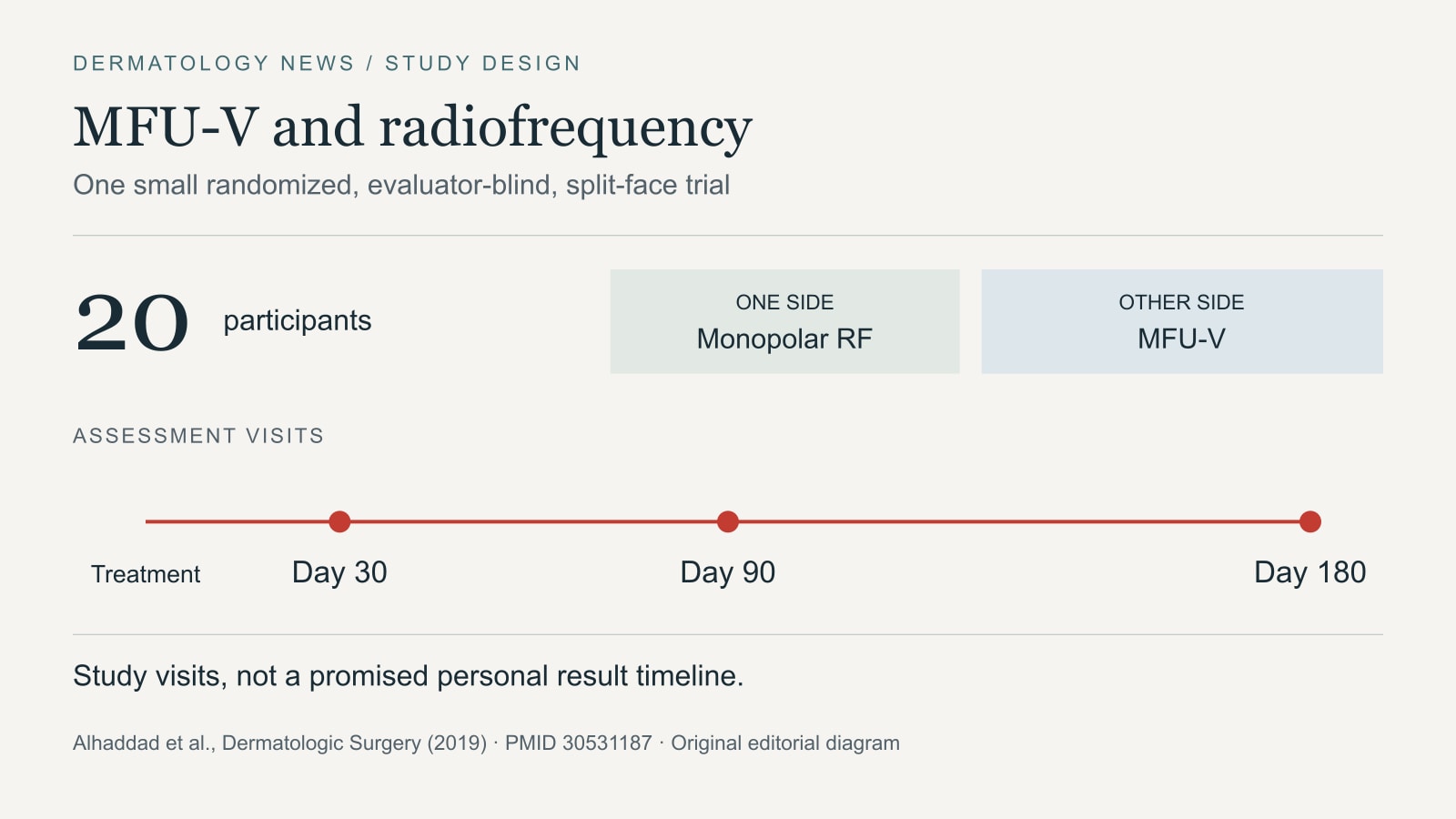
Mechanism, timeline, comparator data vs MFU-V, adverse events, and patient selection for monopolar radiofrequency facial tightening.
Mechanism, timeline, comparator data, adverse events, and patient selection for microfocused ultrasound — based on published clinical trials and reviews.
Evidence for FDA-approved hydroquinone + tretinoin + fluocinolone for melasma — efficacy vs monotherapy, adverse effects, and adjunctive options.
What patients should ask and clinicians should disclose before MFU-V, radiofrequency, or combination skin tightening — checklist + red flags.