Seborrheic dermatitis: autumn flares and new treatments
Why seborrheic dermatitis flares as weather cools, plus trial evidence on roflumilast foam, the first FDA-approved PDE4 inhibitor for the disease.
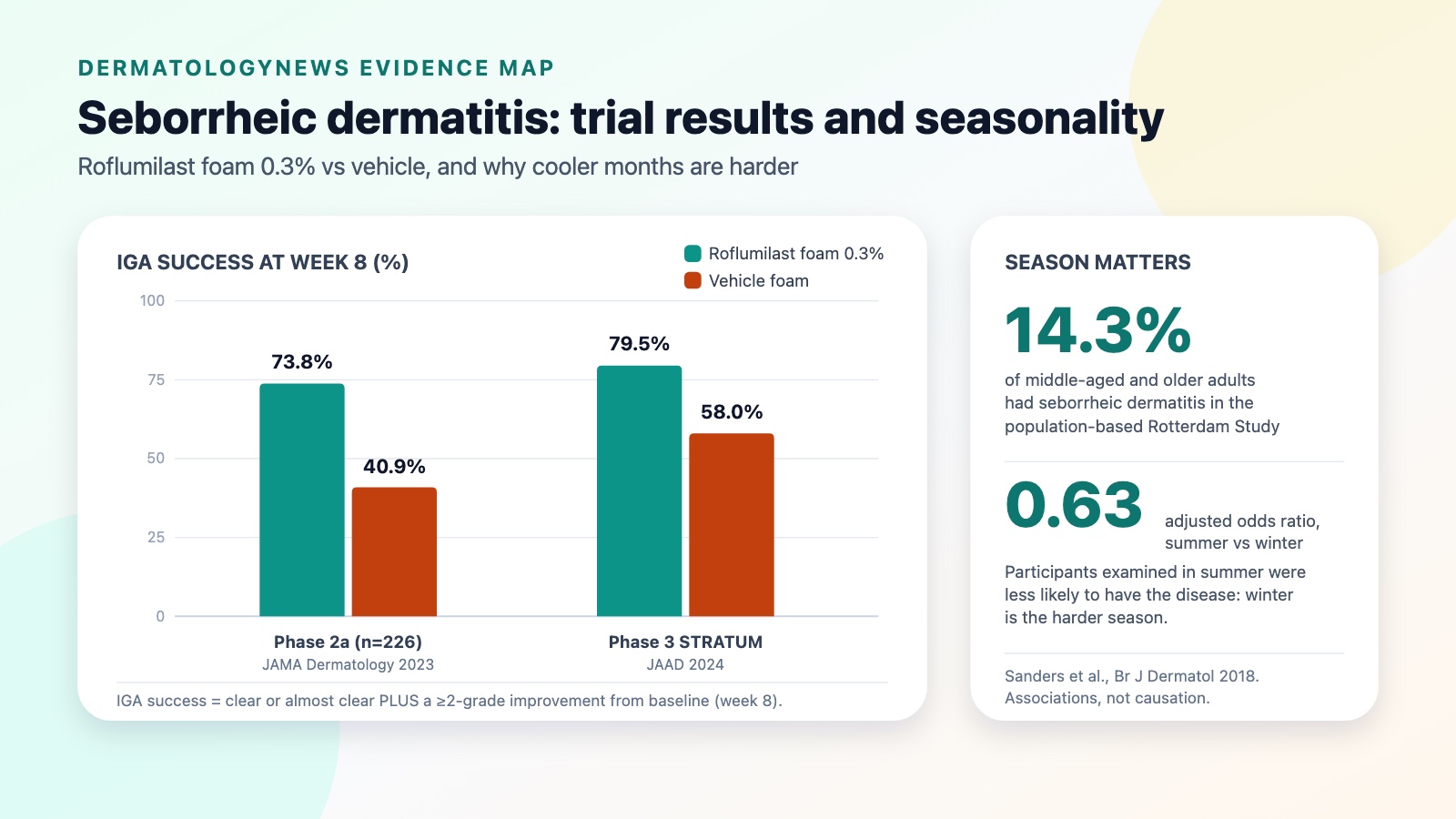
Seborrheic dermatitis is one of the most common inflammatory skin diseases, affecting 14.3 percent of middle-aged and older adults in the population-based Rotterdam Study, and it is a winter-dominant condition: participants examined in summer were significantly less likely to have it than those examined in winter [1]. As Korea moves into autumn, the scaling and redness around the nose, eyebrows, and scalp that quieted over summer often return. The treatment conversation has also changed. Roflumilast foam 0.3%, a once-daily topical phosphodiesterase-4 (PDE4) inhibitor, became the first drug in its class approved by the US Food and Drug Administration for seborrheic dermatitis, in adults and children 9 years of age and older [5][7]. In the phase 3 trial, 79.5 percent of patients reached clear or almost-clear skin plus at least a two-grade improvement from baseline at week 8, versus 58.0 percent with vehicle foam [2].
What seborrheic dermatitis is and who gets it
Seborrheic dermatitis is a chronic, relapsing inflammatory dermatosis of sebum-rich skin: the scalp, the T-zone and sides of the nose, the eyebrows, the ears, and sometimes the central chest and skin folds. Its pathogenesis involves sebaceous-gland lipid secretion, colonization by Malassezia yeasts, and an inflammatory response with disruption of the skin barrier [6]. Dandruff, scaling of the scalp without visible inflammation, sits at the mild end of the same spectrum.
The Rotterdam Study, which examined 5,498 middle-aged and elderly adults with full-body skin checks, found seborrheic dermatitis in 14.3 percent. Men were about twice as likely to be affected as women, and the condition was associated with lighter skin and with generalized dry skin (xerosis) [1].
Why autumn and winter are harder
The same population data quantify the seasonal effect: participants examined in summer had significantly lower odds of seborrheic dermatitis than those examined in winter, with an adjusted odds ratio of 0.63 [1]. The association with xerosis suggests one mechanism: as humidity falls, barrier function declines, and drier, more permeable skin appears to favor the disease [1]. Reduced ultraviolet exposure in the darker months is another proposed contributor, though the mechanism remains unconfirmed [1][6]. The Rotterdam data are cross-sectional prevalence figures from a Dutch cohort, so they describe a seasonal pattern rather than predicting any individual's flares [1]. Still, the cooling months are when the disease clusters, which makes autumn a sensible time to have a maintenance plan in place. Readers dealing with the broader dry-season shift may also find our autumn skin barrier guide useful.
Standard treatment and its limits
Conventional therapy targets the yeast and the inflammation: topical antifungals such as ketoconazole in shampoos and creams, intermittent short courses of low-potency topical corticosteroids for flares, and topical calcineurin inhibitors as an off-label steroid-sparing option on the face [5]. These options control most cases but have familiar limits. Relapse after stopping is the rule, corticosteroid use on the face and folds is constrained by atrophy risk with prolonged use, and adherence suffers when products are cosmetically unpleasant on hair-bearing skin [5]. A recent pharmacotherapy review describes this as a treatment landscape that provides temporary control rather than durable remission [5][6].
What the roflumilast evidence shows
Roflumilast is a potent PDE4 inhibitor, an anti-inflammatory mechanism distinct from both antifungals and corticosteroids [5]. The foam formulation was designed for hair-bearing areas, and the pivotal trials applied it once daily to all affected areas, including scalp, face, trunk, and folds [2][3].
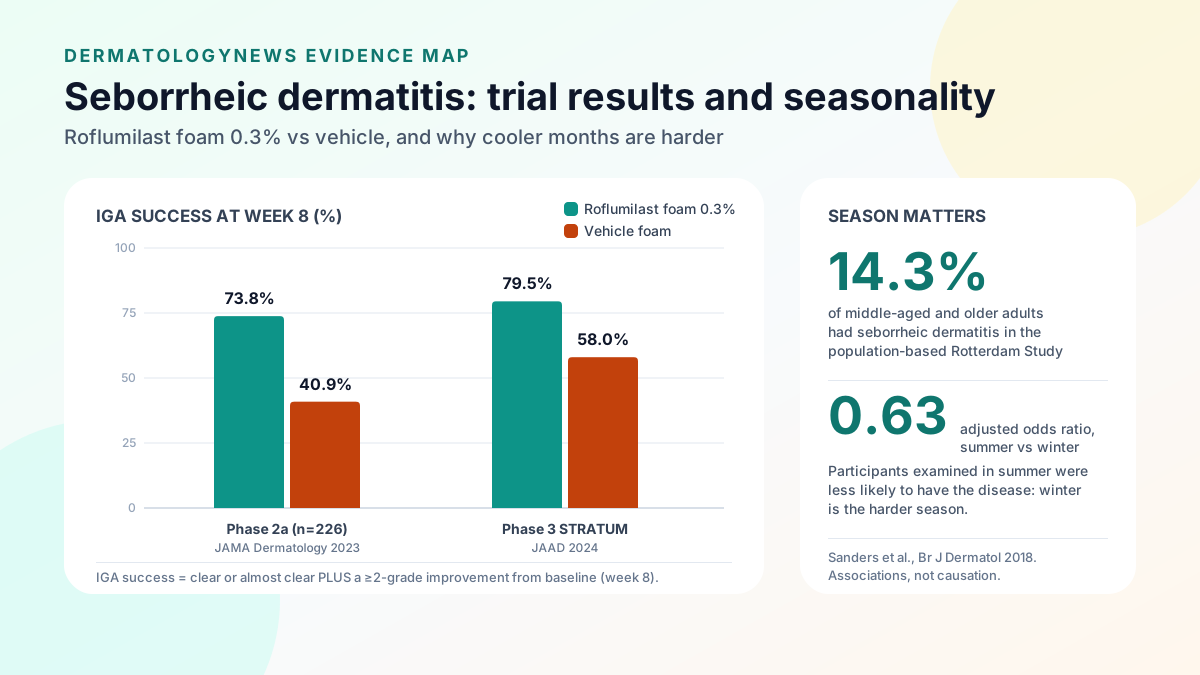
- Phase 2a (226 adults with at least moderate disease, 8 weeks). In the JAMA Dermatology trial, 73.8 percent of roflumilast-treated patients achieved Investigator Global Assessment (IGA) success, defined as clear or almost clear plus at least a two-grade improvement from baseline, versus 40.9 percent with vehicle. Itch improved significantly, and adverse events were similar to vehicle [3].
- Phase 3 STRATUM (adolescents and adults, 8 weeks). 79.5 percent of roflumilast-treated patients achieved IGA success, again defined as clear or almost clear plus at least a two-grade improvement from baseline, versus 58.0 percent with vehicle. Differences were already significant at week 2, and tolerability was again comparable to vehicle [2].
- Long-term open-label extension (up to 52 weeks). Of 400 participants, 62 were enrolled for the full 52 weeks. Adverse-event rates were low, application-site stinging was reported by 1.1 percent or fewer at each visit, and 76.0 percent of assessed patients at week 24 and 80.4 percent at week 52 had an IGA of clear or almost clear, a plain IGA measure rather than the composite endpoint used in the randomized trials. The extension was open-label and uncontrolled [4].
On this evidence, the FDA approved roflumilast foam 0.3% for seborrheic dermatitis in adults and children 9 years of age and older, the first PDE4 inhibitor approved for the disease (label revised 06/2026) [5][7]. Its practical appeal is a once-daily, steroid-free option for the face and scalp, where the disease lives and where corticosteroid time-limits bite [2][5].
Adverse events, limitations, and realistic expectations
- Label safety information. In the seborrheic dermatitis trials reflected in the US label, the most common adverse reactions with roflumilast foam were nasopharyngitis (1.5 percent), nausea (1.3 percent), and headache (1.1 percent). The foam is contraindicated in moderate to severe liver impairment (Child-Pugh B or C), and its propellants are flammable: fire, flame, and smoking should be avoided during and immediately after application [7].
- The vehicle response was high. In the phase 3 trial, 58.0 percent of patients on vehicle foam alone achieved IGA success, clear or almost clear plus at least a two-grade improvement, so the absolute advantage of the active drug was about 21 percentage points [2].
- Trials were short for a chronic disease. The randomized data cover 8 weeks; the 52-week extension was open-label, uncontrolled, and included only 62 patients treated for the full year, which weakens conclusions about durability [2][4].
- Industry involvement is pervasive. All three roflumilast trials were funded by the manufacturer, with company authors on each paper [2][3][4].
- No head-to-head comparisons exist. How roflumilast performs against ketoconazole or intermittent corticosteroids, in efficacy and in cost, is untested [5].
- Cost and access matter. A branded prescription foam is a different proposition from generic antifungal shampoo, and approval, availability, and reimbursement differ by country. Established antifungal-based regimens remain effective first-line care [5].
- Relapse remains expected. Seborrheic dermatitis is controlled, not cured, regardless of agent [1][5].
Diet and lifestyle evidence deserves a brief note: a systematic review found adherence to a Western diet associated with higher seborrheic dermatitis risk in women, most included studies reporting an association with regular alcohol use, mixed findings for obesity, and no interventional evidence that dietary change treats the disease [6].
When it might be something else
Facial redness and scaling in the cooler months has a differential. Persistent centrofacial flushing with visible vessels points to rosacea rather than seborrheic dermatitis; our rosacea phenotype guide covers the distinction. Itchy flexural eczema suggests atopic dermatitis, and well-demarcated silvery plaques suggest psoriasis, which can overlap with seborrheic dermatitis on the scalp. Diagnosis by a board-certified dermatologist matters because maintenance strategies differ.
Bottom line
Seborrheic dermatitis is common, chronic, and seasonally patterned, with winter-dominant prevalence documented in population data, so a cool-season flare is unsurprising and is not by itself a treatment failure [1]. Antifungal-based care remains the foundation, and short steroid courses still manage acute flares [5]. Roflumilast foam 0.3% adds the first FDA-approved PDE4 option, approved for ages 9 and older: once daily, steroid-free, with roughly 74 to 80 percent of trial patients reaching clear or almost-clear skin plus at least a two-grade improvement at 8 weeks versus 41 to 58 percent on vehicle, and low adverse-event rates in a smaller open-label extension [2][3][4][7]. Its place in practice will depend on access, cost, and how clinicians weigh a high vehicle response and the absence of head-to-head data [2][5].
Common questions
- Is seborrheic dermatitis just bad dandruff?
- Dandruff and seborrheic dermatitis sit on one spectrum. Dandruff is scaling limited to the scalp without visible inflammation, while seborrheic dermatitis adds redness and can involve the face, brows, sides of the nose, ears, and chest. Both relate to sebum, Malassezia yeasts, and an individual inflammatory response.
- Why does seborrheic dermatitis get worse in autumn and winter?
- Population data show the condition is more prevalent in winter than in summer, and it is associated with generally dry skin. Falling humidity weakens the skin barrier, and reduced ultraviolet exposure may also play a role, although the mechanism is not fully established. Those data are cross-sectional, so they do not predict any individual's course, but for many patients flares cluster in the cooling months, and a cool-season flare is not by itself a sign treatment has failed.
- Is roflumilast foam a steroid?
- No. Roflumilast is a phosphodiesterase-4 inhibitor, an anti-inflammatory that works through a different pathway than corticosteroids. That matters for seborrheic dermatitis because the disease favors the face and skin folds, where long-term steroid use is limited by side effects such as skin thinning.
- How well does roflumilast foam work?
- In the phase 3 trial, 79.5 percent of patients on once-daily roflumilast foam reached the primary endpoint at week 8, defined as clear or almost-clear skin plus at least a two-grade improvement from baseline, versus 58.0 percent on the vehicle foam. An open-label, uncontrolled extension in which 62 of 400 participants completed a full year found sustained responses and low adverse-event rates.
- Can seborrheic dermatitis be cured?
- No available treatment is curative. Seborrheic dermatitis is a chronic, relapsing condition, and the realistic goal is control: clearing flares, extending the time between them, and choosing maintenance options that are safe for long-term use on the face and scalp.
References
- Sanders MGH, Pardo LM, Franco OH, Ginger RS, Nijsten T. Prevalence and determinants of seborrhoeic dermatitis in a middle-aged and elderly population: the Rotterdam Study. — British Journal of Dermatology, 2018 · PMID: 28856679 · DOI: 10.1111/bjd.15908
- Blauvelt A, Draelos ZD, Stein Gold L, et al. Roflumilast foam 0.3% for adolescent and adult patients with seborrheic dermatitis: a randomized, double-blinded, vehicle-controlled, phase 3 trial. — Journal of the American Academy of Dermatology, 2024 · PMID: 38253129 · DOI: 10.1016/j.jaad.2023.12.065
- Zirwas MJ, Draelos ZD, DuBois J, et al. Efficacy of roflumilast foam, 0.3%, in patients with seborrheic dermatitis: a double-blind, vehicle-controlled phase 2a randomized clinical trial. — JAMA Dermatology, 2023 · PMID: 37133856 · DOI: 10.1001/jamadermatol.2023.0846
- Alexis AF, Bukhalo M, Cook-Bolden FE, et al. Long-term safety and efficacy of roflumilast foam 0.3% in patients with seborrheic dermatitis: a phase II, open-label trial of up to 52 weeks. — American Journal of Clinical Dermatology, 2026 · PMID: 41175336 · DOI: 10.1007/s40257-025-00984-2
- Dhillon J, Mahajan A, Xie J, Tchack M, Rao BK. Roflumilast and the changing landscape of seborrheic dermatitis treatment. — Annals of Pharmacotherapy, 2025 · PMID: 40635650 · DOI: 10.1177/10600280251355662
- Woolhiser E, Keime N, Patel A, Weber I, Adelman M, Dellavalle RP. Nutrition, obesity, and seborrheic dermatitis: systematic review. — JMIR Dermatology, 2024 · PMID: 39102684 · DOI: 10.2196/50143
- ZORYVE (roflumilast) topical foam 0.3% prescribing information (revised 06/2026). — US FDA-approved label via DailyMed, 2026