Autumn skin barrier repair: what the evidence supports
Falling humidity and temperature measurably weaken the skin barrier. What changes in autumn, what moisturizers do, and when dryness needs a doctor.
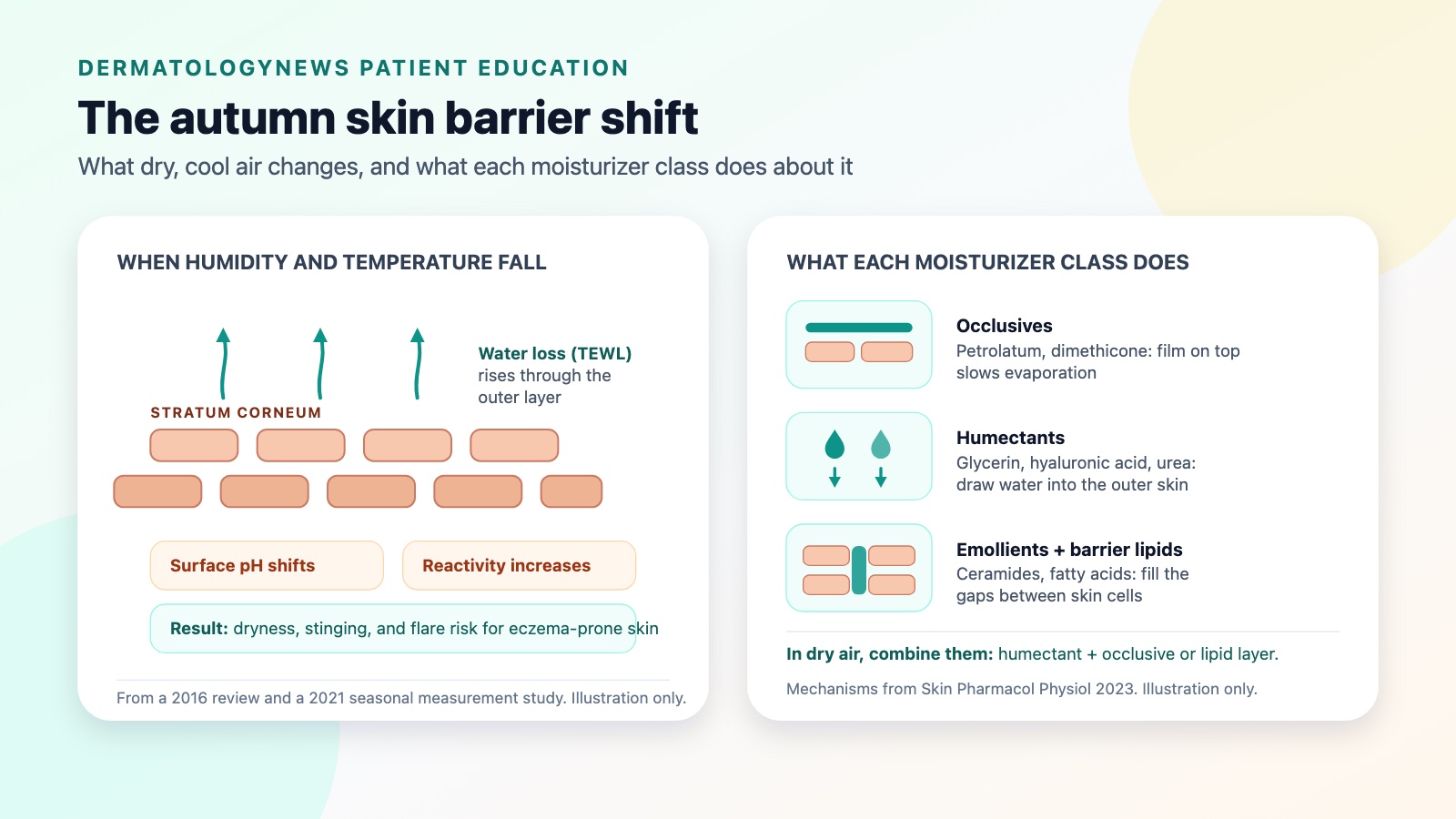
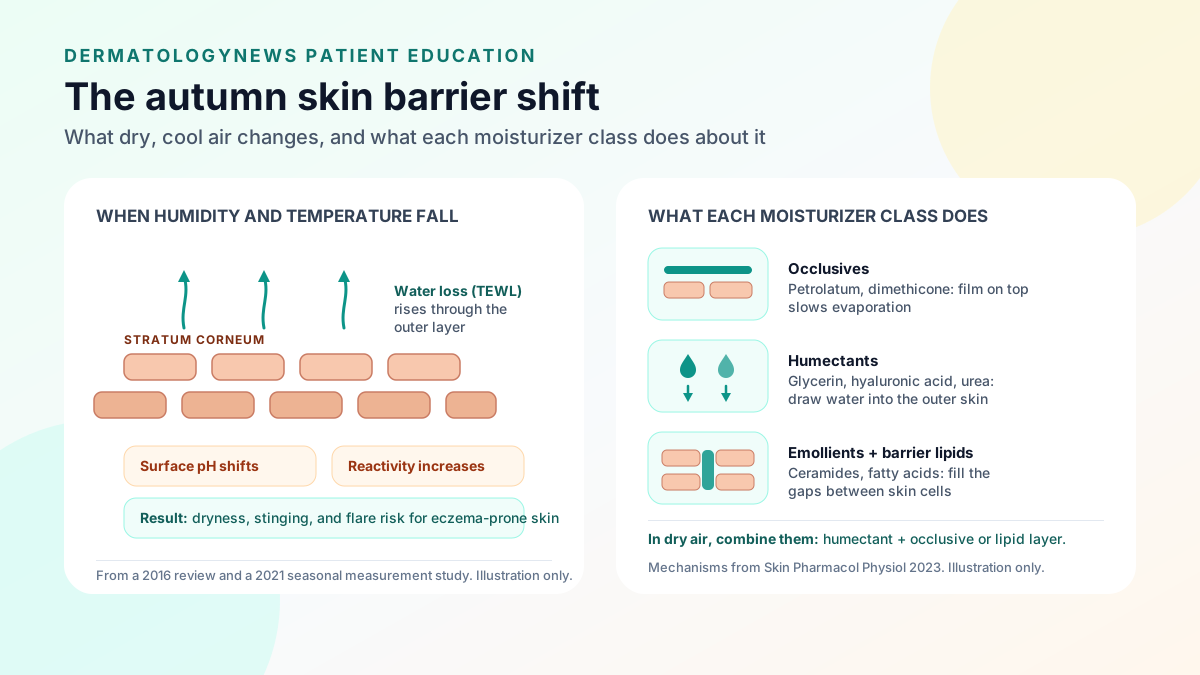
When air turns cold and dry, the skin's outer barrier measurably weakens. In studies comparing winter with summer, water escapes faster through the stratum corneum and the skin's surface pH and blood flow shift, and review evidence links low humidity and low temperature to a barrier that reacts more readily to irritants and allergens [1][2]. Autumn is the transition into that state. This is why the same face that tolerated a retinoid all summer can sting in October, and why eczema so often flares as the cold season begins [1][5]. The cold-season shift also shows up in controlled measurements of Korean indoor environments during the heating season [3]. The good news is that the response is equally well understood: moisturizers with occlusive, humectant, and lipid components counter the specific changes that dry air causes [4].
What the skin barrier is
The skin barrier is more than a single layer. Current models describe four interdependent components: a physical barrier of corneocytes and lipids (including ceramides), a chemical barrier of acids and enzymes that keeps the surface at a mildly acidic pH, a microbiologic barrier of resident flora, and an immunologic barrier beneath [4]. The outermost physical layer, the stratum corneum, controls how fast water diffuses out of the body, measured as transepidermal water loss (TEWL). When the barrier is healthy, TEWL is low and the skin tolerates friction, cleansers, and actives; when it is disrupted, TEWL rises and sensitivity follows [4].
What changes when the weather turns
A systematic review of environmental studies concluded that low humidity and low temperature produce a general decrease in skin barrier function and make the skin more susceptible to mechanical stress. Keratinocytes release more pro-inflammatory cytokines and cortisol, the number of dermal mast cells increases, and the skin becomes more reactive to irritants and allergens [1]. Cold, dry weather also increases the prevalence and flare risk of atopic dermatitis [1][5].
Measurement studies show the same shift outside the laboratory. In a Chinese study of 140 adults measured in both winter and summer, TEWL, skin pH, and cutaneous blood flow all differed significantly between seasons in every group tested, and some sensitive-skin subgroups showed additional changes in hydration and nerve-related thresholds [2]. The studies compare winter with summer rather than tracking autumn week by week, so the transition itself is inferred; starting consistent barrier care as conditions become drier is reasonable, although preventive timing has not been directly tested [1][2].
The indoor heating factor
In Korea, the outdoor season change comes with an indoor one: ondol floors, heaters, and sealed windows. A randomized split-face study of healthy Korean women examined what six hours in a heated indoor environment in winter does to normal skin. Facial skin temperature, pore visibility, roughness, redness, and wrinkle measures all worsened significantly within that single exposure, and TEWL rose on the forearm [3]. On the side of the face treated with a multi-ingredient moisturizing cream containing ceramides, elasticity, pores, texture, and wrinkle measures were better preserved than on the untreated side [3]. The study was small and cosmetic-industry affiliated, but its practical message is modest and reasonable: in the heating season, dry indoor air is itself an exposure, and moisturizing before it helps [3][4].
Evidence-based adjustments for autumn
Moisturizer ingredients work through distinct, complementary mechanisms, and understanding them makes product choice less about brands and more about function [4]:
- Occlusives (petrolatum, dimethicone) form a film that slows water evaporation, directly countering the TEWL rise of dry air [4].
- Humectants (glycerin, hyaluronic acid, urea) draw water into the stratum corneum. In very dry air, humectants work better when paired with an occlusive layer that keeps the drawn-in water from evaporating [4].
- Emollients and barrier lipids (ceramides, fatty acids) integrate into the stratum corneum and support its structure [3][4].
- Mildly acidic formulations support the enzymes that produce ceramides and maintain the barrier's chemical layer [4].
Beyond product choice, the mechanism argues for reducing avoidable barrier stress in the dry season. Cold, dry conditions leave the skin more susceptible to irritants [1], so gentler cleansing, shorter and cooler washing, and reapplying moisturizer after water contact are reasonable habits, even though these routines have not been tested in dedicated trials. Photoprotection remains relevant after summer ends; our guide to photoprotection including visible light explains why the habit is year-round. Retinoid users who notice more stinging in dry weather can space or buffer applications; see our review of topical retinoid options for irritation-management strategies.
When it is more than dry skin
Seasonal dryness sits on a spectrum that ends in disease, and the transition weeks are when flares begin [1][5]:
- Atopic dermatitis flares with cold, dry weather; many climate studies associate low humidity with worse disease, although findings vary by region and study design [1][5]. Persistent itchy, red, scaly patches deserve medical treatment; our review of new biologic options for atopic dermatitis covers the current landscape.
- Hand eczema is aggravated by irritant exposure, and cold, dry conditions make skin more vulnerable to irritants [1]; our review of delgocitinib for chronic hand eczema covers the newest option when moisturizers are not enough.
- Seborrheic dermatitis also worsens as the weather cools, with scaling and redness around the nose, brows, and scalp; our companion piece on seborrheic dermatitis flares and new treatments covers it in depth.
- Facial redness and stinging that persists regardless of season may be rosacea rather than dryness; see our rosacea management guide.
Limitations and realistic expectations
- Most moisturizer studies are small and short. Many, including the Korean indoor study, involve industry funding or affiliation, and endpoints are instrumental rather than disease outcomes [3][4].
- Seasonal physiology varies by person. Sensitive-skin subgroups respond differently to the same seasonal shift, so no single routine fits everyone [2].
- Climate associations are not uniform. Reviews of climate and atopic dermatitis report inconsistent findings across regions and study designs [5].
- Moisturizers manage, they do not cure. For established eczema or seborrheic dermatitis, barrier care supports but does not replace prescription treatment [1][4].
Bottom line
The seasonal decline in humidity and temperature produces a measurable weakening of the skin barrier in winter-versus-summer comparisons: higher water loss, shifted surface chemistry, and greater reactivity [1][2]. Supporting the barrier through the autumn transition, with a moisturizer that combines humectant, occlusive, and lipid components, applied consistently and especially around heated indoor exposure, is the intervention the mechanistic and clinical literature supports [3][4]. Dryness that itches, cracks, or persists despite this is no longer a cosmetic problem: persistent inflammation warrants clinical assessment and may need prescription treatment [1][5].
Common questions
- Why does my skin get worse when the seasons change?
- Low humidity and falling temperatures measurably reduce skin barrier function: water loss through the outer layer rises, and the skin becomes more reactive to irritants and allergens. Measurement studies found extra seasonal changes in some sensitive-skin subgroups, and cold, dry weather raises flare risk in eczema-prone skin.
- Do I really need a different moisturizer in autumn?
- Often a richer one helps. Occlusive ingredients slow water evaporation, humectants draw water into the outer skin, and emollients fill gaps between skin cells. In drier air, formulas that combine a humectant with an occlusive or lipid component are the reasonable choice, since humectants alone can be less helpful when ambient humidity is very low.
- Are ceramide creams worth it?
- Ceramides are structural lipids of the outer skin layer, and moisturizers containing them support the barrier's physical and chemical layers. In a small industry-affiliated Korean split-face study in winter, a multi-ingredient cream containing ceramides preserved several facial measures under indoor heating, so the finding is supportive rather than definitive, and it reflects the whole formula rather than ceramides alone.
- Does indoor heating damage skin?
- Heated indoor air is dry air, and a Korean study found measurable changes in facial skin, including increased roughness and redness, after only six hours in a heated room in winter. Moisturizing before prolonged time in heated environments reduced those changes, so heating effects are real but manageable.
- When is autumn dryness a medical problem?
- When it itches persistently, cracks, stings with everything you apply, or comes with red scaly patches. Cold, dry weather raises the risk of eczema flares, and hands take heavy irritant exposure. At that point a dermatologist visit is worthwhile, because an established flare often needs prescription treatment rather than another product change.
References
- Engebretsen KA, Johansen JD, Kezic S, Linneberg A, Thyssen JP. The effect of environmental humidity and temperature on skin barrier function and dermatitis. — Journal of the European Academy of Dermatology and Venereology, 2016 · PMID: 26449379 · DOI: 10.1111/jdv.13301
- Jiang W, Wang J, Zhang H, et al. Seasonal changes in the physiological features of healthy and sensitive skin. — Journal of Cosmetic Dermatology, 2021 · PMID: 34599628 · DOI: 10.1111/jocd.14476
- Park EH, Jo DJ, Jeon HW, Na SJ. Effects of winter indoor environment on the skin: unveiling skin condition changes in Korea. — Skin Research and Technology, 2023 · PMID: 37357654 · DOI: 10.1111/srt.13397
- Rajkumar J, Chandan N, Lio P, Shi V. The skin barrier and moisturization: function, disruption, and mechanisms of repair. — Skin Pharmacology and Physiology, 2023 · PMID: 37717558 · DOI: 10.1159/000534136
- Fernandez K, Mundada M, So A, Wei ML. Influence of climate on atopic dermatitis. — Dermatologic Clinics, 2026 · PMID: 41207773 · DOI: 10.1016/j.det.2025.08.007