Asteatotic eczema and winter itch: causes, skin care and when to see a doctor
Asteatotic eczema, or winter eczema, cracks dry skin on the shins. Who gets it, guideline advice on bathing and moisturizers, and when itch needs a check.
Asteatotic eczema is eczema that develops on very dry skin. It is also called eczema craquelé, xerotic eczema or winter eczema. It typically affects older adults, most often on the lower legs, where fine cracks form a crisscross pattern that clinicians compare to crazy paving or a dried riverbed [1]. Cold weather, dry indoor air and frequent bathing make it worse, which is why it flares in winter [1][2].
Winter itch is itch from the same dry skin, before a rash appears or without one [2][3]. The European guideline on chronic pruritus links seasonal itch in wintertime with eczema on dried-out skin in older people [3]. Guidelines put a daily moisturizer and gentler bathing first, and add an anti-inflammatory treatment once the skin is inflamed [2][3].
Itch is different when it lasts 6 weeks or more on skin that looks normal. That pattern calls for a doctor's assessment, because kidney, liver, thyroid and blood disorders, and medicines, can cause it [3][7].
What asteatotic eczema and winter itch are
Asteatosis is another word for xerosis, or dry skin [2]. When dry skin goes without enough care, repeated scratching inflames it, and asteatotic eczema develops [2]. StatPearls describes it as one of the most common causes of dermatitis in older adults [1]. Dry skin itself is common at that age: a JAMA review of itch in older patients states that more than 50% of them have xerosis [7].
The European pruritus guideline calls itch chronic once it has lasted 6 weeks or more [3]. It names seasonal itch in wintertime ("winter pruritus") as a feature of eczema on dried-out skin in older people, and a common one in atopic dermatitis and psoriasis [3]. In older patients with chronic itch, it adds, some degree of dry skin is present in most cases [3].
Why dry air weakens the skin barrier, and what each class of moisturizer ingredient does, is covered in our autumn skin barrier article.
Who gets it
StatPearls attributes asteatotic eczema mainly to age-related loss of lipids in the stratum corneum, the skin's outer layer, together with cold weather and frequent bathing [1]. Three studies show how common dry and cracked skin is in older people, each in a different population and with a different definition:
- Asteatotic eczema: 20.8% of 552 adults aged 70 to 93 in northern Finland, examined by dermatologists, one of the five most common skin diseases in that group [5].
- Asteatosis on the lower legs: 79.2% of 173 residents of long-term care facilities in Japan. Residents with lower scores for activities of daily living were more likely to have it [6].
- Dry skin of any extent: 60% of 5,547 middle-aged and older participants of the Rotterdam Study in the Netherlands; a fifth of those had generalized dry skin [4].
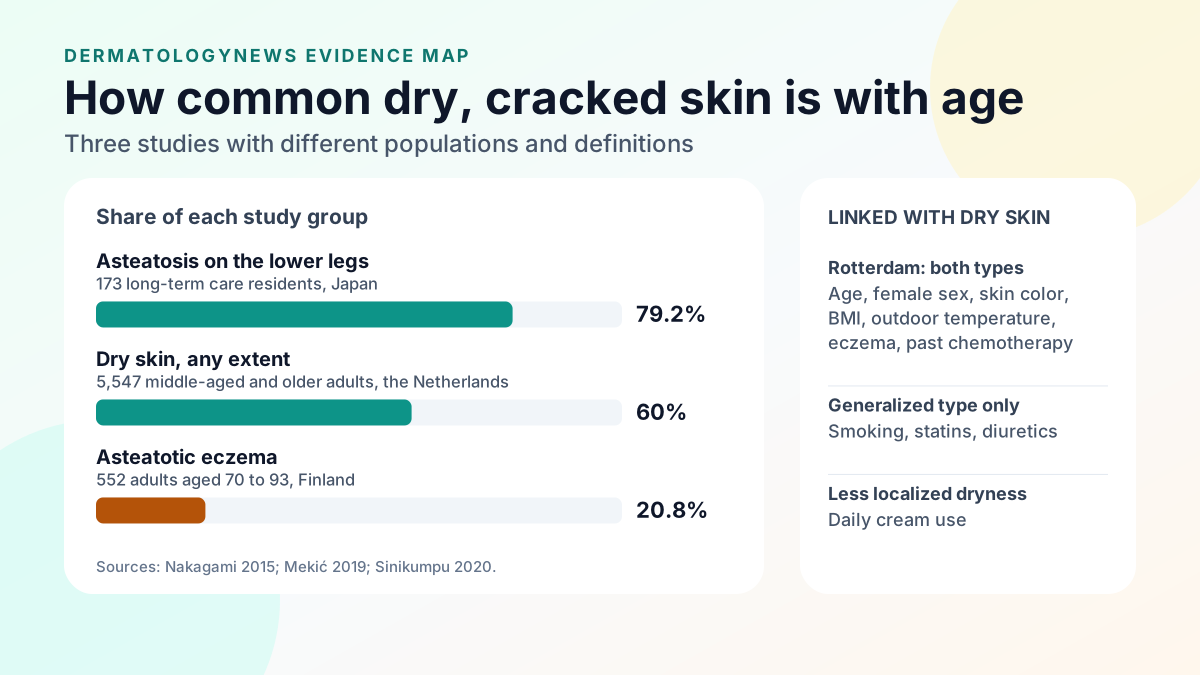
In the Rotterdam Study, older age, female sex, skin color, body mass index, outdoor temperature, eczema and past chemotherapy were linked with both localized and generalized dry skin. Smoking, statins, diuretics and poorer self-rated health were linked with the generalized form only, and daily cream use with less localized dryness [4]. Because the study was cross-sectional, it shows associations, not causes [4].
The Japanese asteatosis guideline sorts the triggers into three groups [2]:
- Age: less active sebaceous and sweat glands in older skin.
- Environment: low humidity outdoors and in heated or air-conditioned rooms, the guideline's "winter xerosis"; ultraviolet exposure; excessive bathing; and cleansers that strip oils, or hard scrubbing.
- Illness and treatment: skin diseases, diabetes, chronic kidney disease, anticancer drugs and radiotherapy.
Medicines named in the literature include diuretics, cimetidine and some cancer drugs such as paclitaxel [1]. Calcium channel blockers and hydrochlorothiazide, both blood pressure medicines, are important causes of itchy rashes in older patients [7]. Asteatotic eczema has also been reported with hypothyroidism, malnutrition, sudden swelling such as in nephrotic syndrome, and occasionally as a sign of lymphoma [1].
What eczema craquelé looks like
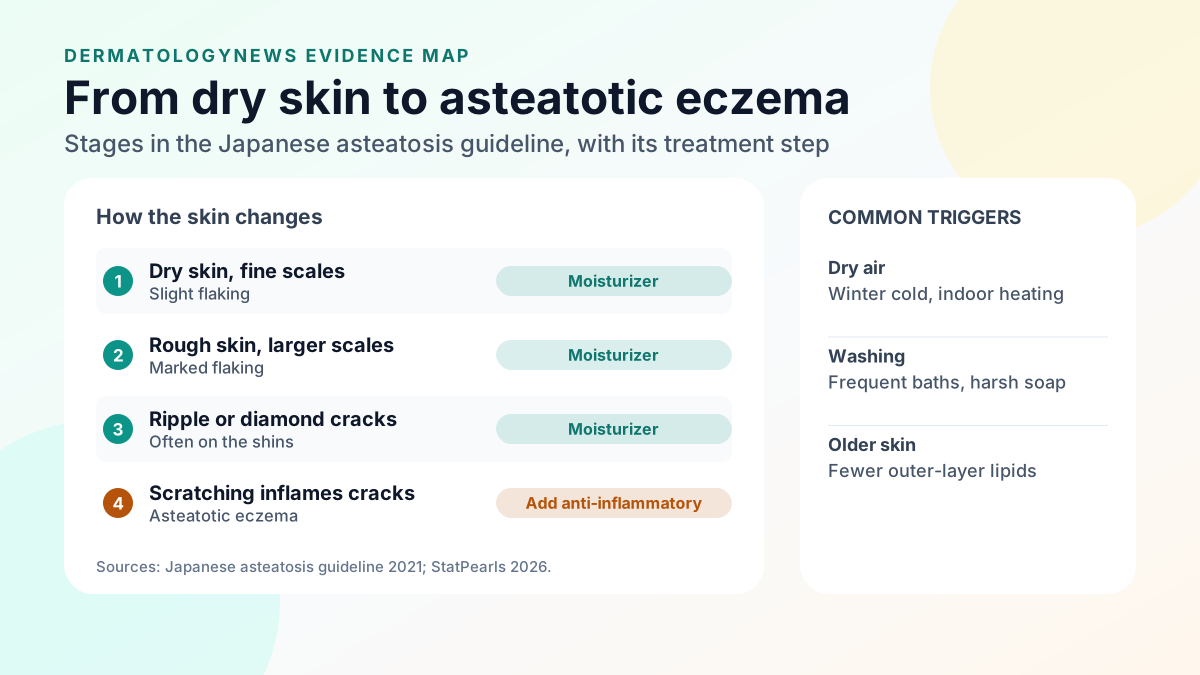
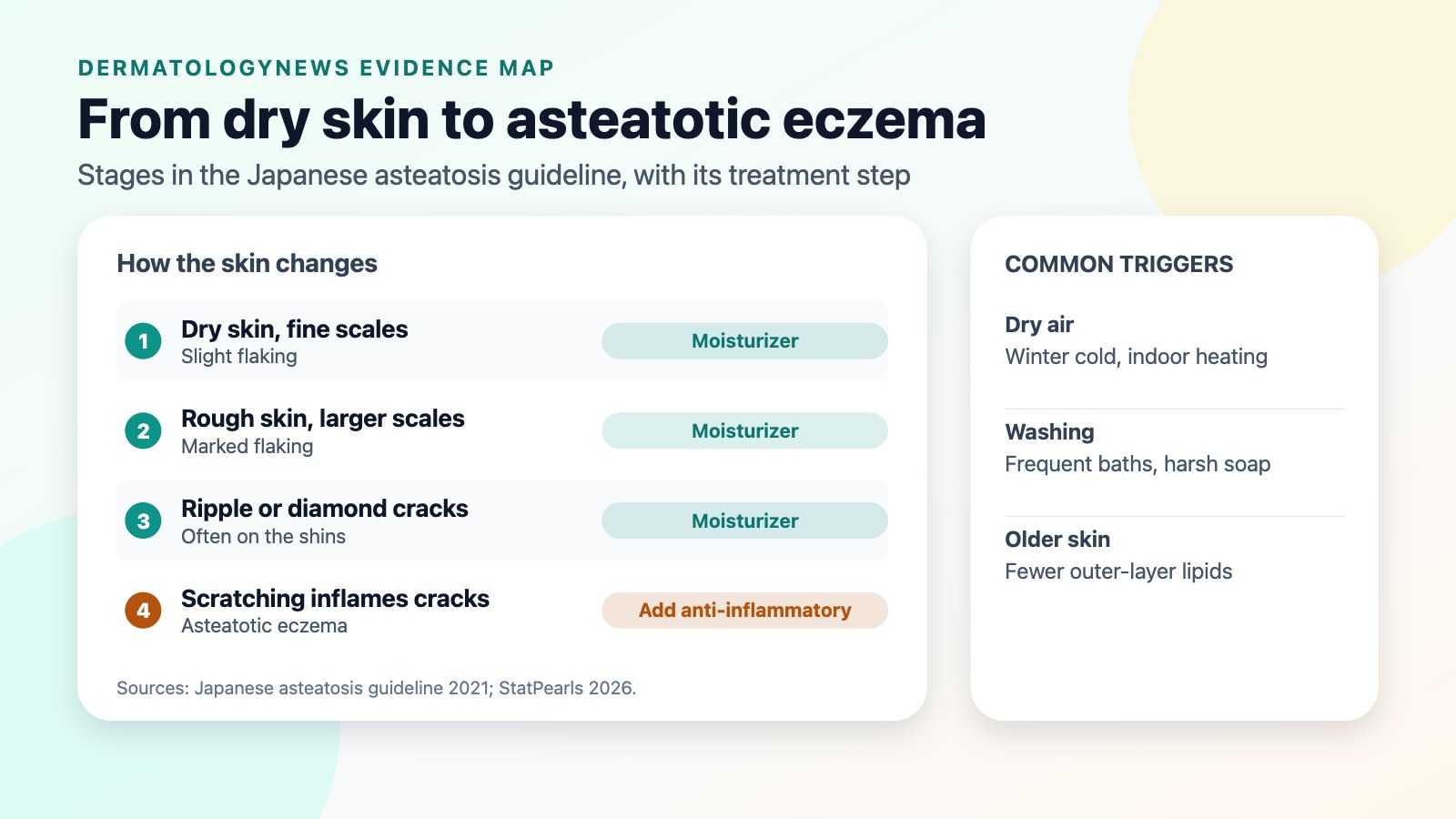
The Japanese guideline describes how asteatosis progresses [2]. It starts as dry skin with fine scales and slight flaking. The surface then turns rough, with larger scales and more flaking, and finally ripple- or diamond-pattern cracks appear. Scratching leaves marks, and in older people small bruise-like spots (purpura); the cracks can be mildly painful [2]. Once scratching inflames the skin, it becomes asteatotic eczema, which can progress to coin-shaped (nummular) patches [2].
Craquelé is French for crackled, like the fine cracks in an old glaze. StatPearls describes fine fissures in a polygonal or curvilinear pattern, the crazy-paving or dried-riverbed look [1]. Diagnosis is usually made by examining the skin [1].
The usual site is the shins, the extensor surfaces of both lower legs; the back, arms and trunk are sometimes involved, while the face and skin folds are affected less often because they produce more sebum and sweat [1][2]. Left untreated, the cracks can bleed and become infected [1]. Dry, cracked hands in winter are a separate topic; our article on delgocitinib for chronic hand eczema covers one prescription option for that condition.
Open the stages figure at full size
Bathing and moisturizers: what the guidelines advise
Moisturizer comes first. The Japanese guideline strongly recommends topical moisturizers for age-related asteatosis (recommendation grade 1, evidence level A), based on many studies in older patients, and finds no evidence that any single moisturizer works best [2]. Both guidelines also give practical advice for washing and the home [2][3]:
- Water and time: lukewarm water and short baths, no longer than 20 minutes, then pat the skin dry [3]. The European guideline's section on older adults adds less frequent bathing, in tepid water [3].
- Moisturizer: apply it every day, especially after showering or bathing [2][3]. The Japanese guideline cites a study that found no significant difference between applying it right after a bath and an hour later, and advises fitting it into the daily routine of the patient, family or care staff [2].
- Cleansers: a mild, non-alkaline, fragrance-free soap or soap-free cleanser [3]. Work up a lather, wash with the hands rather than a nylon towel or brush, rinse well and use little soap on very dry areas [2]. For older adults, the European guideline suggests limiting soap to the armpits, groin, scalp and soles [3].
- Home and clothes: a humidifier when rooms are heated in winter, a cool bedroom at night, and soft clothing rather than wool or stiff fabrics [2][3]. Avoid saunas and frequent washing and bathing [3].
- A helping hand: older people may need help to apply topical treatment properly [3].
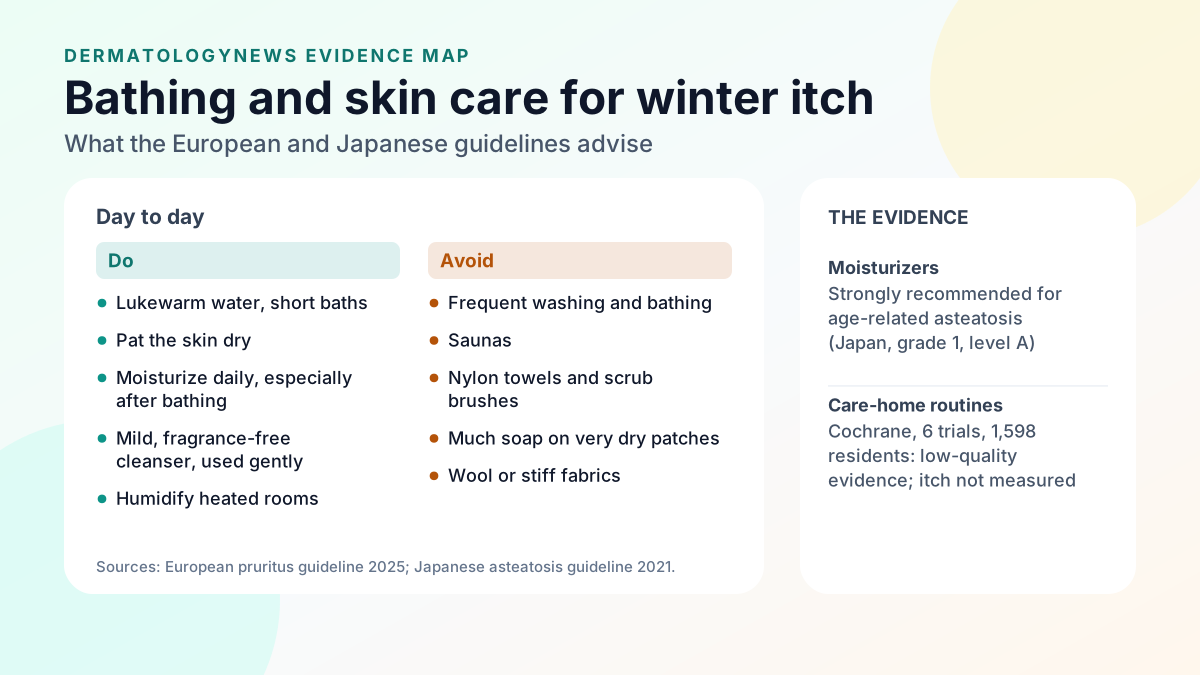
The evidence behind specific routines is thinner than the advice suggests. A Cochrane review found 6 trials of washing and moisturizing routines in 1,598 care-home residents, most of them with a mean age of 80 or more. Low-quality evidence suggested that some routines may reduce dryness, and none of the trials measured itch [8]. The European guideline notes that controlled studies on damaged skin, such as eczema, show less itch with emollients alone, while evidence for skin that looks normal is lacking [3].
When anti-inflammatory treatment is used
Moisturizer alone is for dry skin. If the skin turns to eczema despite moisturizers, the Japanese guideline advises combining them with a topical anti-inflammatory drug such as a topical corticosteroid [2].
The European guideline recommends topical corticosteroids for itch that comes with an inflammatory skin disease, and recommends against them for itch on skin that is not inflamed [3]. It warns that older people are especially susceptible to their side effects and should be monitored closely [3]. Its section on older adults recommends soothing topical products and, if required, anti-inflammatory treatment for dry skin. It lists topical calcineurin inhibitors among the options that can help and advises avoiding topical corticosteroids on older skin [3]. The choice of drug, strength and duration is therefore a clinician's decision for each patient.
A rash that does not behave like ordinary asteatotic eczema needs a second look. In a hospital series of 68 patients with eczema craquelé, a rash that was widespread on the trunk, did not respond to topical corticosteroids or had deep red, inflamed cracks was significantly linked with cancer [12]. Scabies, bullous pemphigoid (a blistering disease) and mycosis fungoides (a skin lymphoma) are also more common in older people and belong on the list in older patients with itch [7].
Itch without a rash: when to see a doctor
Itch on skin that looks normal has a wider list of causes. The European guideline says that when itch began without visible skin changes, doctors should consider systemic, neurological and psychiatric disease, drug side effects and pregnancy [3]. A review of itch in older patients likewise advises looking for skin, systemic and nerve-related causes, and considering dry skin, drug reactions and nerve damage (neuropathy) [7].
The European guideline names patterns that point beyond dry skin [3]:
- itch that has lasted 6 weeks or more;
- itch all over the body, which it calls highly suggestive of an internal disease or a drug;
- itch at night all over the body with chills, tiredness, weight loss, fever or night sweats, which can suggest a malignancy such as Hodgkin's lymphoma;
- itch as the skin cools after a warm shower or bath, which can come from dry skin but also from aquagenic pruritus or polycythaemia vera, a blood disorder;
- any change in medicines in the 12 months before the itch began.
The guideline's assessment includes a full skin and physical examination, including the lymph nodes [3]. First-step blood tests cover a blood count and ESR, kidney function (creatinine, urea), liver tests, LDH, thyroid (TSH), blood sugar (HbA1c, fasting glucose), ferritin and CRP, with further tests if these are abnormal or the itch persists [3].
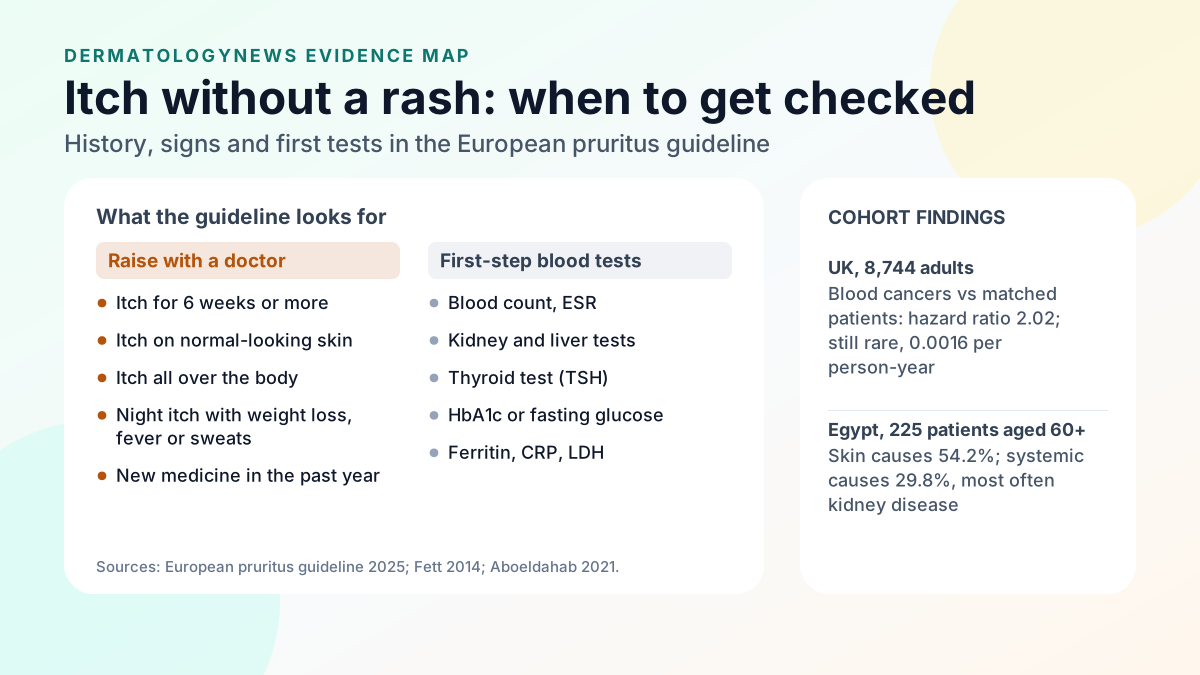
Studies of older patients show how often a cause lies outside the skin. In 225 patients aged 60 or older with itch in Sohag, Egypt, the itch was all over the body in 73.8% and worse in winter in 20%. A skin cause was found in 54.2% and a systemic cause in 29.8%, most often kidney disease [9].
Cancer is a rare cause. In UK primary-care records, 8,744 adults with chronic itch all over the body and no skin disease were compared with 31,580 matched patients without it. The itch group had higher rates of blood cancers (hazard ratio 2.02) and bile duct cancers (hazard ratio 3.73), but not of other cancers. The incidence of blood cancers in the itch group was still low, at 0.0016 per person-year against 0.0008 in matched patients [10]. A second analysis of patients with chronic itch and no skin disease compared the 398 who developed cancer with 8,346 who did not: age over 60 (odds ratio 4.04), male sex, liver disease and smoking were linked with higher odds [11].
Limitations and realistic expectations
- The prevalence figures do not add up to one number. The three studies used different populations, settings and definitions, and all were cross-sectional [4][5][6].
- Skin-care routines are tested in few trials. The care-home trials were small, their evidence was of low quality, and none measured itch [8].
- The guidelines differ on corticosteroids for older skin. The Japanese guideline adds them for eczema that develops despite moisturizers, while the European guideline's section on older adults advises avoiding them [2][3].
- Asteatosis tends to come back. It responds well to moisturizers, but often returns when they are stopped, with the change of season or when a related illness worsens [2].
- The cancer findings come from medical records. Misclassification and detection bias are possible, and the incidence of the cancers involved was very low [10].
Questions to ask at the appointment
- Is this asteatotic eczema, or another itchy skin condition [7]?
- Could any of my medicines be drying my skin or causing the itch [1][3][7]?
- Which moisturizer should I use, how often, and who can help me apply it to my legs [2][3]?
- If the skin is inflamed, which anti-inflammatory treatment do you suggest, and for how long [2][3]?
- My itch has lasted more than 6 weeks on skin that looks normal. Which tests do I need [3]?
Bottom line
Asteatotic eczema is a common winter rash of older skin: dryness that cracks into a crazy-paving pattern on the lower legs and becomes eczema once it is inflamed [1][2]. Guidelines advise a daily moisturizer, lukewarm and less frequent bathing and gentle cleansers, and add a topical anti-inflammatory treatment when the skin is inflamed [2][3]. Itch that lasts 6 weeks or more on normal-looking skin, covers the whole body or comes with weight loss, fever or night sweats is a reason to see a doctor, who can check for kidney, liver, thyroid and blood disorders and review medicines [3][7].
Common questions
- What is asteatotic eczema?
- Asteatotic eczema, also called eczema craquelé, xerotic eczema or winter eczema, is eczema that develops on dry skin. It typically affects older adults, most often on the lower legs, where fine cracks form a crisscross pattern, and it tends to flare in winter [1][2].
- Why does skin itch more in winter?
- Cold outdoor air and heated indoor air are dry, and frequent bathing, harsh cleansers and scrubbing dry the skin further [1][2]. The European pruritus guideline links seasonal itch in wintertime with eczema on dried-out skin in older people, and with atopic dermatitis and psoriasis [3].
- How should I bathe if my skin cracks and itches in winter?
- The European and Japanese guidelines advise lukewarm water and short baths, patting the skin dry, a mild, fragrance-free cleanser used gently, little soap on very dry areas and a moisturizer every day, especially after bathing. They advise against frequent washing and bathing, saunas, nylon towels and scrub brushes [2][3].
- Is eczema craquelé serious?
- Usually not. The underlying dry skin responds well to moisturizers, although it tends to return when they are stopped or the season changes [2]. Cracks can bleed and become infected, and the rash is occasionally a sign of another illness such as thyroid disease or lymphoma, so eczema craquelé that spreads to the trunk or does not settle with treatment needs a doctor's review [1][12].
- When should itching without a rash be checked by a doctor?
- When it lasts 6 weeks or more, covers the whole body, comes at night with weight loss, fever or night sweats, or began after a change in medicines [3]. The European guideline then calls for a full skin and physical examination and first blood tests, including a blood count, kidney, liver and thyroid tests, blood sugar and iron stores [3].
References
- Srivastava D, Sathe NC, Persaud Y. Asteatotic Eczema. — StatPearls [Internet], StatPearls Publishing, updated January 10, 2026 · PMID: 31747214
- Saeki H, Tsunemi Y, Arai S, et al. English version of guidelines for the management of asteatosis 2021 in Japan. — The Journal of Dermatology, 2022;49(3):e77-e90 (Japanese Dermatological Association guideline) · PMID: 34970776 · DOI: 10.1111/1346-8138.16293
- Weisshaar E, Müller S, Szepietowski JC, et al. European S2k Guideline on Chronic Pruritus. — Acta Dermato-Venereologica, 2025;105:adv44220 · PMID: 40843597 · DOI: 10.2340/actadv.v105.44220
- Mekić S, Jacobs LC, Gunn DA, et al. Prevalence and determinants for xerosis cutis in the middle-aged and elderly population: a cross-sectional study. — Journal of the American Academy of Dermatology, 2019;81(4):963-969.e2 · PMID: 30586613 · DOI: 10.1016/j.jaad.2018.12.038
- Sinikumpu SP, Jokelainen J, Haarala AK, et al. The high prevalence of skin diseases in adults aged 70 and older. — Journal of the American Geriatrics Society, 2020;68(11):2565-2571 · PMID: 32754902 · DOI: 10.1111/jgs.16706
- Nakagami G, Kimura N, Takehara K, et al. Relationship between activity of daily living and asteatosis in the lower legs among elderly residents in long-term care institutions: a cross-sectional study. — International Wound Journal, 2015;12(5):586-589 · PMID: 24131671 · DOI: 10.1111/iwj.12169
- Berger TG, Shive M, Harper GM. Pruritus in the older patient: a clinical review. — JAMA, 2013;310(22):2443-2450 · PMID: 24327039 · DOI: 10.1001/jama.2013.282023
- Cowdell F, Jadotte YT, Ersser SJ, et al. Hygiene and emollient interventions for maintaining skin integrity in older people in hospital and residential care settings. — Cochrane Database of Systematic Reviews, 2020;1:CD011377 · PMID: 32006460 · DOI: 10.1002/14651858.CD011377.pub2
- Aboeldahab S, Khalil F, Ezz Eldawla R. Clinical and laboratory characteristics of elderly patients with pruritus. — Clinical, Cosmetic and Investigational Dermatology, 2021;14:1009-1015 · PMID: 34408461 · DOI: 10.2147/CCID.S322527
- Fett N, Haynes K, Propert KJ, Margolis DJ. Five-year malignancy incidence in patients with chronic pruritus: a population-based cohort study aimed at limiting unnecessary screening practices. — Journal of the American Academy of Dermatology, 2014;70(4):651-658 · PMID: 24485529 · DOI: 10.1016/j.jaad.2013.11.045
- Fett N, Haynes K, Propert KJ, Margolis DJ. Predictors of malignancy development in patients with chronic pruritus. — Journal of Dermatological Science, 2016;82(2):123-128 · PMID: 26874971 · DOI: 10.1016/j.jdermsci.2016.01.010
- Sparsa A, Boulinguez S, Liozon E, et al. Predictive clinical features of eczema craquelé associated with internal malignancy. — Dermatology, 2007;215(1):28-35 · PMID: 17587836 · DOI: 10.1159/000102030