Chilblains (pernio): causes, when to get checked, and what the treatment evidence shows
Itchy red or purple patches on toes and fingers after cold, damp weather: how chilblains differ from Raynaud's, when to get checked and what trials show.
Chilblains, also called pernio or perniosis, are small, itchy patches that appear on the skin a few hours after time in the cold, mostly on the toes and fingers [7]. The skin turns red or purple and can itch or burn [7]. They are a non-freezing cold injury: the skin does not freeze, but cold, wet weather sets off inflammation in it [2][1]. Most chilblains clear up on their own in 2 to 3 weeks [7]. In a 2016 randomized trial of 32 people with chronic chilblains, nifedipine, the drug studied most, did no better than placebo, and avoiding the cold, keeping hands and feet warm and stopping smoking remain the first recommendations [3][1]. Chilblains that do not heal, keep returning or come with symptoms elsewhere in the body need a medical check, because they can be secondary to diseases such as lupus [7][1][5].
What chilblains look like and who gets them
Chilblains appear mostly on the fingers and toes, and sometimes on the face and legs [7]. Redness can be harder to see on brown and black skin [7]. A systematic review of 13 studies with 477 adults found that chilblains affected more women than men (57% versus 43%), at a weighted average age of 34, and that papules, nodules and itching were the most frequently reported signs [2]. Reported incidence ranges from 11.5 cases per 100,000 person-years in Northern California to 90 to 170 per 100,000 person-years in the Netherlands, where it varies from year to year [2].
The cause is not fully understood, but narrowing of small blood vessels in the cold appears to play a part [1]. The NHS describes the sequence: cold narrows the blood vessels in the fingers and toes, and as the skin warms, vessels near the surface widen while deeper vessels stay narrow, which causes pain, itching and color change [7]. In the review's meta-regressions, smoking and frequent occupational exposure to water made the tissue changes of chilblains more likely to be found [2].
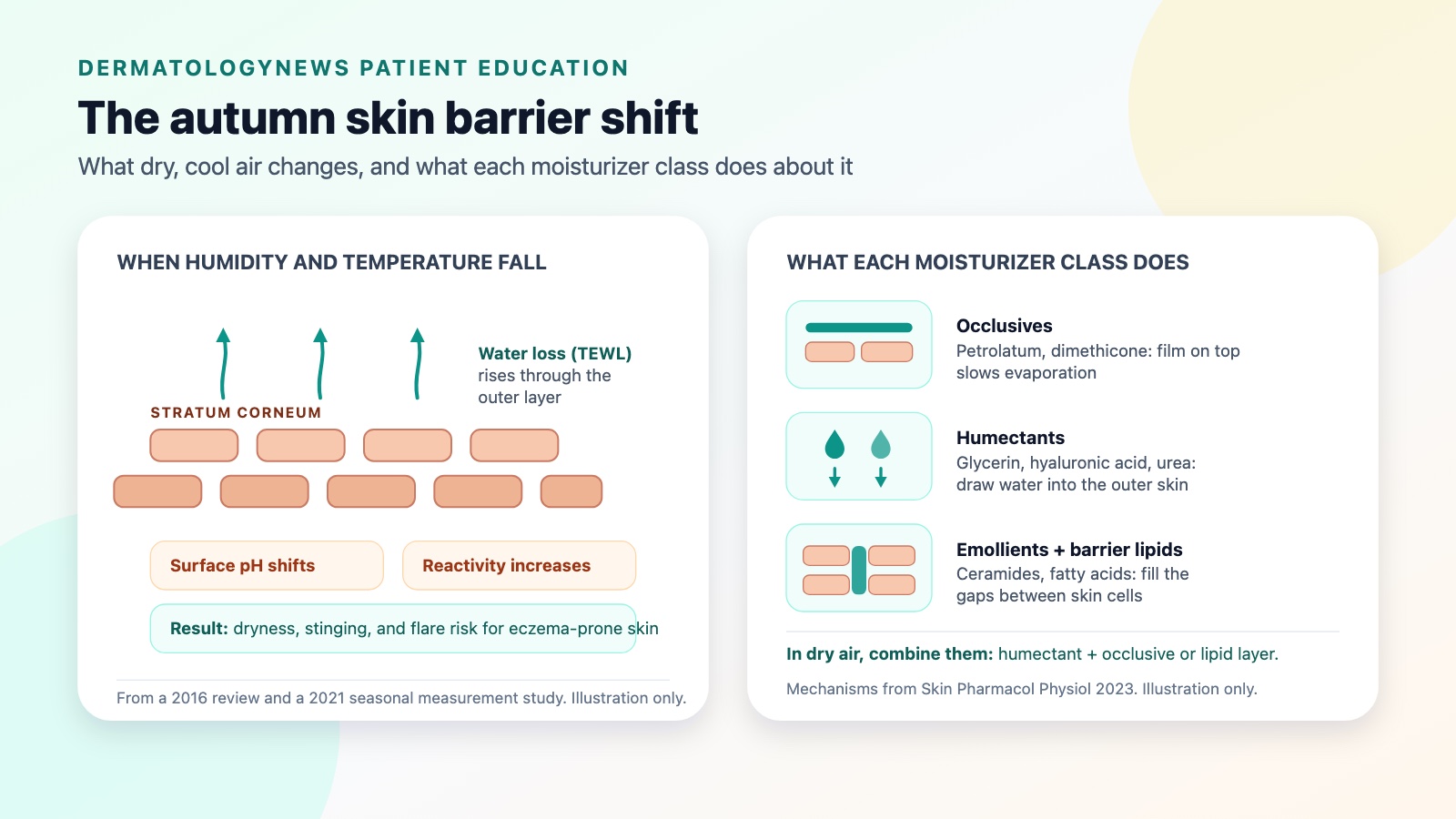
Diagnosis is usually made from the history and appearance [1]. A skin biopsy can help when the picture is unclear, and it typically shows dermal swelling and an inflammatory infiltrate, often around the sweat glands [1]. Seasonal changes in the skin barrier are covered in our autumn skin barrier article.
Chilblains or Raynaud's?
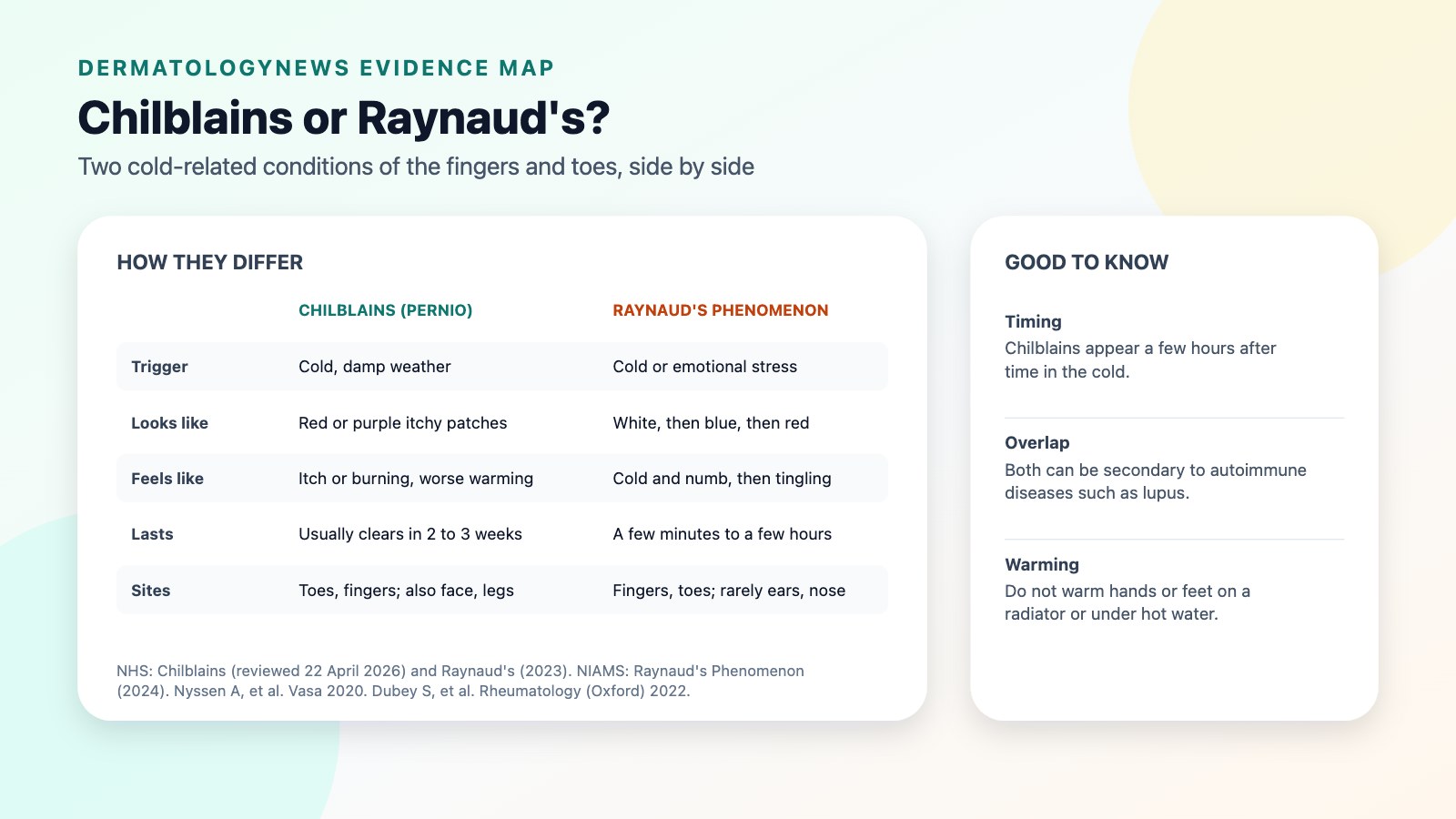
Both conditions involve the fingers and toes and the cold. In Raynaud's phenomenon, cold or emotional stress triggers attacks in which the skin turns pale or white, then blue, and then red as blood returns, with numbness followed by tingling, burning or throbbing [8]. An attack lasts from a few minutes to a few hours [8]. Chilblains instead appear hours after the cold as burning or itchy swelling, get worse as the skin warms up and usually clear within 2 to 3 weeks [7][9].
The two can overlap. Chilblains are often studied as secondary to underlying conditions that include Raynaud disease [2], and both can be secondary to lupus [5][8].
When to get chilblains checked
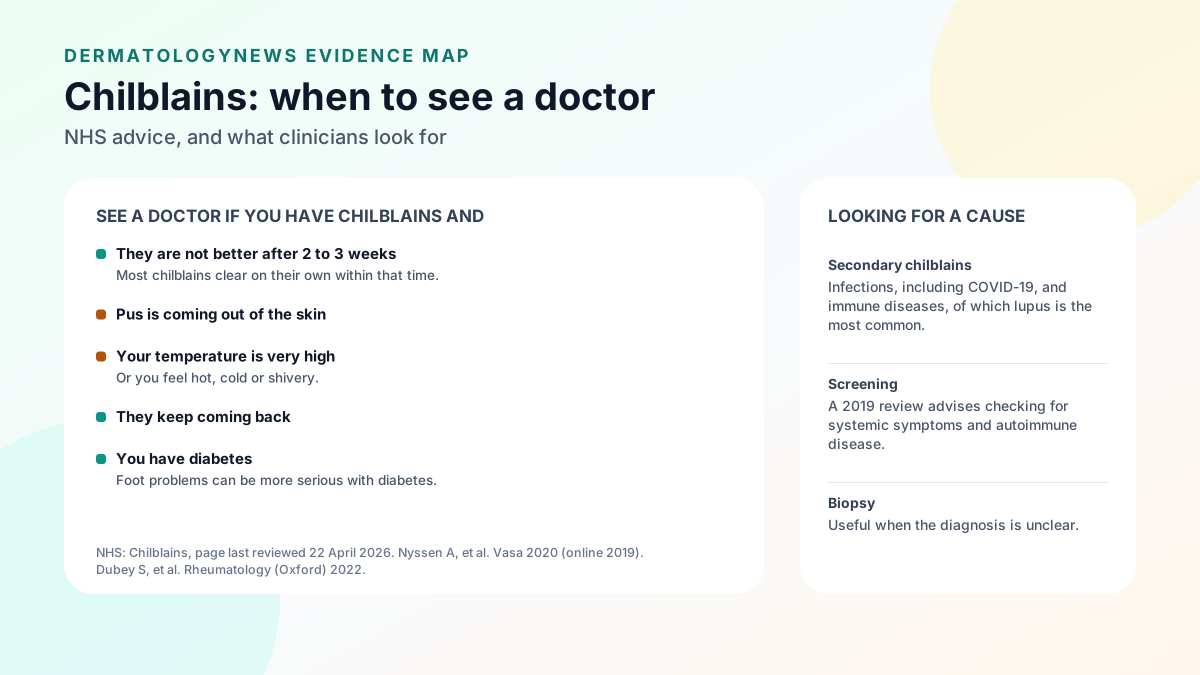
The NHS advises seeing a doctor if you have chilblains and [7]:
- your skin is not getting better after 2 to 3 weeks;
- pus is coming out of the skin;
- your temperature is very high, or you feel hot, cold or shivery;
- you keep getting chilblains;
- you have diabetes, because foot problems can be more serious.
Clinicians also look for a cause. A 2019 review advises screening for systemic symptoms and underlying autoimmune disease [1]. Chilblains can be secondary to infections, including COVID-19, and to immune-mediated inflammatory diseases, of which systemic lupus erythematosus is the most common [5]. Chilblain lupus erythematosus, first described in 1888 as cold-induced lesions, has its own diagnostic criteria [5]. Associations with vasculitis and antiphospholipid syndrome have also been reported [6]. Painful red lumps on the shins have a different set of causes, covered in our article on erythema nodosum.
What the treatment evidence shows
Warmth and protection come first
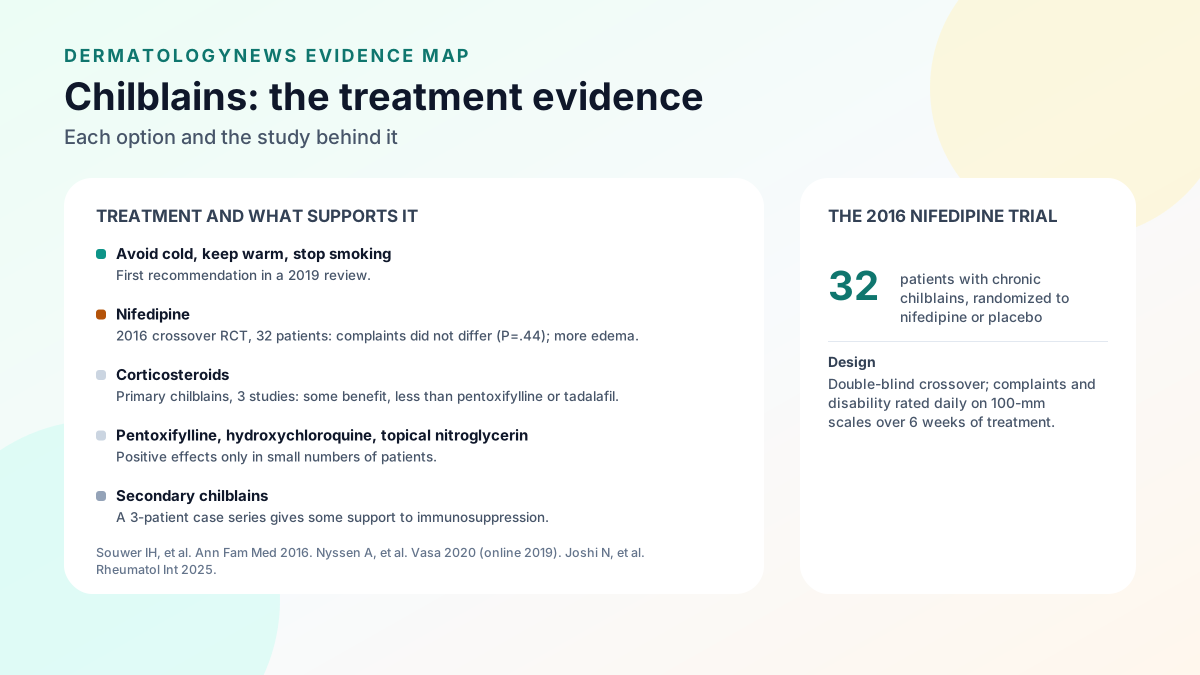
Avoiding the cold, keeping hands and feet warm and stopping smoking are the first recommendations in a 2019 review [1]. The NHS adds practical steps [7]:
- Wear warm, waterproof clothing, gloves and thick socks in cold or damp weather.
- Dry the skin and warm it slowly after cold exposure; do not put hands or feet on a radiator or under hot water.
- Avoid smoking, caffeine and decongestant medicines, which can affect blood flow in the fingers and toes.
- Do not scratch or pick at the skin.
Nifedipine
Nifedipine, a calcium channel blocker that widens blood vessels, is the drug evaluated most often for chilblains, but not every study has confirmed that it works [1][4]. A 2016 primary-care trial closely followed the design of an older small trial: 32 people with chronic chilblains were randomized in a double-blind, placebo-controlled crossover trial [3]. After 6 weeks of treatment, complaints scored on a 100-mm scale differed by 1.84 mm in favor of nifedipine (95% CI, -6.67 to 2.99; P = .44), and disability by 0.56 mm in favor of placebo (P = .75) [3]. Nifedipine lowered systolic blood pressure and caused more swelling (edema), and the authors concluded that the results do not support routine use [3]. A doctor may still prescribe a medicine that widens blood vessels in some cases [7].
Other treatments
A 2025 evidence-based review found no high-quality randomized trials for chilblains; its recommendations rest on case reports, observational studies and trials in related conditions such as Raynaud's phenomenon [4]. It describes vasodilators taken by mouth, such as nifedipine, and topical nitroglycerin as having shown efficacy in improving peripheral blood flow, and reports that antimalarials and the antidepressant fluoxetine show promise, particularly when chilblains are secondary to another disease [4]. Topical betamethasone is often used, but its effect has not been confirmed by randomized trials; pentoxifylline, hydroxychloroquine and topical nitroglycerin have helped only small numbers of patients [1]. In primary chilblains, three studies found some benefit from corticosteroids, smaller than with pentoxifylline or tadalafil, and there are no trials in secondary chilblains [6].
Limitations and realistic expectations
- Low-certainty descriptive data. The systematic review graded the certainty of its pooled tissue findings as low [2].
- Prevention. The protective steps aim to stop chilblains coming back as well as to ease them [7].
Questions to bring to the appointment
- Could this be Raynaud's phenomenon, or both conditions together [8][2]?
- Do I need blood tests or a skin biopsy to look for lupus or another underlying cause [1][5]?
- Would a medicine that widens blood vessels be worth trying, and what side effects should I watch for [3][7]?
- Do any of my current medicines, such as decongestants, affect blood flow to my fingers and toes [7]?
Bottom line
Chilblains are itchy or burning red or purple patches that appear hours after cold, damp exposure and usually clear in 2 to 3 weeks [7]. Avoiding the cold, keeping warm and not smoking are the first measures [1]. In the 2016 randomized trial, nifedipine did not outperform placebo [3]. Chilblains that persist, recur or come with other symptoms deserve a medical check for an underlying cause such as lupus [7][1][5].
Common questions
- How long do chilblains last?
- Chilblains usually go away on their own in 2 to 3 weeks [7]. They tend to appear a few hours after time in the cold, and the NHS describes protective steps that can stop them coming back [7].
- What is the difference between chilblains and Raynaud's?
- Raynaud's phenomenon causes attacks in which the fingers or toes turn white, then blue, then red as blood flow returns, usually lasting from a few minutes to a few hours [8]. Chilblains are itchy or burning, red or purple swellings that appear hours after cold exposure, get worse as the skin warms up and usually clear within 2 to 3 weeks [7][9]. The two can occur in the same person, and both can be secondary to lupus [2][5][8].
- When should I see a doctor about chilblains?
- The NHS advises seeing a doctor if chilblains are not getting better after 2 to 3 weeks, if pus comes out of the skin, if you have a very high temperature or feel hot, cold or shivery, if chilblains keep coming back, or if you have diabetes [7]. A 2019 review adds that systemic symptoms and underlying autoimmune disease should be screened [1].
- What is the treatment for chilblains?
- Avoiding the cold, keeping hands and feet warm and stopping smoking are the first recommendations [1]. In a 2016 randomized trial of 32 people with chronic chilblains, nifedipine was not better than placebo after 6 weeks [3].
References
- Nyssen A, Benhadou F, Magnée M, André J, Koopmansch C, Wautrecht JC. Chilblains. — Vasa, 2020;49(2):133-140 (published online December 6, 2019) · PMID: 31808732 · DOI: 10.1024/0301-1526/a000838
- Kapnia AK, Ziaka S, Ioannou LG, Flouri I, Dinas PC, Flouris AD. Population Characteristics, Symptoms, and Risk Factors of Idiopathic Chilblains: A Systematic Review, Meta-Analysis, and Meta-Regression. — Biology (Basel), 2022;11(11):1651 · PMID: 36421364 · DOI: 10.3390/biology11111651
- Souwer IH, Bor JHJ, Smits P, Lagro-Janssen ALM. Nifedipine vs Placebo for Treatment of Chronic Chilblains: A Randomized Controlled Trial. — Annals of Family Medicine, 2016;14(5):453-459 · PMID: 27621162 · DOI: 10.1370/afm.1966
- Sharifzadeh A, Smith GP. An Evidence-Based Review of Perniosis (Chilblains): Therapeutic Strategies and Integration With Raynaud's Syndrome Management. — International Journal of Dermatology, 2025;64(10):1781-1787 · PMID: 40272049 · DOI: 10.1111/ijd.17812
- Dubey S, Joshi N, Stevenson O, Gordon C, Reynolds JA. Chilblains in immune-mediated inflammatory diseases: a review. — Rheumatology (Oxford), 2022;61(12):4631-4642 · PMID: 35412601 · DOI: 10.1093/rheumatology/keac231
- Joshi N, Ullah S, Shah A, Dubey S. Novel association of chilblains with inflammatory arthritis: series of three cases and review of literature. — Rheumatology International, 2025;45(4):85 · PMID: 40172580 · DOI: 10.1007/s00296-025-05840-4
- Chilblains. — NHS (UK National Health Service), page last reviewed 22 April 2026
- Raynaud's Phenomenon: Overview, Symptoms and Causes. — National Institute of Arthritis and Musculoskeletal and Skin Diseases (NIH), last reviewed July 2024
- Raynaud's. — NHS (UK National Health Service), page last reviewed 20 July 2023