iPLEDGE changes on November 15, 2026: what changes for isotretinoin patients and prescribers
From November 15, 2026, iPLEDGE lets prescribers allow home pregnancy tests after the first dose and ends the 19-day lockout. What changes and what stays.
iPLEDGE is the FDA-required safety program for isotretinoin, the oral acne medicine, in the United States. Its goal is to mitigate the risk of embryo-fetal toxicity, which FDA describes as life-threatening severe birth defects, and every patient, prescriber and pharmacy that uses isotretinoin must take part in it [1][2].
From November 15, 2026, three rules change:
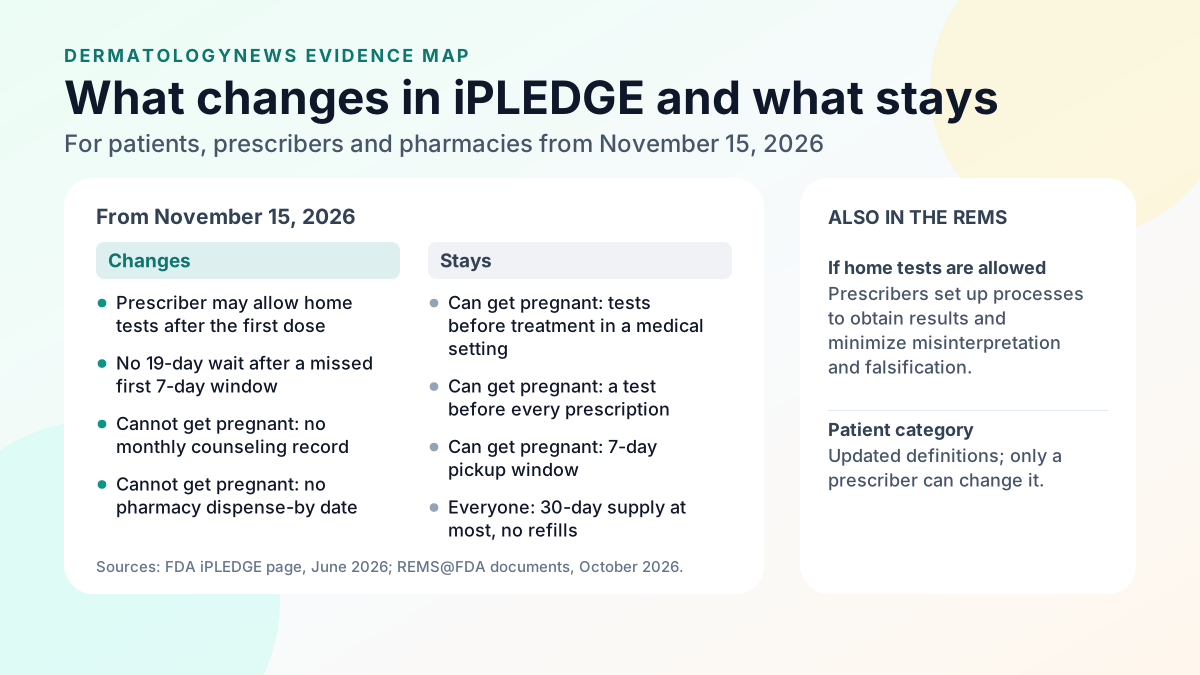
- If you can get pregnant, your prescriber may let you take the monthly pregnancy tests at home once you have taken your first dose [1][4].
- If you can get pregnant and miss the first 7-day pickup window, the repeat pregnancy test can be done right away, without the 19-day wait [1].
- If you cannot get pregnant, your prescriber no longer has to record your counseling in the REMS every month [1].
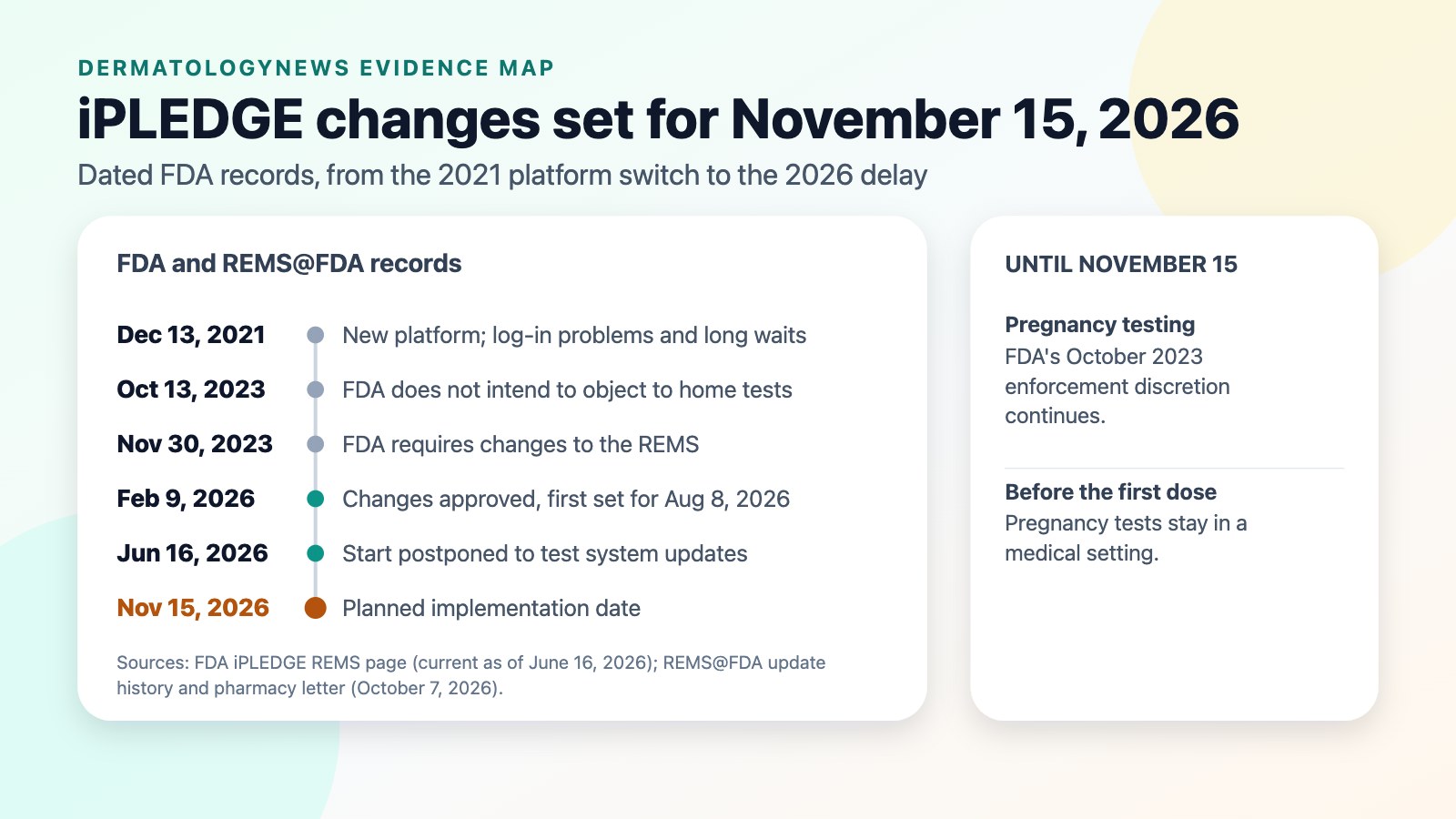
Home testing has been possible in practice since October 2023, when FDA said it did not intend to object to prescribers relying on patients' home pregnancy tests during and after treatment [1]. The November change makes prescriber-authorized home testing part of the REMS itself [1][3].
The pregnancy tests before the first dose stay in a medical setting, and each prescription is still limited to a 30-day supply with no refills [1][4][5]. FDA approved the changes on February 9, 2026. They were initially scheduled for August 8, 2026, then postponed to November 15, 2026 [1].
What changes on November 15, 2026
Home pregnancy tests, if your prescriber allows them
From November 15, a prescriber may allow pregnancy tests outside a medical setting, such as home pregnancy tests, during and after treatment [1]. The REMS letter to medical organizations sets the boundary: the option applies only after the patient has taken the first dose of a course [4]. The patient guide says the prescriber decides where each test is taken and explains how to report home results. Patients must follow the test instructions, use a test that is unexpired and properly stored, and report current and accurate results; false reporting could mean losing access to isotretinoin [7].
No 19-day wait after a missed first pickup window
For patients who can get pregnant, each prescription must be picked up within a 7-day window [3]. Day 1 is the day the pregnancy test specimen is collected, and the window closes at 11:59 p.m. Eastern Time on day 7 [7]. The REMS in place before this change set a waiting period, known as the "19-day lockout", for a patient who did not obtain isotretinoin within the first 7-day window [1]. From November 15, the repeat pregnancy test can be done right away, without a waiting period [1]. If the patient has not yet taken the first dose, the repeat confirmatory test must be done in a medical setting; during treatment, the guide says the repeat test can be done in a medical setting or as the prescriber directs [1][7].
Patients who cannot get pregnant
Patients who cannot get pregnant are counseled at enrollment about the risks of isotretinoin, not sharing it, not donating blood during treatment and for 30 days after stopping, and the REMS requirements [3]. Prescribers should reinforce that counseling throughout treatment, but monthly documentation of counseling in the REMS is no longer required [1]. A new Guide for Patients Who Cannot Get Pregnant replaces the former Fact Sheet [4][6].
At the pharmacy, there is no longer a 30-day prescription window for these patients [1]. The pharmacist no longer receives a "Do Not Dispense After Date" when obtaining the authorization to dispense, but if the prescription is returned to stock, the authorization must be reversed [5]. Before each prescription is dispensed, the authorization checks that the patient is enrolled and the prescriber is certified, and the pharmacist is prompted to enter the prescriber's NPI number for that check [3][5].
Prescribers and pharmacies
- Processes for home tests. Prescribers who allow tests outside a medical setting must establish processes and procedures to obtain the results from the patient and to minimize misinterpretation and falsification [1][3]. The prescriber or a designee must verify and document the negative result before each prescription is written [4].
- Patient categories. The category definitions were updated, and only a prescriber can change a patient's category [4].
- Pharmacy training. Training of all staff involved in dispensing is required at enrollment and annually, and the pharmacy's authorized representative keeps the training records [1][5].
- Pregnancy registry. The objective of documenting the outcome of each pregnancy, and the data collection for it, was removed from the registry requirement [1][6]. Registry guides for healthcare providers and for patients were added to the REMS materials [4].
- Contraception counseling. The REMS educational materials now carry updated contraception counseling information, including more on emergency contraception [4][6].
Pregnancy testing from November 15
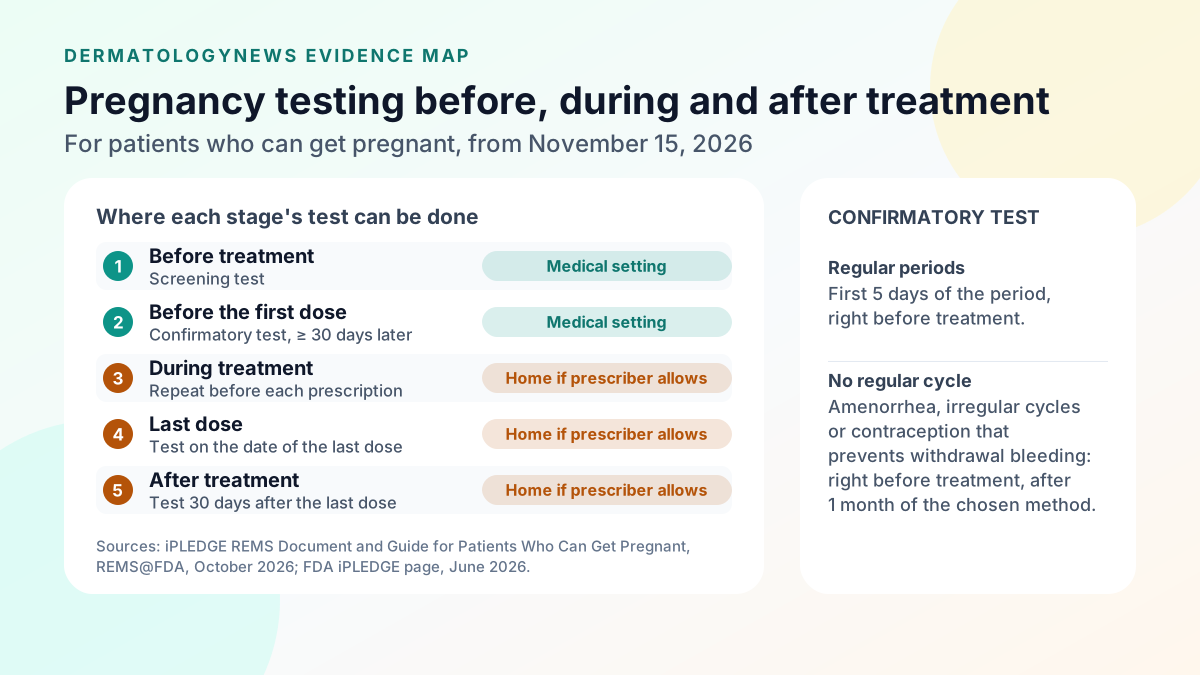
For patients who can get pregnant, the REMS document updated in October 2026 sets out pregnancy testing by stage [3]. Testing repeats before each prescription, and a missed pickup window adds a repeat test [3][7].
- Before treatment: screening test. Done in a medical setting, such as a prescriber's office, clinic or laboratory, when the decision to prescribe isotretinoin is made [3][4].
- Before the first dose: confirmatory test. Done in a medical setting, at least 30 days after the screening test and right before treatment starts [3][7]. With regular menstrual cycles, it falls in the first 5 days of the menstrual period [3][7]. With amenorrhea, irregular cycles or a contraceptive that prevents withdrawal bleeding, it is done right before treatment, after 1 month of the chosen pregnancy prevention method [3][7].
- During treatment: repeated before each prescription. A negative test within 7 days before each prescription, which may be done at home if the prescriber allows it [1][3].
- Last dose and after treatment. A test on the date of the last dose and another 30 days after it, also at home if the prescriber allows it [1][3].
What stays the same
These rules carry on after November 15:
- For patients who can get pregnant, the pregnancy tests before the first dose are still done in a medical setting [1].
- Patients who can get pregnant still need a negative pregnancy test before each prescription; what changes is where it may be done [1][3].
- The 7-day pickup window remains for patients who can get pregnant [1][3].
- Prescribers may still prescribe no more than a 30-day supply, and isotretinoin is dispensed only with a new prescription, with no refills [4][5].
- Patients who cannot get pregnant are still counseled at enrollment [1].
The October 2026 REMS document also sets these requirements. Patients who can get pregnant use their chosen pregnancy prevention method, either two forms of iPLEDGE-approved birth control or abstinence, for 30 days before treatment, during treatment and for 30 days after it ends [3][7]. Never share isotretinoin. Do not donate blood during treatment or for 30 days after stopping. Prescribers report pregnancies to the REMS [3]. The patient guide tells anyone who thinks they may be pregnant to stop isotretinoin immediately and call the prescriber [7].
What iPLEDGE is
The iPLEDGE Program began in early 2005 and became the iPLEDGE REMS in 2010 [1]. It is a "shared system" REMS: one centralized program for prescribers, pharmacies and patients, regardless of which isotretinoin product is used [1]. REMS@FDA lists the products in it, including Absorica, Amnesteem, Claravis, Myorisan, Zenatane and generic isotretinoin [6]. Only enrolled and activated prescribers can prescribe isotretinoin, only enrolled and activated pharmacies can dispense it, and patients must be enrolled and agree to meet the program's requirements [2][8]. Since December 13, 2021, the program has had two patient categories: patients who can get pregnant and patients who cannot get pregnant [1].
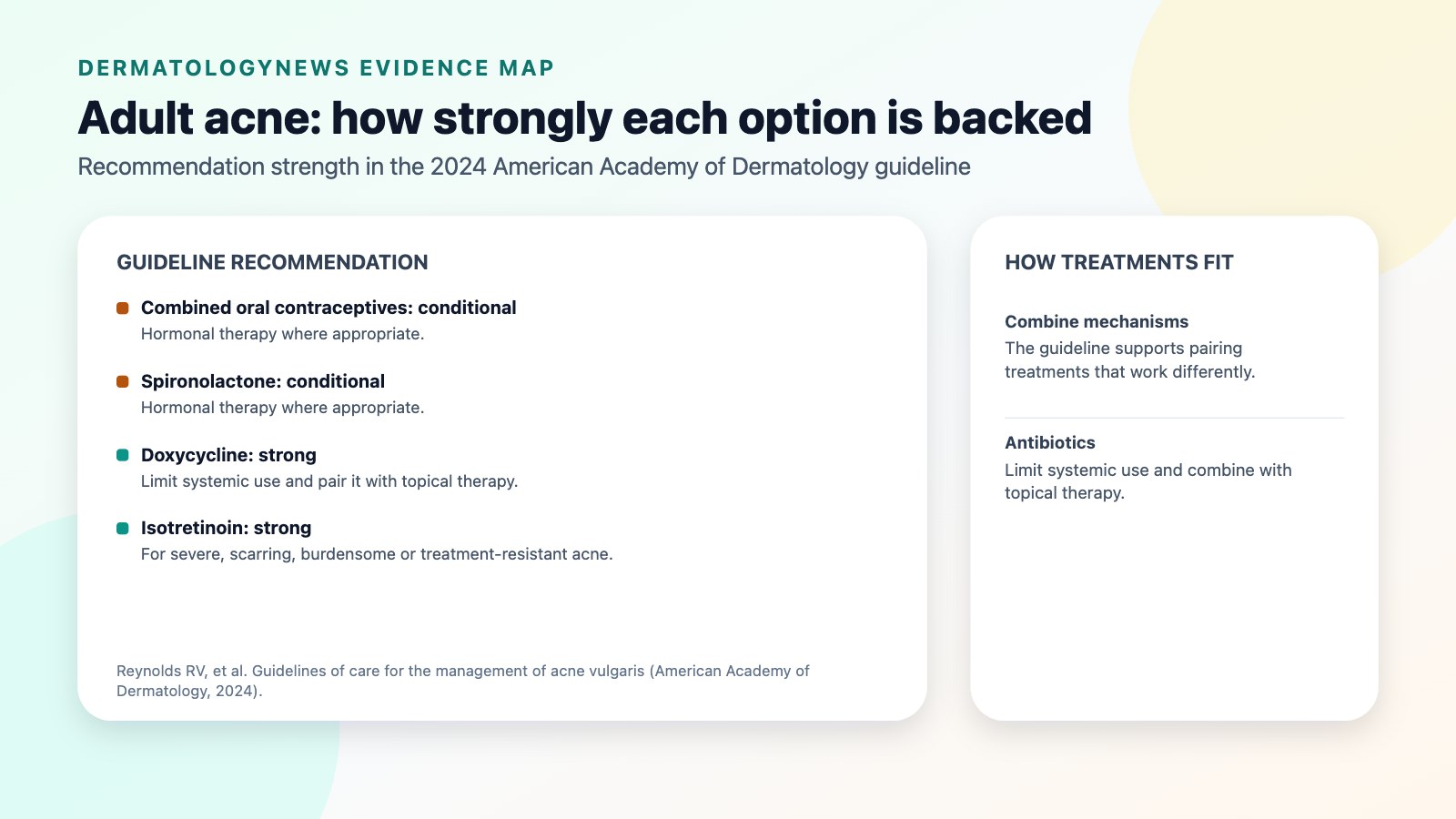
The REMS addresses one risk, embryo-fetal toxicity [3]. For isotretinoin's other serious risks, the iPLEDGE website refers readers to the Prescribing Information, including its boxed warning [8]. The American Academy of Dermatology's 2024 guideline strongly recommends oral isotretinoin for acne that is severe, causing psychosocial burden or scarring, or failing standard oral or topical therapy [9]. Our teen acne evidence review and adult female acne article cover where it fits among other acne treatments.
How the change got here
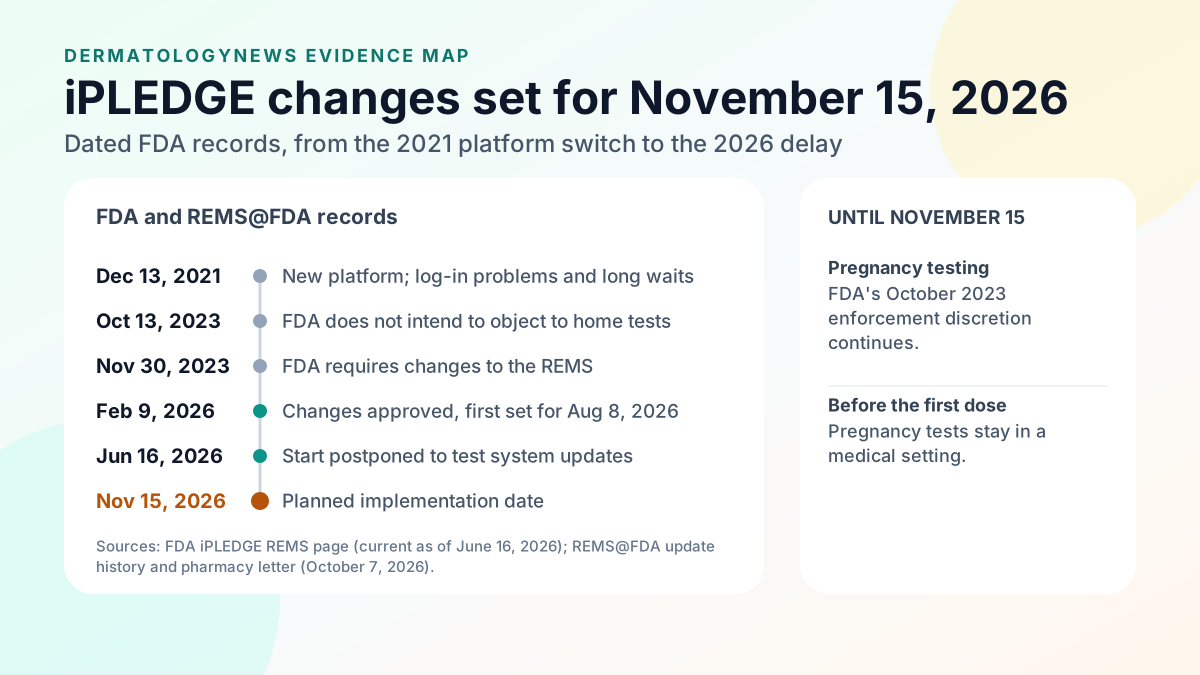
- December 13, 2021. A modified REMS took effect with the two patient categories and a new platform, needed because the previous system administrator had stopped supporting the program [1]. Many users could not get into their accounts and faced long call center waits, which FDA said disrupted access to treatment for many patients [1].
- October 13, 2023. As COVID-19 accommodations wound down, FDA said it did not intend to object if prescribers used pregnancy tests not performed in a CLIA-certified laboratory or relied on patients' home pregnancy tests during and after treatment; tests before treatment still had to be done in a medical setting [1].
- November 30, 2023. FDA notified isotretinoin manufacturers that they must modify the REMS, after considering advice from a March 2023 meeting of its Drug Safety and Risk Management and Dermatologic and Ophthalmic Drugs advisory committees, and public feedback [1].
- February 9, 2026. FDA approved the modifications, which also include changes the manufacturers proposed [1][2]. They were initially scheduled to take effect 180 days after approval, on August 8, 2026 [1].
- June 16, 2026. FDA postponed implementation to November 15, 2026, to allow more time to test system updates, minimize technical issues for users and help ensure uninterrupted access to treatment [1].
- October 7, 2026. REMS@FDA posted the updated REMS document and materials; the letter to pharmacy organizations among them dates the change to November 15, 2026 [5][6].
Until the modifications are fully implemented, FDA continues the October 2023 enforcement discretion on pregnancy testing [1]. As of November 1, 2026, FDA's page, with content current as of June 16, 2026, and the iPLEDGE REMS website both give November 15, 2026 as the date [1][8]. The iPLEDGE REMS website and its contact center, 866-495-0654, carry the program's current details [1][8].
Open the timeline figure at full size
Limitations and realistic expectations
- Tests before treatment stay in a medical setting. FDA explains that making sure a patient is not pregnant before starting is critically important for preventing fetal exposure, and that doing all pre-treatment tests in a medical setting gives additional assurance [2].
- Prenatal exposure still occurred. In a Québec cohort of 559,215 pregnancies from 1998 to 2022, first-trimester exposure to retinoids, the drug group that includes isotretinoin, was not eliminated despite long-standing pregnancy prevention programs; the authors report associations over time and note that concurrent changes in practice could not be fully separated from the programs [10].
Questions to ask your prescriber
- Will you allow home pregnancy tests after my first dose, and how should I report the results [1][7]?
- When and where should my screening and confirmatory tests be done, given my menstrual cycle and birth control [3][7]?
- If I miss a 7-day pickup window, where should the repeat test be done [1][7]?
- Which pharmacies near me take part in iPLEDGE [8]?
Bottom line
From November 15, 2026, iPLEDGE keeps its structure with three changes FDA describes as reducing burden: prescriber-authorized home pregnancy tests after the first dose become part of the REMS, the 19-day lockout after a missed first pickup window ends, and monthly counseling documentation stops for patients who cannot get pregnant [1][3][4]. Tests before the first dose stay in a medical setting, testing before every prescription continues for patients who can get pregnant, and the 30-day supply limit remains [1][3][5].
Common questions
- When do the iPLEDGE changes take effect?
- FDA approved the changes on February 9, 2026. They were initially scheduled for August 8, 2026, then postponed on June 16, 2026 to November 15, 2026, to allow more time to test system updates [1]. The iPLEDGE REMS website gives the same date [8]. Until the changes are fully implemented, FDA continues its October 2023 enforcement discretion on pregnancy testing [1].
- Can I take my iPLEDGE pregnancy tests at home?
- From November 15, 2026, a prescriber may allow pregnancy tests outside a medical setting, such as home tests, during and after treatment, but only after the patient has taken the first dose of a course [1][4]. Since October 2023, FDA has said it does not intend to object when prescribers rely on such home tests during and after treatment [1]. The screening and confirmatory tests before treatment must still be done in a medical setting such as a prescriber's office, clinic or laboratory [3].
- Is the iPLEDGE 19-day lockout going away?
- Yes. From November 15, 2026, a patient who can get pregnant and misses the first 7-day pickup window can repeat the pregnancy test right away, without a waiting period [1]. If treatment has not started yet, that repeat confirmatory test must be done in a medical setting [1].
- When is the confirmatory pregnancy test done?
- In a medical setting, at least 30 days after the screening test and right before treatment starts [3][7]. With regular menstrual cycles it falls in the first 5 days of the period; with amenorrhea, irregular cycles or contraception that prevents withdrawal bleeding, it is done right before treatment, after 1 month of the chosen pregnancy prevention method [3][7].
- What changes for patients who cannot get pregnant?
- Counseling is still required at enrollment, but monthly documentation of counseling in the REMS is no longer required, and prescribers should reinforce the counseling during treatment [1]. Pharmacies no longer receive a dispense-by date for these patients, and each prescription is still limited to a 30-day supply with no refills [3][5].
References
- FDA. iPLEDGE Risk Evaluation and Mitigation Strategy (REMS). — U.S. Food and Drug Administration, content current as of June 16, 2026
- FDA. Questions and Answers on the iPLEDGE REMS. — U.S. Food and Drug Administration, content current as of June 16, 2026
- Risk Evaluation and Mitigation Strategy (REMS): Isotretinoin (iPLEDGE) Shared System REMS. REMS Document. — Isotretinoin applicants, REMS@FDA, most recent REMS update October 2026 (posted October 7, 2026)
- iPLEDGE REMS. Medical Organizations Communication Letter: Changes to the iPLEDGE REMS. — iPLEDGE REMS sponsors, REMS@FDA (posted October 7, 2026)
- iPLEDGE REMS. Pharmacy Organizations Communication Letter: Changes to the iPLEDGE REMS on 11/15/2026. — iPLEDGE REMS sponsors, REMS@FDA (posted October 7, 2026)
- REMS@FDA. Isotretinoin iPLEDGE Shared System REMS: products, summary and update history. — U.S. Food and Drug Administration, REMS last update October 7, 2026
- iPLEDGE REMS. Guide for Patients Who Can Get Pregnant. — iPLEDGE REMS material, REMS@FDA (posted October 7, 2026)
- iPLEDGE REMS website: Program Changes, Important – Effective November 15, 2026. — iPLEDGE REMS, notice viewed November 1, 2026
- Reynolds RV, Yeung H, Cheng CE, et al. Guidelines of care for the management of acne vulgaris. — Journal of the American Academy of Dermatology, 2024;90(5):1006.e1-1006.e30 · PMID: 38300170 · DOI: 10.1016/j.jaad.2023.12.017
- Khan NS, Sheehy O, Leal LF, Tchuente V, Bérard A. Reducing Exposure Before Birth: An Interrupted Time Series Study of Prenatal Exposure to Fetotoxic Medications Under Risk Management Plans in Canada. — Clinical Pharmacology & Therapeutics, 2026;120(3):721-730 · PMID: 42244106 · DOI: 10.1002/cpt.70353