Teen acne: what the 2024 acne guideline recommends
Which acne treatments carry strong recommendations for adolescents in the 2024 American Academy of Dermatology guideline, what the trials behind them found, and where the evidence is thin.
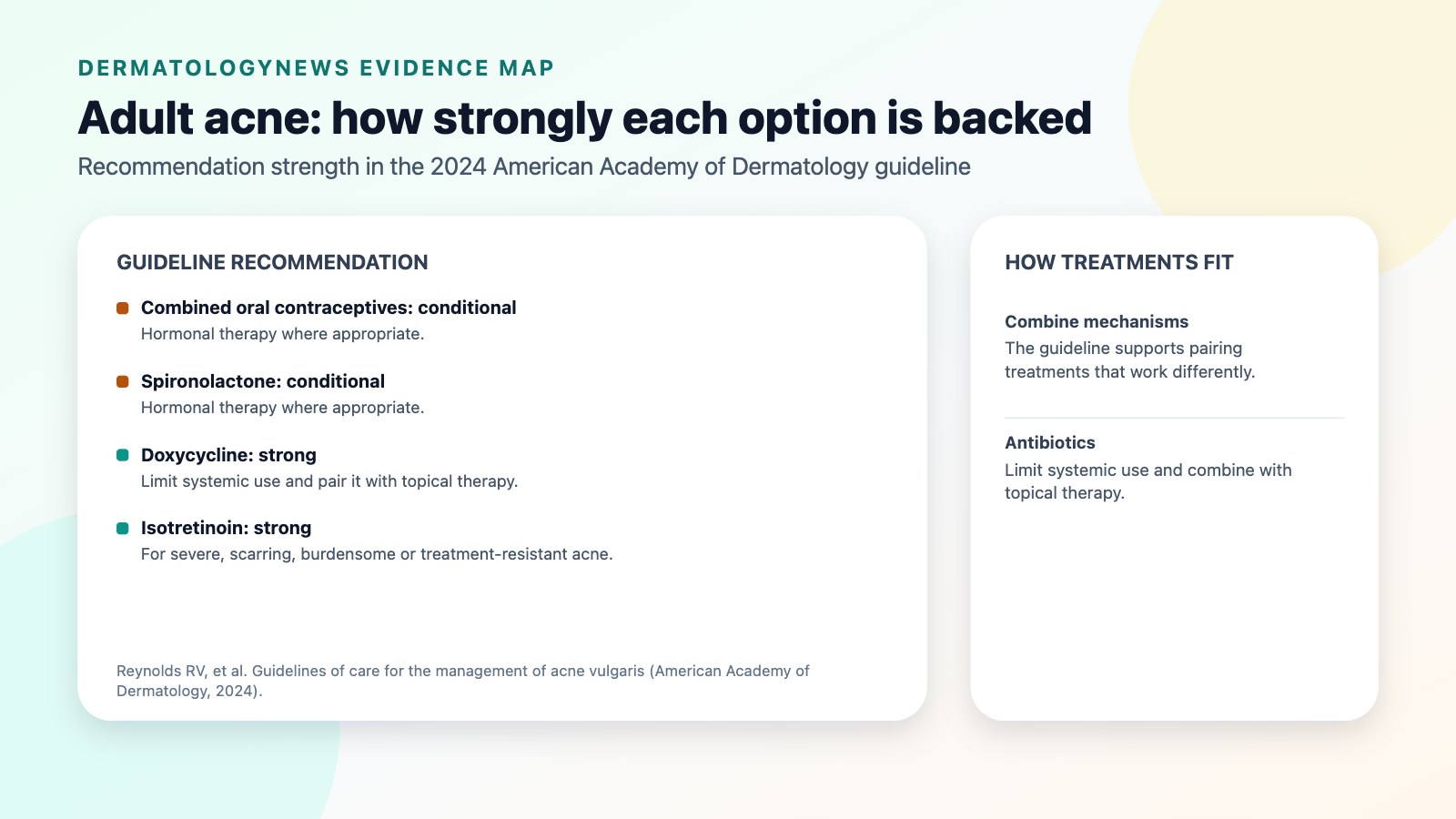
Acne vulgaris affects roughly 85 percent of people aged 12 to 24, and adolescence is when most treatment decisions are first made [2]. The current reference point for those decisions is the 2024 American Academy of Dermatology guideline, which graded the evidence with the GRADE approach and issued 18 recommendations and 5 good practice statements [1]. Its strong recommendations are few and specific: benzoyl peroxide, topical retinoids, topical antibiotics and oral doxycycline, with oral isotretinoin strongly recommended for acne that is severe, scarring, psychosocially burdensome, or unresponsive to standard therapy [1].
Why teenage acne is treated early
Acne is an inflammatory disease of the pilosebaceous unit, and it is classified by age, lesion morphology (comedonal, inflammatory, mixed, nodulocystic), distribution and severity, including whether scarring, post-inflammatory erythema or hyperpigmentation is already present [2]. Two facts shape the case for early treatment. Scarring can be permanent once it has formed, so the aim is to control inflammation before scars accumulate [2]. And the condition is not only cosmetic: a meta-analysis of 42 studies found acne associated with depression (r = 0.22) and anxiety (r = 0.25), with the authors recommending that clinicians treat acne actively and consider psychiatric screening or referral [7]. Correlation coefficients of that size describe a modest association across populations, not a prediction for any one teenager, but they are why the guideline treats psychosocial burden as an indication in its own right [1].
First line: topical agents, used in combination
The 2024 guideline gives strong recommendations for benzoyl peroxide, topical retinoids and topical antibiotics, and adds a good practice statement that topical therapies with different mechanisms of action should be combined [1]. The JAMA review summarizes the same first line: retinoids such as tretinoin and adapalene, benzoyl peroxide, azelaic acid, or combinations of them, with oral agents reserved for more severe disease [2]. As a single agent, tretinoin 0.025% gel reduced acne lesion counts by 63 percent from baseline at 12 weeks in a randomized trial of 207 patients [2].
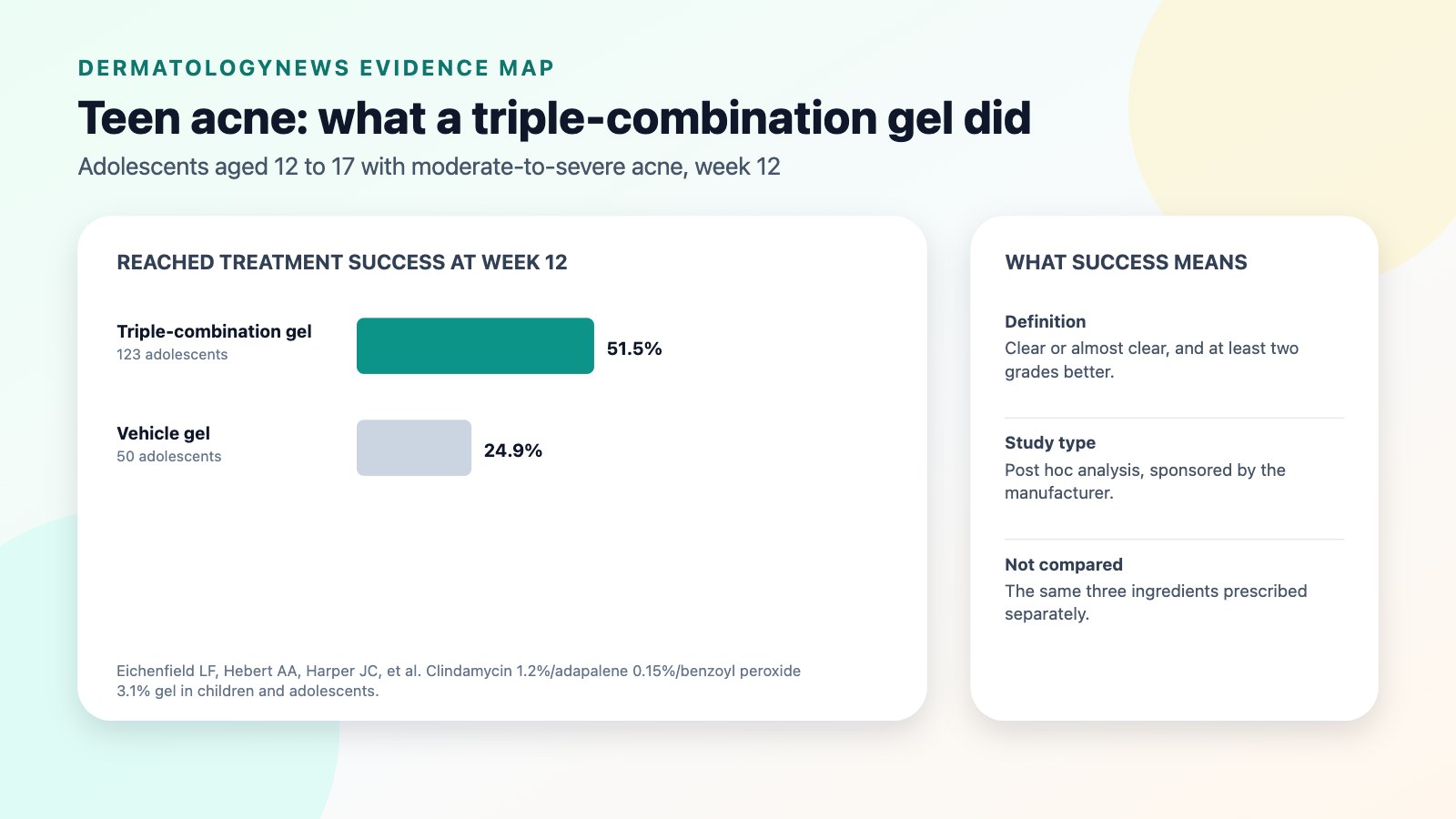
Adolescent-specific data are available for a fixed-dose triple combination of clindamycin phosphate 1.2%, adapalene 0.15% and benzoyl peroxide 3.1% gel. In a post hoc analysis of two phase 3, double-blind, 12-week trials in participants aged 9 and older with moderate to severe acne, adolescents aged 12 to 17 (123 on the gel, 50 on vehicle) reached treatment success in 51.5 percent of cases versus 24.9 percent with vehicle. Treatment success was a composite endpoint: at least a 2-grade reduction in the Evaluator's Global Severity Score and clear or almost clear skin at week 12. Inflammatory and noninflammatory lesion counts fell by 78.3 and 73.7 percent, respectively, with the gel versus 50.5 and 42.9 percent with vehicle. Most adverse events were mild to moderate and fewer than 2.5 percent of participants discontinued because of them [3]. This industry-sponsored, post hoc analysis found better 12-week outcomes with the triple combination than with vehicle, and vehicle recipients also improved. It did not compare the fixed-dose gel with separately prescribed versions of its components [3].
Conditional recommendations, meaning the guideline panel judged the balance of benefits and harms to be closer, cover topical clascoterone, salicylic acid and azelaic acid [1]. Clascoterone is the one genuinely new mechanism: a topical androgen receptor inhibitor. In two identical phase 3 trials enrolling 1,440 patients aged 9 and older with moderate or severe facial acne, twice-daily clascoterone cream 1% produced treatment success (Investigator's Global Assessment 0 or 1 plus at least a 2-grade improvement) in 18.4 and 20.3 percent of patients at week 12, versus 9.0 and 6.5 percent with vehicle; the predominant local reaction was trace or mild erythema [5]. Those success rates are lower in absolute terms than the triple-combination figures above, but the two trial programs used different scales, different populations and different comparators, so the numbers cannot be directly compared.
Oral antibiotics: strong for doxycycline, and always time-limited
Oral doxycycline carries a strong recommendation; oral minocycline and sarecycline carry conditional recommendations [1]. Two good practice statements govern how they are used: limit systemic antibiotic use, and combine systemic antibiotics with topical therapy [1]. That is antibiotic stewardship written into the guideline, and it is the reason a course of antibiotics alone is not considered adequate acne care.
Sarecycline, a narrow-spectrum tetracycline-class antibiotic, was tested in two identically designed phase 3 trials of 12 weeks in patients aged 9 to 45 with moderate to severe facial acne. Investigator's Global Assessment success (at least a 2-grade improvement and a score of clear or almost clear) was 21.9 and 22.6 percent with sarecycline versus 10.5 and 15.3 percent with placebo, and inflammatory lesions fell by roughly 50 percent versus 35 percent with placebo. Vestibular and phototoxic adverse events each occurred in 1 percent or fewer of sarecycline patients [4]. These are meaningful but modest differences over placebo, measured in trials where the drug was used without a topical partner, which the guideline would not recommend in practice [1][4].
Hormonal therapy for female patients
Combined oral contraceptive pills and spironolactone carry conditional recommendations [1]. In a meta-analysis of 32 randomized trials summarized in the JAMA review, combined oral contraception was associated with a 62 percent reduction in inflammatory lesions at 6 months, compared with 26 percent for placebo and 58 percent for oral antibiotics [2]. Conditional recommendations reflect a closer balance of benefits, risks and burden, with patient preferences carrying more weight in the choice [1].
Isotretinoin: strong recommendation, dose still debated
Oral isotretinoin is strongly recommended for acne that is severe, is causing psychosocial burden or scarring, or is failing standard oral or topical therapy [1]. The JAMA review notes that it is approved in the United States for severe recalcitrant nodular acne but is often used for resistant or persistent moderate to severe acne as well [2].
The unresolved question is dose. A 2026 systematic review and meta-analysis compared low-dose regimens (0.5 mg/kg/day or less) with conventional dosing (0.5 to 1.0 mg/kg/day) across four randomized trials with 202 analyzed participants, mostly with moderate acne. At 24 weeks the pooled difference in Global Acne Grading System score favored neither regimen, post-treatment worsening did not differ, and low-dose regimens had better tolerability and higher patient satisfaction. The authors graded the efficacy evidence as low certainty and noted that evidence in substantially more severe acne remains limited [6]. Four trials totaling about 200 patients leave the dosing question open [6]. A 2022 systematic review of adults with mild-to-moderate acne interpreted the same kind of evidence differently, suggesting that conventional dosing improved the odds of prolonged remission, while also rating the evidence as low quality [8]. Differences in populations and outcome definitions limit any direct comparison between the two reviews, and the dose remains a prescribing decision.
Adverse events, limitations and realistic expectations
- Every regimen has a tolerability cost. Topical therapies can irritate; the triple-combination trials recorded mostly mild to moderate adverse events, and clascoterone's main local effect was erythema [3][5]. The guideline recommends combining mechanisms to improve efficacy and to limit reliance on antibiotics; a combination is not automatically gentler than its parts [1].
- What treatment success measures. In the trials above, treatment success required both at least a 2-grade improvement from baseline and clear or almost clear skin at week 12. The percentages exclude patients whose improvement did not meet both criteria, so they are not the share of patients who improved [3][4][5].
- Trial durations are short. The triple-combination, sarecycline and clascoterone reports describe 12-week outcomes [3][4][5]. The isotretinoin review is the only source here that assessed post-treatment outcomes [6].
- Industry sponsorship is the norm. The sarecycline, clascoterone and triple-combination trials were sponsored by their manufacturers, which does not invalidate them but is a reason to weigh the guideline's independent GRADE synthesis above any single trial [1][3][4][5].
- Antibiotics carry a population cost. The guideline recommends limiting systemic antibiotic use and combining systemic antibiotics with topical therapy [1].
- Isotretinoin needs supervision. It is a prescription medicine, and the dosing review rated its efficacy evidence as low certainty and its safety and satisfaction evidence as moderate certainty [6].
- Diet, light therapy and over-the-counter routines. The guideline covers diet and light-based therapies without issuing strong recommendations for them [1], and the JAMA review identifies topical retinoids, benzoyl peroxide, azelaic acid and their combinations as first-line treatment [2]. A routine that cleanses and moisturizes is compatible with treatment; it is not the treatment.
When a teenager should see a dermatologist rather than wait
The guideline identifies severe acne, scarring, psychosocial burden and failure of standard therapy as the situations in which isotretinoin is considered [1], and each of them is also a reason to see a clinician rather than to keep rotating over-the-counter products. Once scars form, atrophic acne scar treatment becomes a separate concern. Adult female acne can persist beyond adolescence.
Bottom line
For adolescent acne, the 2024 guideline's strong recommendations are benzoyl peroxide, topical retinoids, topical antibiotics and oral doxycycline, with isotretinoin strongly recommended when acne is severe, scarring, psychosocially burdensome or unresponsive [1]. In the adolescent subgroup of the triple-combination trials, 51.5 percent reached the composite success endpoint at week 12 compared with 24.9 percent on vehicle [3]. Oral antibiotics work modestly better than placebo and are meant to be time-limited and paired with topicals [1][4]. Clascoterone adds a hormonal mechanism to topical care with a conditional recommendation [1][5]. Isotretinoin dosing remains debated on low-certainty evidence [6]. Because acne is associated with depression and anxiety in adolescents, the decision to treat is also a decision about well-being, and it belongs with a clinician who can examine the skin and follow the response [7].
Common questions
- What is the first-line treatment for teenage acne?
- The 2024 American Academy of Dermatology guideline makes strong recommendations for benzoyl peroxide, topical retinoids and topical antibiotics, and advises combining topical agents with different mechanisms rather than relying on one [1]. A clinician chooses the combination by acne severity, lesion type and tolerability.
- How long can a teenager take oral antibiotics for acne?
- The guideline lists limiting systemic antibiotic use and pairing an oral antibiotic with topical therapy as good practice statements [1]. Oral doxycycline carries a strong recommendation; minocycline and sarecycline are conditional [1]. The exact duration is a prescribing decision, and antibiotics are not meant to be the only treatment.
- Is isotretinoin only for severe acne?
- The guideline strongly recommends oral isotretinoin for acne that is severe, is causing psychosocial burden or scarring, or has failed standard oral or topical therapy [1]. A 2026 meta-analysis of four small randomized trials found low-dose and conventional-dose regimens comparable at 24 weeks in mostly moderate acne, with better tolerability at lower doses, but rated the efficacy evidence low certainty [6].
References
- Reynolds RV, Yeung H, Cheng CE, et al. Guidelines of care for the management of acne vulgaris. — Journal of the American Academy of Dermatology, 2024;90(5):1006.e1-1006.e30 · PMID: 38300170 · DOI: 10.1016/j.jaad.2023.12.017
- Eichenfield DZ, Sprague J, Eichenfield LF. Management of Acne Vulgaris: A Review. — JAMA, 2021;326(20):2055-2067 · PMID: 34812859 · DOI: 10.1001/jama.2021.17633
- Eichenfield LF, Hebert AA, Harper JC, et al. Triple-Combination Clindamycin Phosphate 1.2%/Adapalene 0.15%/Benzoyl Peroxide 3.1% Gel for Moderate-to-Severe Acne in Children and Adolescents. — Journal of Drugs in Dermatology, 2024;23(12):1049-1057 (post hoc analysis of two industry-sponsored phase 3 trials) · PMID: 39630680 · DOI: 10.36849/jdd.8643
- Moore A, Green LJ, Bruce S, et al. Once-Daily Oral Sarecycline 1.5 mg/kg/day Is Effective for Moderate to Severe Acne Vulgaris: Results from Two Identically Designed, Phase 3, Randomized, Double-Blind Clinical Trials. — Journal of Drugs in Dermatology, 2018;17(9):987-996 (industry-sponsored) · PMID: 30235387
- Hebert A, Thiboutot D, Stein Gold L, et al. Efficacy and Safety of Topical Clascoterone Cream, 1%, for Treatment in Patients With Facial Acne: Two Phase 3 Randomized Clinical Trials. — JAMA Dermatology, 2020;156(6):621-630 (industry-sponsored) · PMID: 32320027 · DOI: 10.1001/jamadermatol.2020.0465
- Zou J, Li Y, Wang L, et al. Individualizing isotretinoin dosing in acne: comparable 24-week efficacy and better tolerability at lower daily doses. — Frontiers in Medicine, 2026;13:1771320 (systematic review and meta-analysis, PROSPERO CRD42024536322) · PMID: 41877774 · DOI: 10.3389/fmed.2026.1771320
- Samuels DV, Rosenthal R, Lin R, Chaudhari S, Natsuaki MN. Acne vulgaris and risk of depression and anxiety: A meta-analytic review. — Journal of the American Academy of Dermatology, 2020;83(2):532-541 · PMID: 32088269 · DOI: 10.1016/j.jaad.2020.02.040
- Al Muqarrab F, Almohssen A. Low-dose oral isotretinoin for the treatment of adult patients with mild-to-moderate acne vulgaris: Systematic review and meta-analysis. — Dermatologic Therapy, 2022;35(4):e15311 · PMID: 35000295 · DOI: 10.1111/dth.15311