How to check if a dermatology study is retracted
Learn how to check a dermatology paper in PubMed for corrections, expressions of concern and retractions, and how to read each notice accurately.
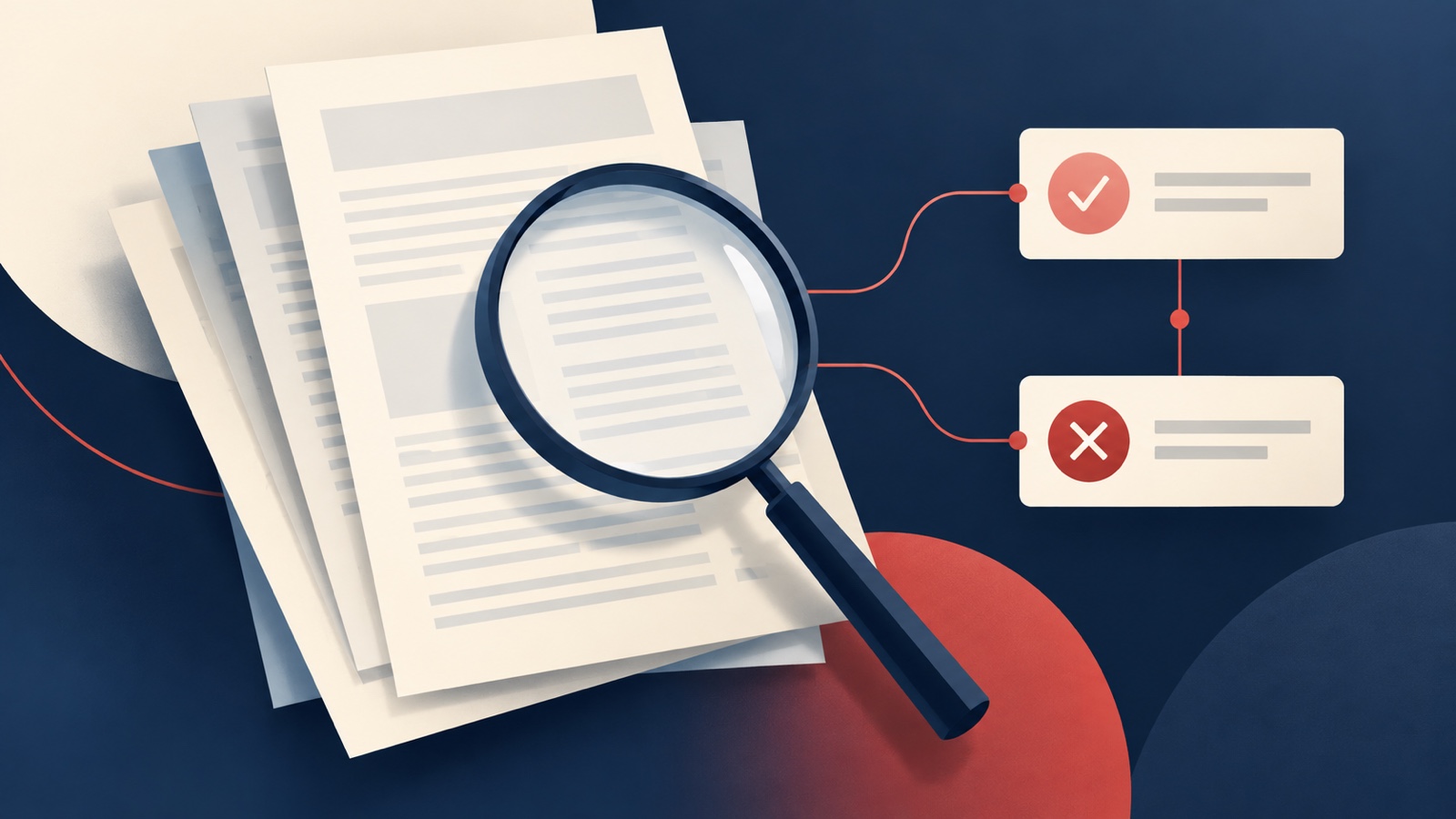
To check if a dermatology study is retracted, open its exact PubMed record by PMID or DOI. Look above the abstract for a Retraction in link, then check whether the publication types include Retracted Publication. Open the linked notice and confirm that its title, journal, DOI and Retraction of link point back to the same paper [1][2]. A correction, expression of concern or editor's note is a different notice and should be described by its own label.
This check answers a narrow question: whether the publication record carries a formal notice. Study methods, relevance to an individual patient and overall trustworthiness still need separate appraisal.
How do I check a study in PubMed?
1. Identify the exact paper
Start with the PMID or DOI rather than a shortened title from a news story, social post or reference list. A PMID identifies one PubMed citation. A DOI identifies the published version itself.
In PubMed, enter the number on its own or use the PMID field tag, such as 38807440[pmid]. The PubMed User Guide also recommends searching by article title or citation details when the identifier is unavailable [2]. Match the authors, journal, year and title before reading any status label.

2. Read the linked-notice label
PubMed links an original article to related notices when NLM receives the relevant citation data from a publisher. The wording tells you the relationship [1]:
| Label on the original article | What it means | Reading limit |
|---|---|---|
| Erratum in | A citable notice corrects or adds information. NLM uses the errata category for corrections, corrigenda, addenda and some partial retractions. | The change may be limited; read its scope before judging the whole article. |
| Expression of concern in | An editor has alerted readers to an unresolved concern while investigation or follow-up continues. | The final editorial outcome is still open. |
| Retraction in | A linked notice says the article has been retracted or withdrawn in whole. | Retraction status alone does not establish misconduct. |
| Corrected and republished in | The article was corrected by republication as a new citable item. | Check which version should be read and cited. |
An Editor's Note is wording chosen by a journal. It can flag a question, explain an update or provide other context. Keep that label unless the journal record or PubMed link assigns a formal expression of concern, correction or retraction.
3. Check the publication type
Scroll to Publication types. A retracted original should carry Retracted Publication; the separate notice should carry Retraction Notice [1]. This second signal helps when the linked-notice panel is easy to miss.
PubMed's help page also documents link-status search terms. For example, hasretractionin finds records linked to retraction notices, while hasretractionof finds the notices themselves [2]. These searches are useful for auditing a reference list, but the individual record and notice still need to be opened.
4. Open the notice and verify the pair
Open the notice rather than relying on a banner or label alone. Compare:
- the original title;
- journal, year, volume and article number;
- PMID and DOI;
- the notice's Retraction of, Erratum for or other reciprocal link; and
- the notice's stated scope and reason, if provided.
This step prevents a similarly titled paper, commentary or later update from being mistaken for the notice attached to the study you are checking.
5. Check the journal page when the decision matters
PubMed is a strong starting point, but it is a bibliographic database. Open the DOI or journal page to read the current notice and article labeling. Save the date of your check because records can change after publication.
If the paper affects a clinical decision, a literature review or a patient-facing claim, look beyond status. Assess study design, population, outcomes, statistical analysis, conflicts, later replication and current guidelines. A formal notice is one piece of evidence, not a complete quality rating.
A dermatology example: matching a paper to its retraction notice
PubMed record 38807440 is a 2024 Skin Research and Technology article about topical phenytoin plus microneedling for atrophic acne scars. As checked on September 25, 2026, the record shows all three of the signals described above [3]:
- a Retraction in link to PMID 40947850;
- Retracted Publication in its publication types; and
- the original DOI,
10.1111/srt.13766.
The linked 2025 item is titled as a retraction, carries the publication type Retraction Notice, uses DOI 10.1111/srt.70225, and links back to PMID 38807440 as Retraction of [4]. The notice says the article was accepted after an insufficient peer-review process, reports scientific inconsistencies, and identifies duplication within Figure 1 [4].
Those records establish that the study was retracted. They do not establish author misconduct. NLM states that its retraction links do not distinguish retractions caused by honest error from those caused by misconduct or plagiarism; the reason must come from the notice itself [1].
Why the notice categories should stay separate
These labels describe different editorial actions. Collapsing them into "the paper was withdrawn" can mislead readers in either direction.
A correction can leave the main result intact, alter it materially or address only citation metadata. An expression of concern warns that an issue remains unresolved. A retraction withdraws the article in whole. A corrected and republished article directs readers to a replacement. An editor's note may sit outside those formal PubMed relationships.
When writing about a study, use the narrowest accurate sentence. For example:
- "PubMed links a published correction" when that is the record.
- "The journal posted an expression of concern; the investigation was unresolved when checked" when that is the record.
- "The study is indexed as a retracted publication and links to a retraction notice" when both signals are present.
Make broader claims about fraud, fabrication, patient harm or author intent only when a reliable source explicitly establishes them.
What a clean PubMed record cannot prove
A PubMed record with no linked notice offers no assurance that the study is valid. A recent notice may not yet be linked, a journal may use a different kind of update, or no formal editorial action may exist. In a comparison of 878 retracted publications from 131 high-impact medical journals, including dermatology journals, PubMed identified 86.3 percent; the Retraction Watch Database identified 92.8 percent and Web of Science 83.6 percent, and coverage varied by discipline [5]. Checking more than one source lowers the chance of missing a notice. A paper can also remain unretracted while being small, biased, poorly reported, contradicted by later work or irrelevant to the patient in front of you.
A corrected paper may remain useful, so read what changed before discarding it. Status checking tells you what happened to the publication record; critical appraisal answers the broader quality questions.
Limitations and practical safety
PubMed is a bibliographic database, rather than a universal study investigator or certificate of clinical validity [1]. Labels and links can change, so record the date and identifiers you checked. Retraction can also take years: among 1,209 dermatology retractions in the Retraction Watch Database, 118 were explicitly attributed to paper mills, none before 2018, and their mean time from publication to retraction was 957 days [6]. If a conclusion could change treatment, compare current guidelines and higher-level evidence instead of relying on one article or its retraction status. Discuss the decision with a board-certified dermatologist.
What to record before you rely on the paper
Record four things: the exact PMID or DOI, the linked-notice label, the publication type and the reciprocal notice. Use the journal's exact term for a correction, expression of concern, editor's note or retraction, and take the reason from the notice itself. A retraction alone is not proof of misconduct; a clean status record is not proof of clinical validity.
Common questions
- How can I tell if a dermatology study has been retracted?
- Open the exact PubMed record by PMID or DOI, look for a 'Retraction in' link, and check whether the record's publication types include 'Retracted Publication.' Then open the linked notice and confirm that it names the same article [1][2].
- Is an expression of concern the same as a retraction?
- No. An expression of concern alerts readers to an unresolved integrity question. A later investigation may lead to a correction, retraction or another outcome, but the concern itself is not a retraction [1].
- Does a correction mean the whole study is invalid?
- Not necessarily. A correction may fix or add specific information. PubMed groups several notices, including corrigenda and some partial retractions, under errata, so readers should open the notice and identify exactly what changed [1].
- If PubMed shows no retraction, does that prove the study is reliable?
- No. The absence of a linked notice means only that you did not find that type of notice in the record at the time checked. It does not validate the study's design, analysis, clinical relevance or current standing at the journal.
- Does PubMed flag every retracted paper?
- Not always. In a comparison of 878 retracted publications from 131 high-impact medical journals, PubMed identified 86.3 percent, the Retraction Watch Database 92.8 percent and Web of Science 83.6 percent, with coverage varying by specialty [5].
References
- National Library of Medicine. Errata, Retractions, and Other Linked Citations in PubMed. — National Library of Medicine, last reviewed February 10, 2026
- National Library of Medicine. PubMed User Guide. — PubMed, updated September 24, 2026
- Sadeghzadeh-Bazargan A et al. Evaluation and comparison of the efficacy and safety of the combination of topical phenytoin and microneedling with microneedling alone in the treatment of atrophic acne scars: A controlled blinded randomized clinical trial. — Skin Research and Technology, 2024;30(6):e13766 · PMID: 38807440 · DOI: 10.1111/srt.13766
- RETRACTION: Evaluation and Comparison of the Efficacy and Safety of the Combination of Topical Phenytoin and Microneedling With Microneedling Alone in the Treatment of Atrophic Acne Scars: A Controlled Blinded Randomized Clinical Trial. — Skin Research and Technology, 2025;31(9):e70225 · PMID: 40947850 · DOI: 10.1111/srt.70225
- Sebo P, Sebo M. Comparing the performance of Retraction Watch Database, PubMed, and Web of Science in identifying retracted publications in medicine. — Accountability in Research, 2025;33(2):2484555 · PMID: 40156496 · DOI: 10.1080/08989621.2025.2484555
- Tan E, Epstein R, Ahmed S, Williams HC. Paper Mills in Dermatology: A Cross-Sectional Study of Retracted Publications. — British Journal of Dermatology, 2026 (published online September 5, 2026) · PMID: 42700464 · DOI: 10.1093/bjd/ljag381