Lebrikizumab and nemolizumab: atopic dermatitis evidence
Lebrikizumab and nemolizumab target different atopic dermatitis pathways. Compare their FDA labels, phase 3 designs, safety limits, and evidence gaps.
Lebrikizumab and nemolizumab are biologic medicines with U.S. indications for moderate-to-severe atopic dermatitis in adults and adolescents aged 12 years and older under defined conditions [1][4]. They target different pathways and were tested in different phase 3 programs. Both improved prespecified outcomes compared with placebo, but there is no randomized head-to-head trial showing that one is superior [2][5].
How do the targets differ?
Lebrikizumab is an antibody directed at interleukin-13, a cytokine involved in type 2 inflammation and skin-barrier dysfunction. Its FDA label covers patients aged 12 years and older who weigh at least 40 kg and whose moderate-to-severe atopic dermatitis is not adequately controlled with topical prescription therapy, or when those therapies are not advisable [1]. It can be used with or without topical corticosteroids.
Nemolizumab targets interleukin-31 receptor alpha. IL-31 signaling is closely linked to itch as well as inflammation. The U.S. atopic dermatitis label covers adults and adolescents aged 12 years and older whose disease is not adequately controlled with topical prescription therapies [4]. It is labeled in combination with topical corticosteroids and/or topical calcineurin inhibitors.
The labels therefore are not interchangeable:
| Feature | Lebrikizumab | Nemolizumab |
|---|---|---|
| Primary target | IL-13 [1] | IL-31 receptor alpha [4] |
| U.S. atopic dermatitis age | 12 years and older [1] | 12 years and older [4] |
| Weight condition in cited U.S. AD indication | At least 40 kg [1] | No minimum weight stated in the June 2025 indication [4] |
| Background topical therapy | With or without topical corticosteroids [1] | With topical corticosteroids and/or calcineurin inhibitors [4] |
What did the lebrikizumab trials test?
ADvocate1 and ADvocate2 were replicate, randomized, double-blind phase 3 trials. Adults and adolescents with moderate-to-severe atopic dermatitis received lebrikizumab monotherapy or placebo during a 16-week induction period [2]. Dermira, a Lilly company, funded the programs, and several authors were company employees or disclosed industry relationships.
Both studies favored lebrikizumab on the primary Investigator's Global Assessment endpoint—clear or almost clear with at least a two-point improvement from baseline—and on at least 75% improvement in Eczema Area and Severity Index [2]. Response percentages differed between the replicate studies.
Responders at week 16 entered randomized maintenance groups. Fifty-two-week findings support maintenance with less frequent administration in some initial responders [3]. That second-stage result applies to people who had already responded and were re-randomized. It should not be presented as the expected outcome for everyone who starts treatment.
What did the nemolizumab trials test?
ARCADIA 1 and ARCADIA 2 were randomized, double-blind phase 3 trials in adults and adolescents with moderate-to-severe atopic dermatitis. Unlike the lebrikizumab monotherapy induction trials, nemolizumab was studied with background topical corticosteroids, with or without topical calcineurin inhibitors [5]. Galderma funded the studies, and company employees were among the authors.
Nemolizumab plus background topical therapy outperformed placebo plus background topical therapy on the co-primary outcomes at week 16 [5]. The outcomes assessed clear or almost-clear skin and at least 75% Eczema Area and Severity Index improvement. Itch and sleep outcomes were also measured.
The design difference is central. A nemolizumab response percentage includes the effect of the study's permitted background topical regimen. It cannot be directly ranked against a lebrikizumab monotherapy percentage without a head-to-head design.
An open-label extension reported outcomes through 104 weeks for participants with and without previous nemolizumab exposure [6]. Of 1,903 enrolled participants, 1,901 received treatment; 1,062 had completed week 104 at the July 21, 2024 interim cutoff; the analysis used observed data and did not retain a placebo comparison. Most treatment-emergent events were mild or moderate [6]. Longer exposure is valuable for safety surveillance, but an open extension is vulnerable to attrition and responder-selection effects.
Safety profiles are related to the target and label
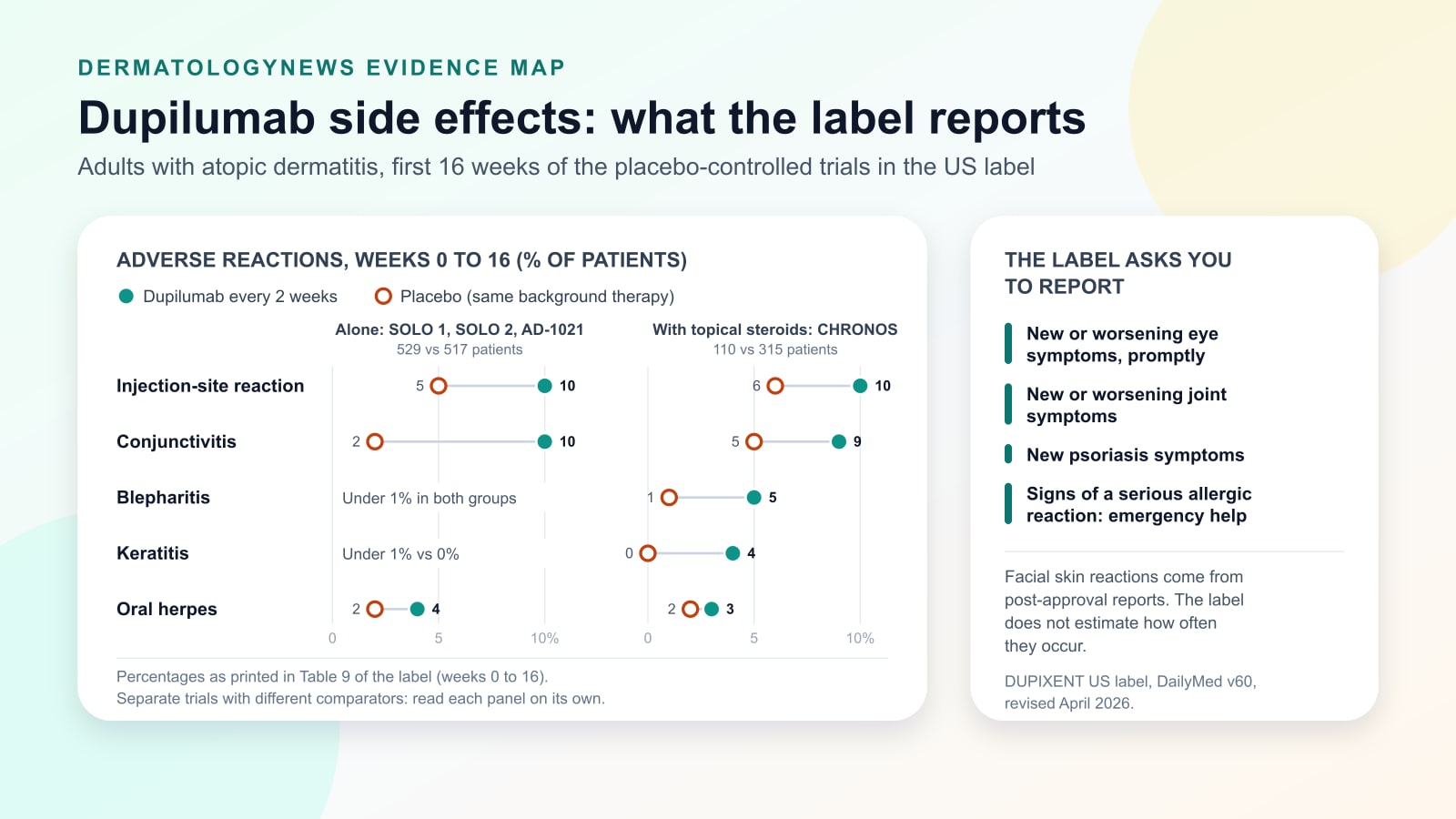
The lebrikizumab label includes warnings for hypersensitivity, conjunctivitis and keratitis, parasitic infections, and vaccination considerations [1]. In the phase 3 program, conjunctivitis was more common with lebrikizumab than placebo [2]. The correct response is not to assume every eye symptom is drug related or harmless; new eye pain, light sensitivity, or vision change needs clinical assessment.
The nemolizumab label addresses hypersensitivity and vaccination, and its trial program reported events including headache, asthma, and injection-related reactions [4][5][6].
Neither medicine is a general treatment for a rash that has not been diagnosed. Contact dermatitis, scabies, fungal infection, cutaneous T-cell lymphoma, drug eruptions, and other conditions can resemble eczema in some settings. A poor response should prompt reassessment rather than automatic escalation.
Why a cross-trial ranking is unreliable
A fair comparison would randomly assign similar participants to one biologic or the other under the same background-treatment and outcome rules. The available pivotal programs did not do that [2][5]. Cross-trial differences include:
- monotherapy induction for lebrikizumab versus required background topical therapy for nemolizumab;
- different randomization and maintenance structures;
- different placebo response rates;
- different handling of rescue treatment and missing data;
- separate sponsor-run programs;
- no shared trial designed to test non-inferiority or superiority.
Mechanism can guide a hypothesis, such as considering prominent itch, but it is not a substitute for comparative clinical evidence. Insurance access, comorbid disease, eye history, injection schedule, prior therapy, and patient priorities can also shape a decision.
Bottom line
Lebrikizumab and nemolizumab both have FDA indications and positive phase 3 evidence for defined patients with moderate-to-severe atopic dermatitis [1][2][4][5]. Lebrikizumab targets IL-13. Nemolizumab targets IL-31 receptor alpha and was tested with background topical therapy.
The evidence supports each medicine against its own control group. It does not support declaring a winner across separate trials. Treatment selection also depends on the label, safety profile and individual clinical needs.
Common questions
- Do lebrikizumab and nemolizumab block the same pathway?
- No. Lebrikizumab blocks interleukin-13 signaling. Nemolizumab targets the interleukin-31 receptor alpha pathway, which is closely involved in itch signaling.
- Can phase 3 response percentages show which biologic is better?
- Not reliably. The pivotal programs used different background therapy, endpoints, analysis rules, and populations. Without a randomized head-to-head trial, comparing percentages across programs can mislead.
- Are both FDA labels identical?
- No. In the cited U.S. labels, both cover moderate-to-severe atopic dermatitis from age 12 under defined conditions, but lebrikizumab includes a minimum weight and can be used with or without topical corticosteroids. The cited June 2025 nemolizumab label states no minimum weight in its atopic-dermatitis indication and requires topical corticosteroids and/or calcineurin inhibitors.
- Does improvement at week 16 prove permanent control?
- No. Atopic dermatitis is chronic and relapsing. Maintenance and extension data provide longer follow-up, but they do not show that disease stays controlled after treatment stops or that rare risks are absent.
References
- FDA. EBGLYSS (lebrikizumab-lbkz): Full Prescribing Information. — U.S. Food and Drug Administration, 2024
- Silverberg JI et al. Two Phase 3 Trials of Lebrikizumab for Moderate-to-Severe Atopic Dermatitis. — New England Journal of Medicine, 2023 · PMID: 36920778 · DOI: 10.1056/NEJMoa2206714
- Blauvelt A et al. Efficacy and safety of lebrikizumab: 52-week results of two phase 3 trials. — British Journal of Dermatology, 2023 · PMID: 36994947 · DOI: 10.1093/bjd/ljad022
- FDA. NEMLUVIO (nemolizumab-ilto): Full Prescribing Information. — U.S. Food and Drug Administration, revised 2025
- Silverberg JI et al. Nemolizumab with concomitant topical therapy in moderate-to-severe atopic dermatitis (ARCADIA 1 and 2). — The Lancet, 2024 · PMID: 39067461 · DOI: 10.1016/S0140-6736(24)01203-0
- Augustin M et al. Safety and efficacy of nemolizumab for atopic dermatitis up to 2 years in an open-label extension study. — Journal of the European Academy of Dermatology and Venereology, 2026 · PMID: 41081535 · DOI: 10.1111/jdv.70080