Dupilumab (Dupixent) side effects: what the label and trials report
Injection-site reactions, conjunctivitis and facial redness: what the Dupixent label and phase 3 trials show, and which symptoms the label says to report.

Dupilumab, sold as Dupixent, is an injected biologic medicine that blocks interleukin-4 and interleukin-13 signaling by targeting the interleukin-4 receptor alpha [2]. In the United States it is indicated for moderate-to-severe atopic dermatitis from 6 months of age when topical prescription therapies do not control the disease or are not advisable, among several other conditions [1]. In adult monotherapy trials over 16 weeks, two reactions stand out in the label: injection-site reactions, in 10 percent of patients on dupilumab versus 5 percent on placebo, and conjunctivitis, in 10 versus 2 percent [1]. Facial redness, joint pain and new psoriasis are described mainly in reports gathered after approval [1][5].
Where the safety numbers come from
The label pools three 16-week placebo-controlled monotherapy trials in adults (SOLO 1, SOLO 2 and AD-1021) with CHRONOS, a 52-week adult trial with topical corticosteroids in both groups; Sanofi and Regeneron, which market the drug, funded SOLO and CHRONOS [1][2][3]. The 2024 American Academy of Dermatology guideline strongly recommends dupilumab for adults and notes that most trials of systemic therapies are short, which limits comparative conclusions about long-term efficacy and safety [6]. Two newer biologics are covered in our review of lebrikizumab and nemolizumab.
The reactions reported most often
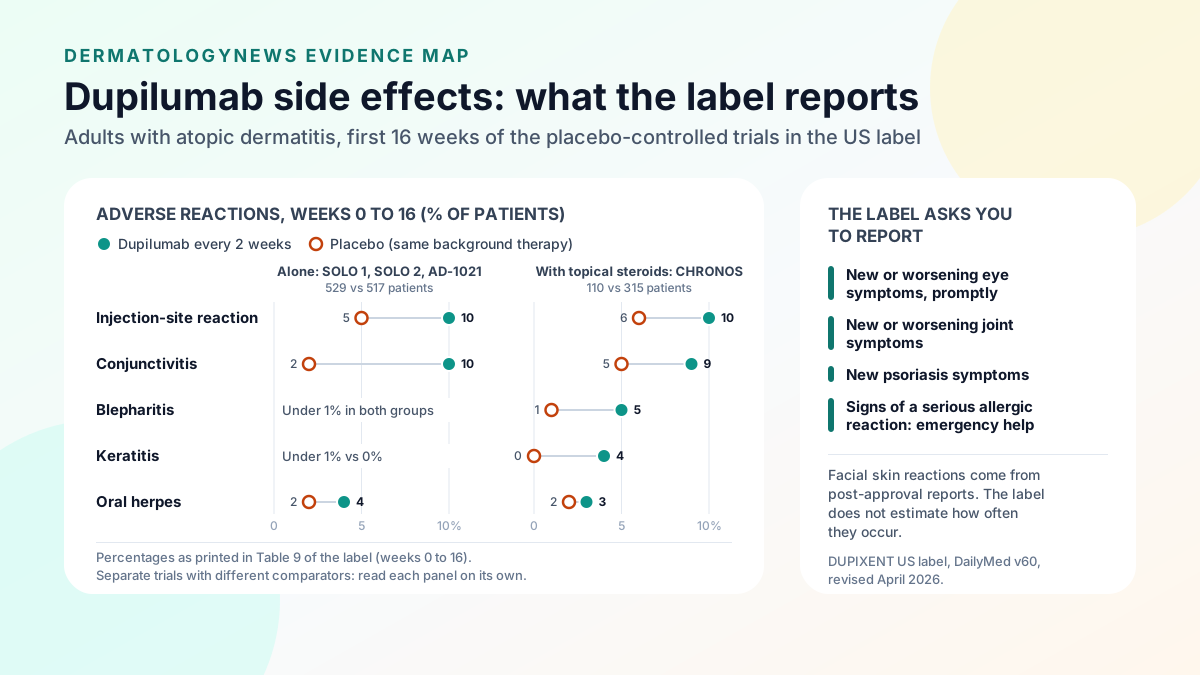
The label lists reactions that occurred in at least 1 percent of dupilumab-treated adults, and more often than in the comparison group, during the first 16 weeks [1]:
| Reaction, weeks 0 to 16 | Dupilumab alone | Placebo | Dupilumab with topical steroids | Placebo with topical steroids |
|---|---|---|---|---|
| Injection-site reaction | 10% | 5% | 10% | 6% |
| Conjunctivitis | 10% | 2% | 9% | 5% |
| Blepharitis (eyelid inflammation) | under 1% | under 1% | 5% | 1% |
| Oral herpes (cold sores) | 4% | 2% | 3% | 2% |
| Keratitis (corneal inflammation) | under 1% | 0% | 4% | 0% |
| Other herpes simplex infection | 2% | 1% | 1% | under 1% |
| Eye itching | 1% | under 1% | 2% | 1% |
| Dry eye | under 1% | 0% | 2% | under 1% |
Monotherapy columns pool SOLO 1, SOLO 2 and AD-1021 (529 adults on dupilumab every 2 weeks, 517 on placebo); topical-steroid columns come from CHRONOS (110 versus 315) [1].
Treatment discontinuation because of adverse events occurred in 1.9 percent of both groups through week 16 of the monotherapy trials, and in 1.8 percent with dupilumab versus 7.6 percent with placebo over 52 weeks of CHRONOS [1].
Conjunctivitis and other eye effects
Conjunctivitis was the most frequently reported eye disorder, and most people with conjunctivitis or keratitis recovered or were recovering during treatment [1]. Over 52 weeks of CHRONOS, conjunctivitis was reported in 16 percent of the dupilumab group and 9 percent of the placebo group [1]. Conjunctivitis occurred in 21% during an extension with follow-up up to 260 weeks; only 179 participants had at least 260 weeks' exposure [1]. Most conjunctivitis cases in the analyzed trials were mild to moderate [4]. Severe conjunctivitis affected no more than 0.5% when dupilumab regimens were combined within each analyzed AD study [4]. More severe eczema at baseline and a past history of conjunctivitis were linked to more conjunctivitis in both the dupilumab and placebo groups [4].
Reports gathered after approval add an outward-turning eyelid (ectropion), scarring changes of the eye surface, narrowing or blockage of the tear-drainage system, and temporary or ongoing vision loss, including blindness, associated with conjunctivitis, keratitis or blepharitis [1]. The label advises caution in people with significant dry eye disease, significant eyelid abnormalities or surgery, or previous tear-duct surgery [1].

Herpes infections, eosinophils and children
Eczema herpeticum, a spreading herpes simplex infection of eczematous skin, occurred at similar rates with dupilumab and placebo, and herpes zoster in under 1 percent of both groups in the 16-week monotherapy trials [1].
In adults, eosinophilia of 500 cells/mcL or more occurred at similar rates with dupilumab and placebo [1]. In children aged 6 months to 5 years, in the 16-week trial with background topical corticosteroids, counts of 5,000 cells/mcL or more were reported in 8 percent on dupilumab and 0 percent on placebo [1]. The label's warning about eosinophilic pneumonia and blood vessel inflammation (eosinophilic granulomatosis with polyangiitis) concerns people treated for asthma [1].
The label describes the safety profile in its 16-week pediatric trials as similar to that in adults. In children under 6, during the extension through 52 weeks, hand-foot-and-mouth disease was reported in 5 percent and skin papillomas in 2 percent, without stopping the study drug [1].
Reactions known mainly from reports after approval
Facial and neck redness
Facial and neck redness was not reported in the phase 3 atopic dermatitis trials, but it has been reported in clinical practice [5]. The label lists facial skin reactions, including redness, rash, scaling, swelling, bumps, itching, burning and pain, among post-approval reports [1]. A systematic review collected 101 such patients from 16 studies; 45 percent described symptoms different from their usual eczema, and suggested explanations included rosacea, allergic contact dermatitis and head and neck dermatitis [5]. Eleven of the 101 stopped dupilumab because of the redness [5]. Seasonal changes in the skin barrier are covered in our autumn skin barrier article.
Joint pain, psoriatic arthritis and psoriasis
The label warns that arthralgia has been reported, with some patients describing trouble walking or reduced mobility and some hospitalized; in post-approval reports, onset ranged from days to months after the first dose [1]. New-onset psoriatic arthritis requiring systemic treatment has also been reported [1]. The atopic dermatitis adverse-reaction table in the April 2026 label has no arthralgia row [1]. New-onset psoriasis has been reported in people treated for atopic dermatitis or asthma, including people with no family history of it, weeks to months after the first dose [1].
Allergic reactions
Hypersensitivity reactions, including anaphylaxis, serum sickness-like reactions, generalized hives, erythema nodosum and erythema multiforme, were reported in under 1 percent of dupilumab-treated trial participants [1]. This percentage covers hypersensitivity reactions collectively; the label provides no separate anaphylaxis rate [1]. Known hypersensitivity to dupilumab or any ingredient of the product is the only contraindication in the April 2026 label [1].
What the label asks patients to report
The FDA-approved Patient Information and the label's counseling section ask people to tell their healthcare provider about [1]:
- New or worsening eye symptoms, right away, including eye pain or changes in vision such as blurred vision.
- New or worsening joint symptoms.
- New skin symptoms, including possible psoriasis.
- For people with asthma: tell your healthcare provider right away about signs of blood vessel inflammation, including rash, worsening shortness of breath, persistent fever, chest pain, dark urine, or numbness or pins and needles in the arms or legs.
- Any side effect that is bothersome or does not go away. Side effects can also be reported to the FDA at 1-800-FDA-1088.

Signs of a serious allergic reaction are the exception. For breathing problems or wheezing, swelling of the face, lips, mouth, tongue or throat, hives, fainting or dizziness, among others, the Patient Information tells people to stop using the medicine and tell their healthcare provider or get emergency help right away [1].
Questions to bring to the prescriber
- Does my eye history, such as conjunctivitis, dry eye or eyelid surgery, change how my eyes are monitored [1][4]?
- If my face or neck turns red, how will we tell an eczema flare from a reaction to the medicine [5]?
- Are my vaccinations up to date? The label suggests completing them before starting and avoiding live vaccines during treatment [1].
- How will my asthma or corticosteroid treatment be handled? The label warns against stopping corticosteroids abruptly [1].
- What if I am pregnant or breastfeeding? The label describes a pregnancy registry and has no data on dupilumab in human milk [1].
- Could I have a parasitic worm infection? The label says these are treated before starting [1].
Limitations and realistic expectations
- Post-approval reports have no denominator. Facial reactions, joint symptoms, psoriasis and the serious eye complications come largely from voluntary reports or retrospective case reports, which often cannot reliably establish frequency or causation [1][5].
- Eye data were not collected by eye specialists. The trials had no prespecified eye examinations, and conjunctivitis was diagnosed mostly by dermatologists or allergists [4].
- Manufacturer funding. Beyond funding SOLO and CHRONOS, the manufacturers sponsored the conjunctivitis analysis, and 16 of its 28 authors list a Regeneron or Sanofi affiliation [4].
Bottom line
In adult monotherapy trials over 16 weeks, injection-site reactions and conjunctivitis each occurred in 10 percent of dupilumab-treated patients, against 5 and 2 percent on placebo; with background topical steroids the figures were 10 and 9 percent against 6 and 5 percent [1]. Most conjunctivitis cases in the analyzed trials were mild to moderate [4]. The label asks patients to report new or worsening eye, joint and skin symptoms and to get emergency help for signs of a serious allergic reaction [1].
Common questions
- What are the most common side effects of Dupixent for eczema?
- In adult monotherapy trials over 16 weeks summarized in the US label, the reactions that occurred more often with dupilumab than with placebo included injection-site reactions (10 versus 5 percent), conjunctivitis (10 versus 2 percent) and oral herpes (4 versus 2 percent) [1]. In the adult trial with background topical corticosteroids, eyelid inflammation (5 versus 1 percent) and corneal inflammation (4 versus 0 percent) were also more frequent over the same 16 weeks [1].
- Does Dupixent cause eye problems?
- Conjunctivitis was the most frequently reported eye disorder in the atopic dermatitis trials and occurred more often than with placebo; most affected people recovered or were recovering during treatment [1]. Most conjunctivitis cases in the analyzed trials were mild to moderate, and higher rates were linked to more severe eczema and a past history of conjunctivitis [4]. The label asks patients to report new or worsening eye symptoms right away, and post-approval reports include vision loss associated with conjunctivitis, keratitis or blepharitis [1].
- Can Dupixent cause a red face?
- Facial and neck redness was not reported in the phase 3 atopic dermatitis trials but has been described in clinical practice [5]. The label lists facial skin reactions among post-approval reports without an estimated frequency [1]. A systematic review collected 101 reported patients. These reports describe several possible explanations for facial redness, including rosacea, allergic contact dermatitis and head and neck dermatitis [5].
- Does Dupixent cause joint pain?
- The label carries a warning for arthralgia (joint pain). Some patients reported trouble walking or reduced mobility, some were hospitalized, and onset in post-approval reports ranged from days to months after the first dose [1]. The label asks patients to report new or worsening joint symptoms [1].
References
- DUPIXENT (dupilumab) injection, for subcutaneous use. US Prescribing Information and Patient Information. — Regeneron Pharmaceuticals and sanofi-aventis U.S., FDA-approved labeling via DailyMed (U.S. National Library of Medicine); revised April 2026, SPL version 60
- Simpson EL, Bieber T, Guttman-Yassky E, et al. Two Phase 3 Trials of Dupilumab versus Placebo in Atopic Dermatitis. — New England Journal of Medicine, 2016;375(24):2335-2348 (SOLO 1 and SOLO 2; sponsors: Sanofi and Regeneron) · PMID: 27690741 · DOI: 10.1056/NEJMoa1610020
- Blauvelt A, de Bruin-Weller M, Gooderham M, et al. Long-term management of moderate-to-severe atopic dermatitis with dupilumab and concomitant topical corticosteroids (LIBERTY AD CHRONOS): a 1-year, randomised, double-blinded, placebo-controlled, phase 3 trial. — The Lancet, 2017;389(10086):2287-2303 (sponsors: Sanofi and Regeneron) · PMID: 28478972 · DOI: 10.1016/S0140-6736(17)31191-1
- Akinlade B, Guttman-Yassky E, de Bruin-Weller M, et al. Conjunctivitis in dupilumab clinical trials. — British Journal of Dermatology, 2019;181(3):459-473 (sponsors: Sanofi and Regeneron) · PMID: 30851191 · DOI: 10.1111/bjd.17869
- Jo CE, Finstad A, Georgakopoulos JR, Piguet V, Yeung J, Drucker AM. Facial and neck erythema associated with dupilumab treatment: A systematic review. — Journal of the American Academy of Dermatology, 2021;84(5):1339-1347 · PMID: 33428978 · DOI: 10.1016/j.jaad.2021.01.012
- Davis DMR, Drucker AM, Alikhan A, et al. Guidelines of care for the management of atopic dermatitis in adults with phototherapy and systemic therapies. — Journal of the American Academy of Dermatology, 2024;90(2):e43-e56 · PMID: 37943240 · DOI: 10.1016/j.jaad.2023.08.102