Seasonal hair shedding: why it peaks in autumn
Hair shedding follows an annual rhythm that peaks in early autumn. What trichogram and search data show, how much is normal, and when to seek care.
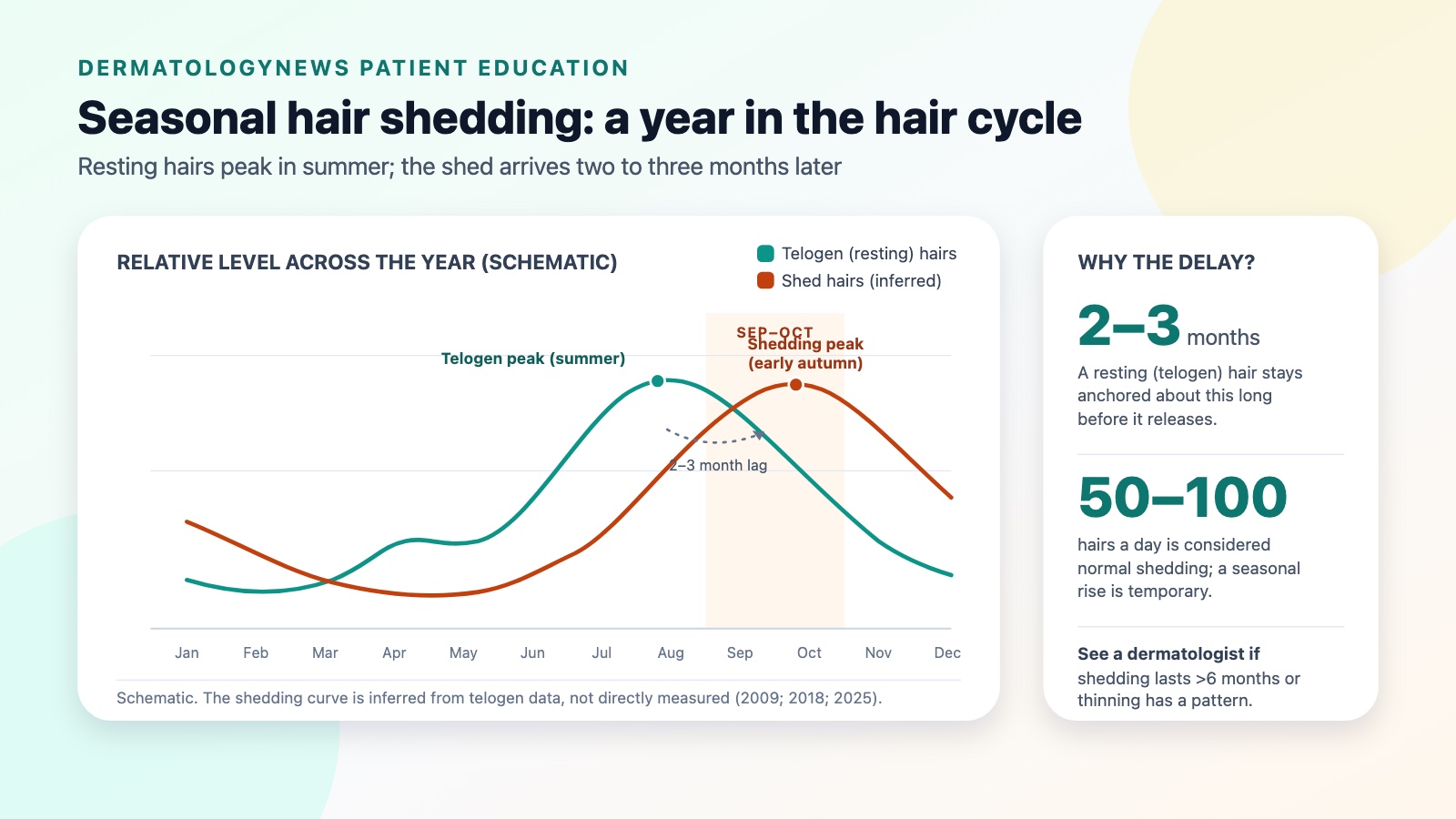
Seasonal hair shedding is a temporary rise in daily hair fall that follows an annual rhythm, and in the Northern Hemisphere it is most noticeable in early autumn. The pattern has a biological basis: a retrospective analysis of trichograms from 823 healthy women, collected over a six-year period, found the proportion of hairs in the resting telogen phase peaks in summer [1]. Because a telogen hair typically stays anchored for about two to three months before it releases, a summer telogen peak points to shedding that rises in September and October, an inference from the hair cycle rather than a directly measured hair count [1][6]. Population search data mirror the rhythm, with interest in hair loss climbing in summer and early autumn year after year [2]. For most people the change is modest, self-limited, and needs no treatment. The practical task is telling this benign cycle apart from hair loss that will not recover on its own, such as pattern hair loss or disease-related telogen effluvium [4][5].
What seasonal hair shedding is
Human scalp hairs cycle independently through a long growth phase (anagen), a brief transition, and a resting phase (telogen) that ends when the hair releases and a new one grows in its place. Telogen effluvium is the umbrella term for diffuse shedding caused by an abnormally synchronized release of telogen hairs, and dermatologists classify seasonal shedding among its mildest, physiological forms: many follicles reach the end of their resting phase together, and the shed becomes noticeable [4].
Shedding of roughly 50 to 100 hairs a day is considered normal, and short-lived shedding above a person's usual baseline is common after triggers such as illness, childbirth, weight loss, or a change of season [6]. What distinguishes seasonal shedding is its timing: it recurs at the same point in the year and settles without intervention [1][4].
The evidence for an autumn peak
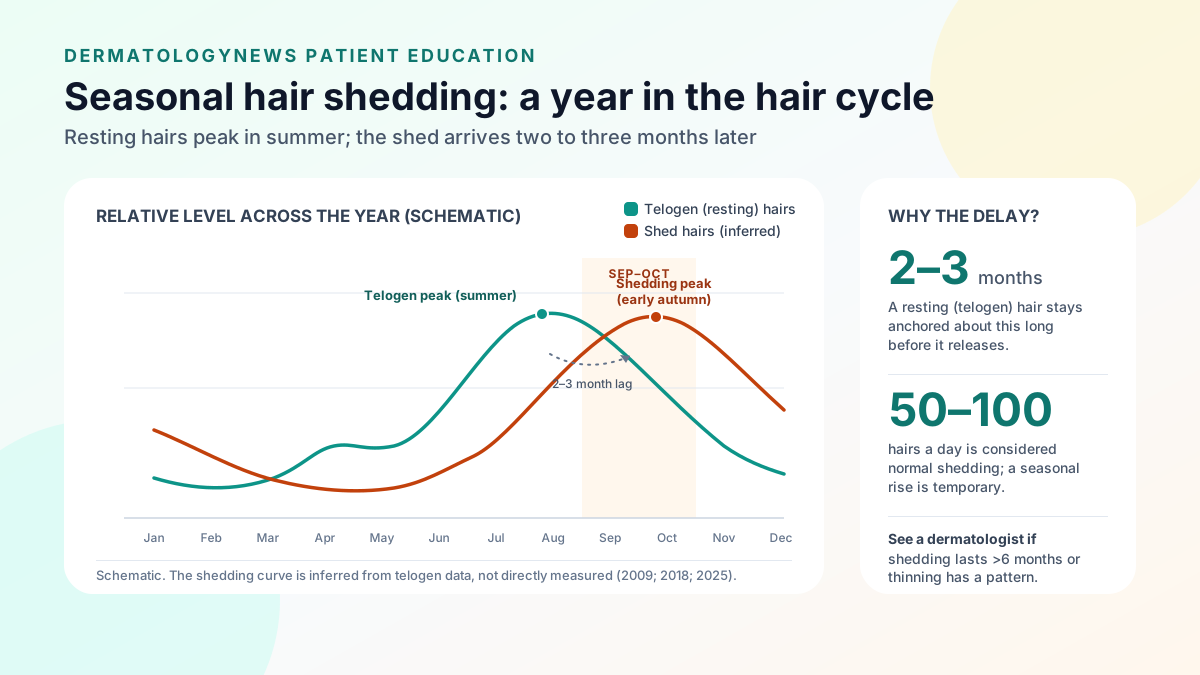
The most direct data come from trichograms, microscopic counts of plucked hairs that measure how many follicles are resting. In the Zurich analysis of trichograms from 823 otherwise healthy women, accumulated over six years, the telogen fraction was highest in summer, showed a second smaller rise in spring, and was lowest in late winter [1]. Because telogen typically lasts about two to three months, a summer telogen peak is consistent with hair fall rising in early autumn; the study measured resting hairs rather than counting shed hairs, so the exact timing and size of the autumn shed are inferred from the hair cycle, not directly measured [1][6].
Search behavior points the same way. A time-series analysis of 12 years of Google Trends data reported significant seasonal periodicity in hair-loss searches, with interest greatest in summer and autumn and lowest in winter [2]. A 2025 analysis extended the question to Southern Hemisphere countries and again found seasonal patterning in hair-loss searches, consistent with a rhythm that tracks local seasons rather than the calendar [3]. Search interest is an indirect measure, but its agreement with the trichogram data across hemispheres supports a real biological cycle [1][2][3].
Why the cycle exists is not settled. Proposed explanations include day-length effects on the hair cycle and an evolutionary remnant of seasonal coat change in mammals, but no mechanism has been confirmed in humans [1][4].
Normal shedding or something else
Seasonal shedding is a diagnosis of pattern and timing, and other causes are common. In a Swiss specialist hair-referral clinic's ten-year series of more than 15,000 patients, pattern hair loss accounted for 67 percent of diagnoses at that clinic, while telogen effluvium of all kinds accounted for about 7 percent [5]. Referral populations are selected, so those proportions do not describe everyone with autumn shedding, but they underline that persistent hair loss usually has a specific diagnosis worth making [5].
Signs that point away from seasonal shedding include:
- Shedding that persists beyond about six months, which fits chronic telogen effluvium or another diagnosis rather than a seasonal cycle [4].
- Thinning concentrated at the part line, crown, or temples, the signature of female pattern hair loss or male pattern hair loss, which progress without treatment.
- Round or well-demarcated bald patches, which suggest alopecia areata and warrant prompt assessment.
- A clear trigger in the preceding two to three months, such as major illness, surgery, rapid weight loss, or starting a medication [6]. For readers using GLP-1 medications, our review of GLP-1 medications and hair shedding covers that scenario in detail.
- Scalp symptoms such as scaling, redness, or itching, which point to an inflammatory scalp condition rather than a shedding cycle.
What helps
For seasonal shedding itself, the evidence supports reassurance rather than treatment: in physiological seasonal shedding the follicles remain healthy and re-enter the growth phase [1][4]. Practical measures are simple. Monthly photographs of the part line can document whether density is staying stable over time; informal counts of shed hairs vary widely from day to day and are not diagnostic.
Supplement marketing is aggressive each autumn, but starting one solely because shedding is seasonal is not supported by evidence. Persistent, heavy, or otherwise unexplained shedding warrants clinical evaluation rather than self-treatment, and any coexisting pattern hair loss can be treated on its own merits [6].
Limitations and realistic expectations
- The core dataset is observational. The trichogram study was retrospective, from a single center, and enrolled only women, so the size of the effect in men and other populations is less certain [1].
- Search data measure interest, not hairs. Google Trends analyses capture worry about hair loss, which may be amplified by media cycles, not shedding itself [2][3].
- The mechanism is unproven. Day-length and hormonal explanations remain hypotheses [1][4].
- Seasonal shedding can overlap with other diagnoses. An autumn shed can sit on top of early pattern hair loss, and only an examination distinguishes them [5].
- The exact course is not established. Studies measured resting-hair proportions, not how long the shed lasts; expect a gradual settling, and have shedding that persists or keeps worsening assessed [1][4].
Bottom line
Autumn hair shedding is a real, well-documented rhythm: resting-phase hairs peak in summer and release two to three months later, and search data from both hemispheres trace the same annual curve [1][2][3]. For most people it is a temporary, self-correcting process that needs monitoring rather than treatment. Shedding that lasts beyond six months, thinning in a defined pattern, bald patches, or scalp symptoms are the signals that the problem is not the season, and those deserve a board-certified dermatologist's assessment [4][5].
Common questions
- Is autumn hair shedding real or a myth?
- It is a documented pattern. An analysis of six years of trichogram records from 823 women found the share of hairs in the resting telogen phase peaks in summer, and because telogen hairs typically release two to three months later, shedding is expected to rise in early autumn. Google search analyses in both hemispheres show a matching seasonal cycle.
- How much daily hair shedding is normal?
- Shedding of roughly 50 to 100 hairs a day is considered normal, and a seasonal rise means somewhat more than your usual baseline for a few weeks. Shedding that persists beyond about six months, or thinning concentrated at the part line or crown, deserves a dermatologist's assessment.
- Does seasonal shedding lead to baldness?
- Seasonal shedding itself is not expected to cause baldness: it is a synchronized release of resting hairs from follicles that remain healthy and re-enter the growth phase. Persistent loss of density is a different matter, because it can indicate a coexisting condition such as pattern hair loss, so progressive or patterned thinning should be evaluated.
- Should I take supplements for autumn hair loss?
- Not on the basis of the season alone. Seasonal shedding is expected to settle without treatment, and no supplement has been shown to shorten it. Persistent or heavy shedding is a reason for clinical assessment, where a dermatologist can look for treatable contributors, rather than for self-treatment.
- How long does seasonal shedding last?
- A precise duration has not been established in studies, which measured resting-hair proportions rather than tracking the shed itself. The pattern implies a rise over several weeks that eases as follicles cycle back into growth. If daily shedding remains clearly elevated past about six months, that fits chronic telogen effluvium or another diagnosis rather than a seasonal rhythm.
References
- Kunz M, Seifert B, Trüeb RM. Seasonality of hair shedding in healthy women complaining of hair loss. — Dermatology, 2009 · PMID: 19407435 · DOI: 10.1159/000216832
- Hsiang EY, Semenov YR, Aguh C, Kwatra SG. Seasonality of hair loss: a time series analysis of Google Trends data 2004-2016. — British Journal of Dermatology, 2018 · PMID: 29048738 · DOI: 10.1111/bjd.16075
- McMullen E, Berkowitz J, Berkowitz M, Donovan J. Seasonal trends of hair loss in the Southern Hemisphere: an analysis of Google search patterns. — International Journal of Dermatology, 2025 · PMID: 40116230 · DOI: 10.1111/ijd.17744
- Rebora A. Proposing a simpler classification of telogen effluvium. — Skin Appendage Disorders, 2016 · PMID: 27843920 · DOI: 10.1159/000446118
- Caballero Uribe N, Casañas-Quintana E, Trüeb RM. Frequency of types of alopecia in a single-centre hair referral clinic over a ten years period. — International Journal of Trichology, 2025 · PMID: 40654548 · DOI: 10.4103/ijt.ijt_57_24
- American Academy of Dermatology. Do you have hair loss or hair shedding? — American Academy of Dermatology patient guidance