MFU-V (Ultherapy): Evidence, Safety, and Limits
MFU-V means microfocused ultrasound with visualization in aesthetic medicine. Review skin-tightening results, safety, timelines, and patient selection.
MFU-V means microfocused ultrasound with visualization; Ultherapy is the commercial platform reviewed here. It delivers focused ultrasound at selected tissue depths while the operator views the target layer. Clinical evidence supports gradual improvement in mild-to-moderate laxity, but results vary, are assessed over months rather than immediately, and do not establish superiority over monopolar radiofrequency [1][3][4].
How MFU-V works
MFU-V uses transducers that emit ultrasound energy focused at specific depths beneath the skin surface — typically 1.5, 3.0, and 4.5 mm — while a real-time imaging mode (DeepSEE) allows the operator to visualize the tissue layers being treated and confirm appropriate placement [6]. At the focal point, the absorbed energy generates a small, controlled thermal coagulation zone. Surrounding tissue is not destroyed; instead, the wound-healing response recruits fibroblasts to the coagulation zones, where new type I and III collagen and elastin are produced over the following months [1][2].
Importantly, the epidermal barrier is preserved. A 24-week biophysical evaluation in 22 women treated with MFU-V at the jawline and submentum showed no significant change in transepidermal water loss, hydration, or erythema, and skin temperature remained within physiologic range three days after treatment [4]. The same study documented a significant increase in measured skin elasticity at weeks 12 and 24 compared with baseline.
Expected timeline
The clinical evidence consistently describes a delayed onset and a gradual build of effect:
- 0–14 days: transient edema and tenderness can occur; objective measures of laxity may show no improvement in this window.
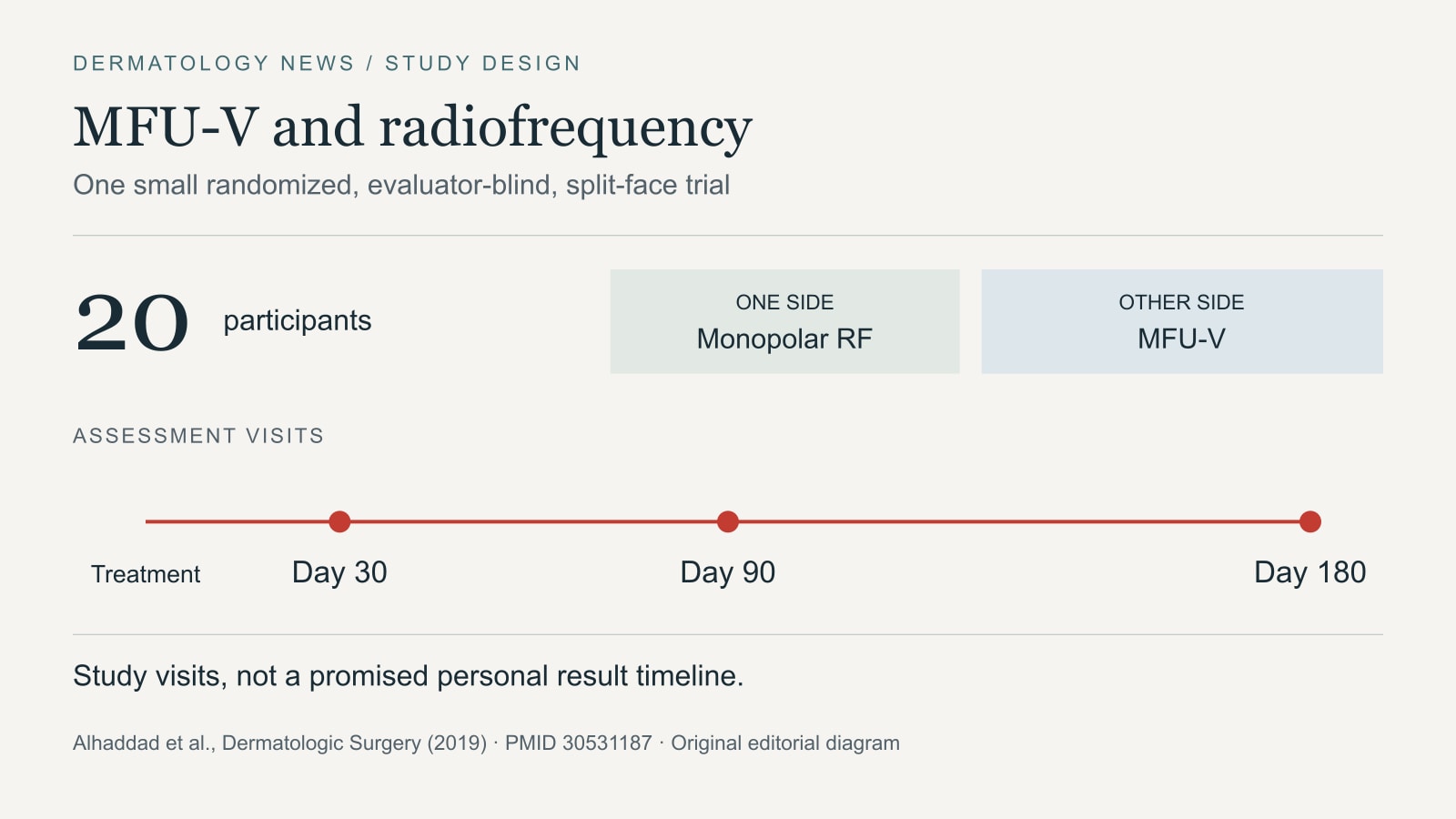
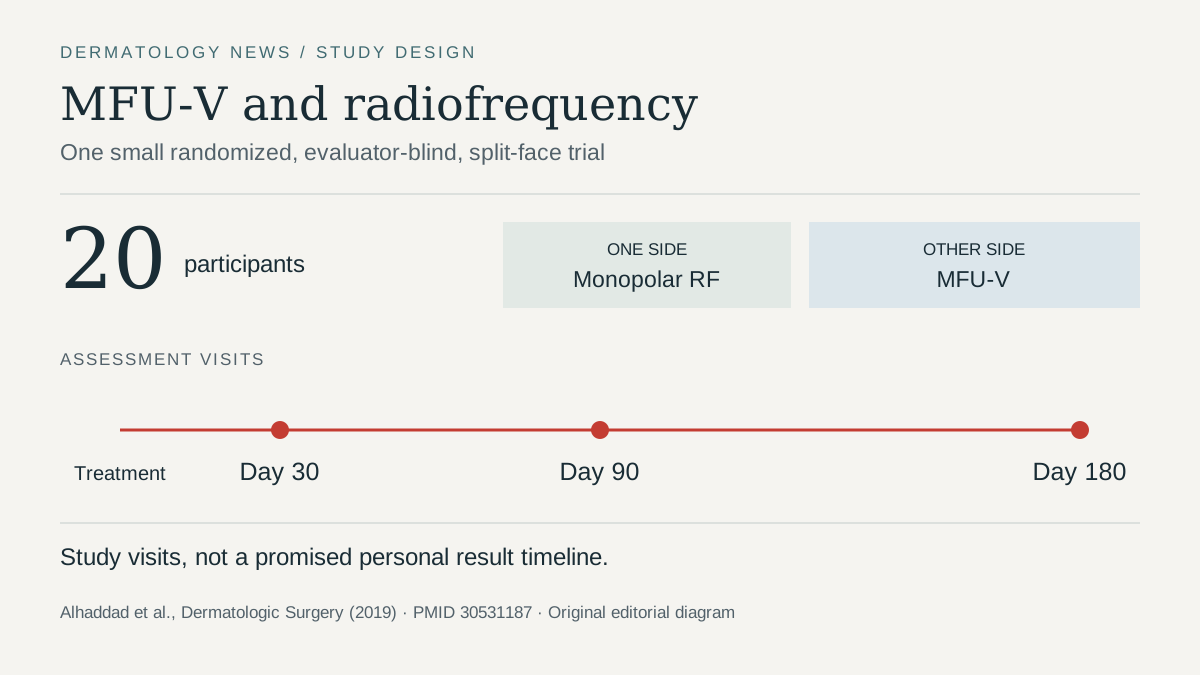
- 30 days: the 20-person split-face trial used this as an early assessment point [3].
- 90 days: the same trial used this as an intermediate assessment point [3].
- 180 days: the split-face trial's final follow-up and the 22-person physiology study's approximate 24-week endpoint fall here [3][4].
- 48 weeks and beyond: some combination evaluations report later outcomes, but these do not isolate MFU-V or establish a universal duration after one session [2].
These are research checkpoints, not a fixed timetable for an individual. Published studies generally assess gradual change over months rather than an immediate endpoint.
Comparative evidence with monopolar radiofrequency
For a deeper look at monopolar radiofrequency, see our companion article on Thermage and monopolar RF skin tightening.
A randomized, split-face, evaluator-blind trial of 20 subjects compared monopolar radiofrequency (MRF) on one side of the face with MFU-V on the other and followed subjects for six months [3]. Both modalities produced significant improvement on the Fasil Face and Neck Laxity Rating scale at days 30, 90, and 180. Subject-reported Global Aesthetic Improvement Scale scores were similarly favorable on both sides. The investigators did not find a statistically significant difference between the two devices on standardized investigator measures of laxity, patient satisfaction, or adverse events. This small trial did not establish an overall winner, but it also did not prove equivalence between every current device, setting, anatomy, or protocol. A treatment decision still requires an assessment of the concern, anatomy, exact platform, planned settings, material risks, and alternatives [3].
Adverse events and limitations
Across the 67-study narrative review of MFU-V published in 2025, adverse events were generally described as rare and transient [2]. Reported events include:
- Procedural pain during treatment, which is typically managed with topical anesthesia and titration of energy settings.
- Erythema and edema in the hours to days after treatment, which resolve without intervention.
- Transient bruising along the treatment zone.
- Rare reports of transient sensory changes (numbness or paresthesia) and, very rarely, temporary motor weakness when treatment is delivered too close to motor nerve branches — a recognized risk that is mitigated by appropriate visualization, depth selection, and operator training [2][6].
Limitations of the current evidence base are important to acknowledge. Many published studies are sponsored by the device manufacturer, sample sizes are often modest, and standardized outcome scales vary across trials. The Pan-Asian expert consensus explicitly notes that the proliferation of marketing claims around microfocused ultrasound technology has outpaced rigorous comparative evidence in some markets, and recommends patient selection and device choice based on peer-reviewed data rather than marketing assertions [6].
Patient selection
The Korean treatment protocol published in 2023 and the Pan-Asian expert consensus describe the following considerations [5][6]:
- Appropriate candidates: patients with mild-to-moderate skin laxity and adequate dermal thickness; Fitzpatrick skin types I–VI have been treated, with appropriate parameter selection.
- Less optimal candidates: patients with very advanced laxity who would be better served by surgical options; patients with substantial volume loss who may require combined approaches such as biostimulators or filler in addition to MFU-V.
- Contraindications and cautions: active skin infection in the treatment area, severe acne, history of keloid or hypertrophic scarring at facial sites, implanted devices in the treatment field, and pregnancy (where data is limited) are commonly cited reasons to defer or modify treatment.
How MFU-V fits into a broader plan
The 2025 skin-quality narrative review evaluated MFU-V alone and in combination with fillers and neuromodulators across four emergent perceptual categories of skin quality — firmness, surface evenness, tone evenness, and glow [2]. Firmness was the most consistently supported outcome (52 of 67 studies), while effects on tone evenness and glow were supported by a smaller number of studies. Several protocols describe MFU-V as one component of a multimodal plan rather than a single-modality solution: for example, MFU-V for laxity, biostimulators for volume, and conservative use of dermal filler for contour [2][5].
Bottom line
MFU-V is a non-invasive option studied for mild-to-moderate facial laxity. One 22-person study reported elasticity changes at 12 and 24 weeks, and one 20-person split-face trial found no statistically significant overall difference from monopolar radiofrequency through 180 days [3][4]. Neither small study proves a fixed duration, device equivalence, or superiority. Adverse events are often transient in the literature, but sensory or motor-nerve effects have been reported and safe planning depends on the exact device, anatomy, settings, and operator training [2][6]. Patients should expect assessment over months rather than an immediate predetermined change and discuss whether MFU-V fits their pattern of laxity with a qualified clinician.
Common questions
- How long until I see results after an MFU-V session?
- Published studies commonly assess change at 30, 90, and 180 days, rather than promising an immediate result. Those are study checkpoints, not a fixed personal timeline [3][4].
- Is MFU-V painful?
- Procedural discomfort during treatment is the most consistently reported issue and is typically managed with topical anesthesia and titration of energy settings. Newer devices offer parameter adjustments intended to improve tolerability.
- How is MFU-V different from HIFU devices marketed for the face?
- The Ulthera System has indication-specific FDA 510(k) clearances and includes real-time visualization (DeepSEE) to help confirm the tissue layer being treated. Other devices marketed as HIFU require exact-model checks of their imaging features, regulatory records, and directly applicable evidence.
- Are MFU-V results long-lasting?
- A 22-person study documented elasticity changes at 12 and 24 weeks, while the direct comparison trial followed participants for 180 days. Those studies do not establish one fixed duration or maintenance interval for every patient [3][4].
- Who is not a candidate for MFU-V?
- Patients with very advanced laxity may be better served by surgical options. Active skin infection in the treatment area, severe acne, history of keloid scarring at facial sites, implanted electronics in the field, and pregnancy are commonly cited reasons to defer or modify treatment.
References
- Vachiramon V et al. Microfocused Ultrasound in Regenerative Aesthetics: A Narrative Review on Mechanisms of Action and Clinical Outcomes. — Journal of Cosmetic Dermatology, 2024 · PMID: 39501429 · DOI: 10.1111/jocd.16658
- Pavicic T et al. Microfocused Ultrasound With Visualization in Skin Quality: A Narrative Review (67 studies). — Journal of Cosmetic Dermatology, 2025 · PMID: 40847904 · DOI: 10.1111/jocd.70364
- Alhaddad M et al. Randomized split-face trial comparing monopolar radiofrequency vs MFU-V. — Dermatologic Surgery, 2019 · PMID: 30531187 · DOI: 10.1097/DSS.0000000000001653
- Kerscher M et al. Skin physiology and safety of MFU-V for improving skin laxity (24-week follow-up). — Clinical, Cosmetic and Investigational Dermatology, 2019 · PMID: 30666145 · DOI: 10.2147/CCID.S188586
- Park JY et al. Treatment protocol for using MFU-V for skin quality improvement: the Korean experience. — Plastic and Reconstructive Surgery — Global Open, 2023 · PMID: 37250837 · DOI: 10.1097/GOX.0000000000005029
- Park JY et al. Customized Treatment Using MFU-V for Optimized Patient Outcomes: Pan-Asian Expert Panel Consensus. — Journal of Clinical and Aesthetic Dermatology, 2021 · PMID: 34188753
- FDA Premarket Notification — Ulthera System (510(k)) — U.S. Food and Drug Administration