Thermage (monopolar RF) skin tightening: 2026 evidence
Mechanism, timeline, comparator data vs MFU-V, adverse events, and patient selection for monopolar radiofrequency facial tightening.

Monopolar radiofrequency (MRF), most widely known by the brand name Thermage, has been a workhorse non-invasive option for mild-to-moderate facial laxity for over two decades. The technology delivers volumetric heating to the dermis and subcutaneous tissue through a capacitive-coupled tip, triggering immediate collagen contraction and a slower neocollagenesis response over months. The current platform (Thermage FLX) uses AccuREP impedance feedback to adjust energy delivery to the patient's tissue impedance — a refinement intended to deliver more uniform heating and a more tolerable treatment experience compared with earlier generations.
Mechanism
A monopolar radiofrequency device generates an oscillating electric field between the tip electrode and a return pad on the patient's body. As current flows through tissue, resistive heating raises the temperature of the deep dermis and underlying subcutaneous tissue to approximately 60–75°C at the treatment focus. This thermal load:
- Causes immediate contraction of existing collagen triple helices.
- Triggers a controlled wound-healing response in fibroblasts.
- Drives neocollagenesis (type I and III collagen) and elastin remodeling over the following 3 to 6 months [3].
The latest device generation incorporates real-time impedance measurement (AccuREP) to adjust pulse parameters automatically to each shot, intended to standardize energy delivery across patients with different tissue properties.
Expected timeline
The clinical literature describes a two-phase response:
- Day 0: modest immediate skin contraction visible at treatment, attributable to collagen denaturation.
- Day 30: measurable improvement in laxity grading begins to appear on standardized scales [2].
- Day 90: more visible lift and contour refinement as neocollagenesis matures.
- Day 180: the primary endpoint in most randomized trials; outcomes assessed here are reasonably durable [2].
- 12 months and beyond: sustained outcomes reported in long-term follow-up studies, though gradual age-related laxity progression continues independent of the treatment [1].
Patients should be counseled that the meaningful change unfolds over 3 to 6 months, not in the days immediately after a session.
Comparative evidence with MFU-V
For a deeper review of microfocused ultrasound, see our companion article on MFU-V (Ultherapy) skin tightening.
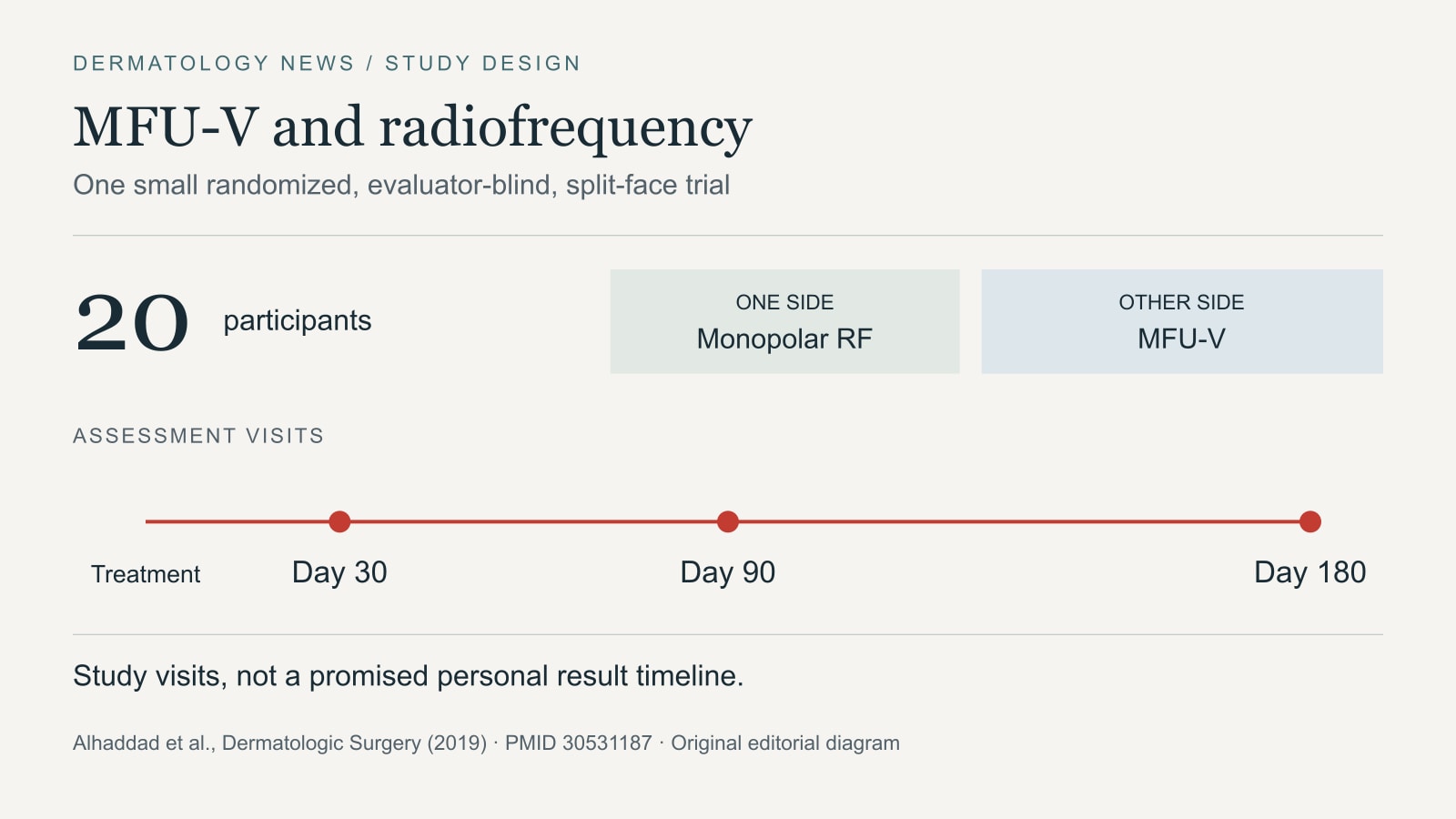
The most informative comparison between monopolar radiofrequency and microfocused ultrasound is a randomized, split-face, evaluator-blind clinical trial that enrolled 20 subjects with mild-to-moderate facial laxity [2]. Each subject received MFU-V on one side of the face and monopolar radiofrequency on the other at a single session, and was followed for six months.
Key findings:
- Both modalities produced statistically significant improvements in the Fasil Face and Neck Laxity Rating scale at day 30, day 90, and day 180.
- The Global Aesthetic Improvement Scale (GAIS) showed comparable subject-reported improvement on both treated sides.
- No statistically significant difference was found between MRF and MFU-V on standardized investigator measures of laxity.
- No statistically significant difference in patient satisfaction or in adverse event rates.
The reasonable clinical interpretation is that MRF and MFU-V are both supported by the evidence for mild-to-moderate laxity, and that device choice should be based on anatomic pattern of laxity, depth of intended treatment, operator experience, and patient preference rather than on assumed superiority of one device over the other. A combined or sequenced approach is also used in clinical practice for patients with both laxity and dermal-quality concerns [2].
Recent device evidence
A 2025 prospective randomized controlled trial compared a novel monopolar RF platform (YOUMAGIC) with the Thermage CPT reference device for the lower face [1]. Forty subjects were randomized 1:1 and followed for six months with Antera 3D photographic assessment of nasolabial fold depression volume. Both arms produced statistically significant reductions in fold depression at 1, 3, and 6 months versus baseline, with no statistically significant difference between arms and no serious adverse events. This non-inferiority data is useful for context, though sample sizes in this class of trial remain modest.
Adverse events and limitations
Across published trials and post-market surveys, the adverse-event profile of contemporary monopolar radiofrequency is generally favorable when treatment is performed by trained operators with appropriately calibrated parameters [1][2][3]:
- Procedural discomfort: the most consistently reported issue; mitigated by topical anesthesia, intra-procedure cryogen cooling, and parameter titration. Newer platforms with vibration tips and impedance feedback report improved tolerability.
- Erythema and edema: typically resolves within hours to days after the procedure.
- Bruising: infrequent.
- Rare adverse events: subcutaneous fat atrophy, burns, post-inflammatory pigment changes (particularly in darker Fitzpatrick skin types), and very rare temporary sensory disturbances. These risks scale with energy parameters and operator technique.
A Korean dermatologist practice survey (n = 82) found 78.8% of respondents reported high satisfaction with monopolar radiofrequency outcomes, and that practice patterns coalesced around 900 shots for facial tightening in patients aged 35 to 65 [3]. This is an indicator of clinician satisfaction in a high-experience market, not a substitute for prospective trial endpoints.
Limitations worth acknowledging:
- Substantial laxity (Glogau IV / severe submental redundancy) is unlikely to be adequately addressed by monopolar radiofrequency alone; surgical options should be discussed.
- Significant facial volume loss is not the primary indication; biostimulator or filler therapy is a separate consideration.
- Outcomes vary with skin type, baseline laxity, and operator parameter selection. Marketing assertions of consistent transformative outcomes are not supported by the controlled-trial evidence base.
Patient selection
Reasonable candidates for monopolar radiofrequency include:
- Patients with mild-to-moderate facial or neck laxity.
- Patients seeking non-invasive maintenance rather than a surgical-equivalent change.
- Patients across Fitzpatrick I–VI when parameters are titrated appropriately.
Cautions or contraindications often cited in clinical practice include:
- Active local infection, severe acne, or recent ablative resurfacing in the treatment area.
- Pacemakers, implanted cardioverter-defibrillators, or other implanted electronics (because the device delivers radiofrequency current through tissue).
- Pregnancy (data limited).
- History of keloid or hypertrophic scarring at facial sites (relative caution).
- Patients with unrealistic outcome expectations — addressed during informed consent rather than at the device.
How MRF fits into a broader plan
Energy-based tightening is one tool in a broader aesthetic plan. Patients with combined laxity and volume loss are often best served by a sequenced approach — for example, monopolar radiofrequency or MFU-V for laxity, biostimulators (such as poly-L-lactic acid or polynucleotide-based products) for dermal quality, and judicious filler use for contour [2]. The order and timing of these interventions are individualized and should be discussed in consultation.
Bottom line
Monopolar radiofrequency is a non-invasive option for mild-to-moderate facial laxity, supported by more than two decades of clinical use and a comparable efficacy and safety profile to MFU-V in randomized comparison [2]. Patients should expect a gradual onset over 3 to 6 months, transient post-procedural discomfort, and individualized outcomes rather than an immediate or universal response. Treatment decisions should be made with a board-certified dermatologist after appropriate assessment.
Common questions
- How long until Thermage results show?
- Modest immediate skin contraction may be visible at the session due to collagen denaturation, but meaningful improvement in laxity grading typically appears around day 30 and is more visible by day 90. Most randomized trials assess outcomes at six months.
- How does Thermage compare with MFU-V (Ultherapy)?
- A randomized split-face trial of 20 subjects found comparable improvements in face and neck laxity at six months, with no statistically significant difference in patient satisfaction or adverse events. Device choice depends on anatomy, depth of laxity, and operator experience rather than overall efficacy.
- Is Thermage painful?
- Procedural discomfort during treatment is the most consistently reported issue. Newer platforms (Thermage FLX) use impedance feedback and vibration to improve tolerability compared with earlier generations, though some discomfort during pulses is common.
- How many Thermage sessions are needed?
- A single session is the most commonly described protocol in the published literature, with maintenance sessions discussed at intervals of approximately 12 to 24 months depending on individual response. The session count should be individualized at consultation.
- Who should not get Thermage?
- Patients with active local infection, recent ablative resurfacing in the treatment area, pacemakers or implanted cardioverter-defibrillators (because radiofrequency current is delivered through tissue), pregnancy, and a history of keloid scarring at facial sites are commonly cited reasons to defer or modify treatment.
References
- Wang Z et al. Long-Term Efficacy and Safety of a Novel Monopolar Radiofrequency Device for Skin Tightening: A Prospective Randomized Controlled Study. — Lasers in Surgery and Medicine, 2025 · PMID: 39957006 · DOI: 10.1002/lsm.70002
- Alhaddad M et al. A Randomized, Split-Face, Evaluator-Blind Clinical Trial Comparing Monopolar Radiofrequency Versus MFU-V for Lifting and Tightening. — Dermatologic Surgery, 2019 · PMID: 30531187 · DOI: 10.1097/DSS.0000000000001653
- Suh DH et al. A survey on monopolar radiofrequency treatment among Korean dermatologists. — Dermatologic Therapy, 2017 · PMID: 28805286 · DOI: 10.1111/dth.12536
- FDA 510(k) Premarket Notification — Thermage System (Solta Medical) — U.S. Food and Drug Administration
- American Society for Dermatologic Surgery — Skin Tightening Patient Resource — American Society for Dermatologic Surgery