Keratosis pilaris: what the evidence actually supports
The rough bumps on upper arms and thighs are common and harmless. What trials show about keratolytics, lasers, and intense pulsed light, and why recurrence is the expected outcome.
Keratosis pilaris is a common, benign disorder of follicular keratinization: small rough papules with a variable ring of redness, on the extensor surfaces of the upper arms, the thighs, and the buttocks. It is usually asymptomatic, and the reason people seek treatment is appearance rather than illness [1]. The evidence for treating it is thinner than the volume of products marketed for it suggests. A review of intervention studies found no systematic reviews of its management in the literature and concluded that lactic acid, salicylic acid, and the 1064-nm Nd:YAG laser were the options with the most supporting evidence in patients aged 12 and older, while noting that high-quality randomized trials with long-term outcomes were still needed [1].
What it is
Keratin builds up at the follicular opening, producing a papule that feels rough to the touch, frequently surrounded by perifollicular erythema. The diagnosis is clinical, made by appearance and distribution, and it is usually asymptomatic, though some patients report mild itch alongside the cosmetic concern [1][6].
The condition is chronic and has two visually distinct components: the rough keratotic papule and the surrounding redness. Treatments do not affect them equally.
What dermatologists actually use
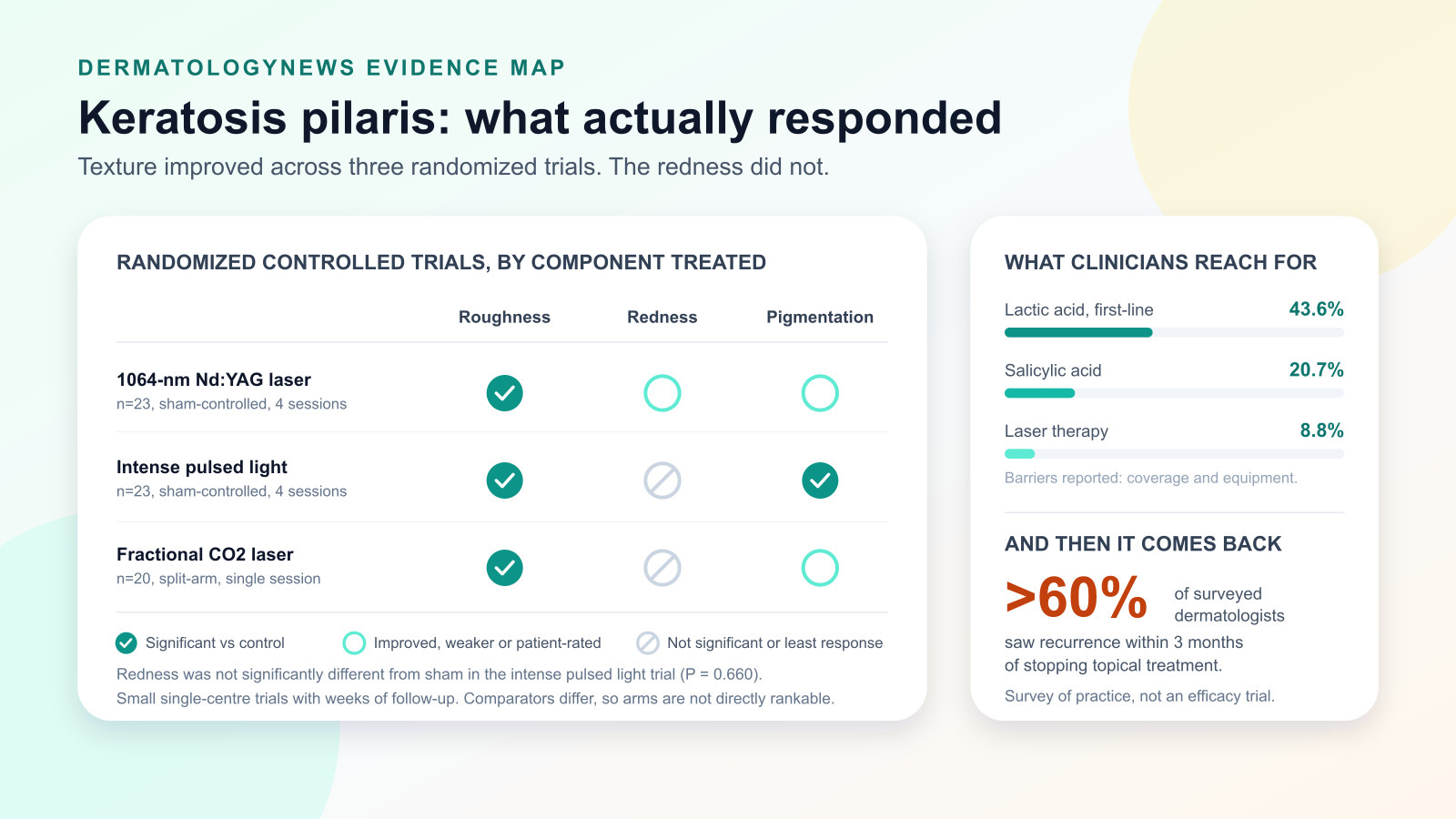
A survey distributed to a random sample of a dermatology conference listserv asked which topical treatments dermatologists reach for and how effective they judged them. Topical lactic acid was the most common first-line choice, reported by 43.6 percent of respondents, followed by salicylic acid at 20.7 percent. Laser therapy was used by 8.8 percent, with lack of insurance coverage and lack of equipment cited as limiting factors [6].
The same survey captured the durability problem plainly: over 60 percent of respondents reported recurrence of lesions within three months of stopping salicylic acid or over-the-counter moisturizer treatment [6]. This is a survey of practice and perceived effectiveness, not a trial of efficacy, and it should be read as a description of what clinicians do rather than as evidence of what works.
What the device trials show
Three randomized trials assessed different outcomes.
- 1064-nm Nd:YAG laser. In a randomized, double-blind, sham-irradiation-controlled trial, 23 Thai patients with untreated keratosis pilaris on the upper outer arms had one arm divided into upper and lower parts, with one part randomized to laser and the other to sham irradiation. After four treatments at four-week intervals, skin roughness measured by an imaging device was significantly reduced compared with control (P < 0.001), and patient-graded improvement in roughness, erythema, hyperpigmentation, and overall appearance was significant. No adverse events including burning, blistering, erosion, pigmentary change, or scarring occurred [2].
- Intense pulsed light. The same group ran an equivalent design in 24 patients, 23 completing. Skin roughness again improved significantly versus sham (P < 0.001). Skin erythema, however, did not differ significantly between treated and control skin (P = 0.660). Hyperpigmentation significantly increased in the control portion relative to the treated portion (P = 0.01), and no adverse events were reported [3].
- Fractional carbon dioxide laser. In a single-blind randomized intraindividual study, 20 adults received a single session to one arm with the contralateral arm as control. At 12 weeks, 30 percent of lesions on the treated side showed moderate to good improvement on blinded physician global assessment (P = 0.02). Keratotic papules and hyperpigmentation appeared to respond better than the erythematous component. Four patients with Fitzpatrick skin type V developed transient pigmentary alteration [4].
| Trial | Main measured improvement | Redness findings |
|---|---|---|
| Nd:YAG laser | Reduced imaging-measured roughness versus sham [2] | Patient-rated erythema improved [2] |
| Intense pulsed light | Reduced imaging-measured roughness versus sham [3] | No significant difference versus sham [3] |
| Fractional CO₂ laser | Improved physician-rated global appearance; roughness could not be assessed from photographs [4] | Less responsive than papules and pigmentation [4] |
A larger comparative study of 60 patients tested fractional carbon dioxide laser against topical 10 percent urea on the opposite side, treating arms and thighs across two sessions four weeks apart. On the arms, blinded assessment recorded excellent improvement in 33.3 percent, good in 60 percent, and moderate in 6.7 percent of patients at the second visit; thigh lesions improved less. Control sides treated with urea showed minimal improvement on arm lesions only, no side effects were reported, and patient satisfaction was significantly higher on the laser-treated arm (P < 0.001) [5].
Nd:YAG and IPL trials measured improvements in roughness; the fractional CO₂ trial found improved physician-rated global appearance. Redness responded less consistently than other assessed features [2][3][4].
Adverse events, limitations, and realistic expectations
- Every trial is small. The randomized studies enrolled 20 to 60 patients each, at single centres, with follow-up measured in weeks rather than years [2][3][4][5]. The intervention review that surveyed this literature explicitly called for high-quality randomized trials with long-term outcomes [1].
- Recurrence is the expected outcome. No treatment discussed here is curative, and the practice survey found most respondents observing recurrence within three months of stopping topical treatment [1][6].
- The redness responds least. In the intense pulsed light trial the erythema difference was not statistically significant, and the fractional carbon dioxide study observed better response in papules and pigmentation than in the erythematous component [3][4].
- Pigmentary risk in darker skin is real. Four of the patients in the fractional carbon dioxide study, all Fitzpatrick type V, developed transient pigmentary alteration, and the authors advised particular caution in darker-skinned patients [4]. Laser treatment of acne scars also requires settings adapted to skin tone.
- Comparators differ between studies. Sham irradiation, untreated control skin, and topical urea are not equivalent comparators, which limits how directly these trials can be ranked against each other [2][3][4][5].
- Access shapes practice. Fewer than one in ten surveyed dermatologists used laser therapy, and the barriers reported were coverage and equipment rather than efficacy judgements [6].
- This is a cosmetic decision about a benign condition. Keratosis pilaris does not threaten health, and choosing no treatment is a reasonable option.
When it might be something else
Rough follicular bumps have a short differential. Persistent inflamed papules and pustules in the same distribution may be folliculitis rather than keratosis pilaris. Scaly, itchy patches on the arms and legs in dry weather may be eczema or simple xerosis, which respond to barrier care rather than keratolytics; skin-barrier care can help. Redness concentrated on the cheeks and central face can indicate rosacea. A clinician can distinguish these on examination.
Bottom line
Keratosis pilaris is benign, common, and chronic, and the published intervention literature is small. Lactic acid, salicylic acid, and the 1064-nm Nd:YAG laser carry the most supporting evidence, according to a review that found no systematic review of the condition's management in the literature [1]. Nd:YAG and IPL trials measured improvements in roughness; the fractional CO₂ trial found improved physician-rated global appearance. Redness responded less consistently [2][3][4]. Recurrence within months of stopping treatment is the pattern most surveyed dermatologists report [6]. A reasonable expectation is smoother skin while a routine continues, not resolution, and for a harmless condition that expectation is worth setting before any device is considered.
Common questions
- What causes keratosis pilaris?
- It is a disorder of follicular keratinization: keratin accumulates at the opening of the hair follicle, producing a small rough papule, often with a ring of redness around it. It typically affects the extensor surfaces of the upper arms, the upper legs, and the buttocks. It is benign and usually causes no symptoms, though some people report mild itch.
- Can keratosis pilaris be cured?
- No treatment currently available is curative. In a survey of dermatologists, over 60 percent reported that lesions recurred within three months of stopping salicylic acid or over-the-counter moisturizer treatment. The realistic goal is reducing roughness and appearance while treatment continues, not permanent clearance.
- Which topical treatment do dermatologists use most?
- In a survey of dermatologists, topical lactic acid was the most commonly used first-line treatment, reported by 43.6 percent of respondents, followed by salicylic acid at 20.7 percent. A review of intervention studies concluded that lactic acid, salicylic acid, and the 1064-nm Nd:YAG laser were the options with the most supporting evidence in patients aged 12 and older.
- Do lasers work for the redness?
- Less well than for the roughness. Nd:YAG and IPL trials measured improvements in roughness; the fractional CO₂ trial found improved physician-rated global appearance. In an intense pulsed light trial, the reduction in skin erythema was not significantly different between treated and sham-treated skin, and a fractional carbon dioxide laser study reported that keratotic papules and pigmentation appeared to respond better than the erythematous component.
- Is it safe to treat with lasers in darker skin?
- It requires caution. In one fractional carbon dioxide laser study, four patients with Fitzpatrick skin type V developed transient pigmentary alteration, and the authors concluded that patients with darker skin should be treated with particular care. Device settings and operator experience matter here more than the choice of device category.
- Does it get worse in cold weather?
- Many patients describe more noticeable bumps in dry, cold months, and the condition is associated with dry skin generally. Seasonal variation has not been established by the cited intervention studies.
References
- Suástegui-Rodríguez I, Camacho-Rosas LH, Peralta-Pedrero ML, Jurado-Santa Cruz F, Morales-Sánchez MA. Keratosis pilaris treatment: evidence from intervention studies. — Skinmed, 2022 · PMID: 35976015
- Maitriwong P, Tangkijngamvong N, Asawanonda P. Innovative 1064-nm Nd:YAG laser significantly improves keratosis pilaris: a randomized, double-blind, sham-irradiation-controlled trial. — Lasers in Surgery and Medicine, 2020 · PMID: 31713266 · DOI: 10.1002/lsm.23184
- Maitriwong P, Tangkijngamvong N, Asawanonda P. Intense pulsed-light therapy significantly improves keratosis pilaris: a randomized, double-blind, sham irradiation-controlled trial. — Journal of Clinical and Aesthetic Dermatology, 2019 · PMID: 32038750
- Vachiramon V, Anusaksathien P, Kanokrungsee S, Chanprapaph K. Fractional carbon dioxide laser for keratosis pilaris: a single-blind, randomized, comparative study. — BioMed Research International, 2016 · PMID: 27247936 · DOI: 10.1155/2016/1928540
- Ismail S, Omar SS. Clinical and dermoscopic evaluation of fractional carbon dioxide laser in management of keratosis pilaris in Egyptian type skin. — Journal of Cosmetic Dermatology, 2020 · PMID: 31523919 · DOI: 10.1111/jocd.13140
- Greenzaid J, Nussbaum D, Friedman A. Keratosis pilaris: treatment practices of board-certified dermatologists. — Journal of Drugs in Dermatology, 2023 · PMID: 37801530 · DOI: 10.36849/JDD.7534
Related articles
Ablative fractional CO2 laser for acne scars: 2026 evidence
Cutaneous warts: what actually works for verrucae