Ablative fractional CO2 laser for acne scars: 2026 evidence
Mechanism, efficacy data, downtime, and the post-inflammatory hyperpigmentation risk that dominates ablative fractional CO2 resurfacing for atrophic acne scars, with a focus on darker and Asian skin.
Ablative fractional carbon dioxide (CO2) laser resurfacing is widely described in the dermatology literature as a well-established energy-based treatment for atrophic acne scars, which make up an estimated 80–90% of all acne scarring [4]. It pairs the fractional photothermolysis concept with an ablative 10,600-nm wavelength: instead of resurfacing the entire surface, it drills microscopic columns of controlled thermal injury separated by untreated skin, which shortens recovery relative to fully ablative resurfacing while still driving dermal remodeling [1].
At a glance
- What it treats: Atrophic acne scars (rolling, boxcar, and ice-pick, usually in combination), which are 80–90% of acne scars [4].
- Typical protocol: 1–3 sessions at monthly intervals; three sessions outperformed fewer in an Asian cohort [2].
- Evidence base: A systematic review of 30 studies (18 prospective randomized trials) supports efficacy; parameters must be customized per patient [1].
- Main limitation: Post-inflammatory hyperpigmentation, reported in up to ~73% in one Asian series and lasting >3 months in ~32% [2].
- Downtime: Several days of crusting/erythema; residual redness can persist beyond three months in a minority [2].
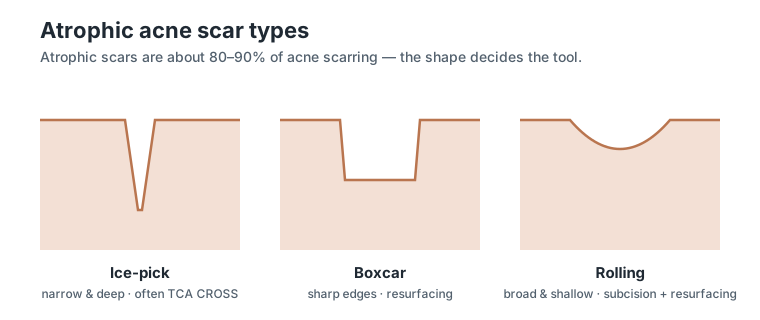
Atrophic scars make up most acne scarring, and shape guides device selection: ice-pick scars often need TCA CROSS, boxcar and rolling scars respond to resurfacing, and tethered rolling scars add subcision.
Mechanism
A fractional CO2 laser emits a 10,600-nm beam that is strongly absorbed by tissue water. Delivered fractionally, it creates arrays of microthermal treatment zones, or narrow columns of vaporized and thermally coagulated tissue, surrounded by intact skin that serves as a reservoir for rapid re-epithelialization. Each zone triggers a wound-healing cascade: fibroblast activation, neocollagenesis, and dermal matrix remodeling that reorganizes scar collagen over the following weeks to months [1]. Because only a fraction of the surface is ablated per pass, recovery is faster and the complication profile is lower than traditional fully ablative CO2 resurfacing [3].
What the evidence shows
The most comprehensive synthesis is a systematic review of 30 studies (12 retrospective, 18 prospective randomized trials) spanning three decades, which concluded that ablative fractional CO2 laser is an effective therapy for acne scars, that treatment sessions, intervals, and parameters should be customized to each patient, and that combination therapy should be considered for ice-pick scars [1].
Quantitatively, controlled and cohort data report meaningful but partial improvement rather than erasure:
- In an Asian retrospective cohort (Fitzpatrick III–IV), mean ECCA acne-scar scores fell from 102.70 to 87.28 after treatment (p ≤ 0.001), and three sessions were associated with better outcomes than fewer [2].
- In a Singapore series of 107 Asian patients (210 treatments), most reported modest texture improvement: about 66% in the under 25% improvement band and 30% in the 25–50% band. This shows that ablative fractional CO2 is an incremental, multi-session treatment, not a one-visit fix [3].
The dominant issue on darker and Asian skin: PIH
For patients with Fitzpatrick III–VI skin, including most Korean and many international patients seen in Seoul, post-inflammatory hyperpigmentation is the risk that governs how aggressively the device can be used. The published Asian data make the trade-off explicit:
- In the Fitzpatrick III–IV cohort, PIH affected 73.17% of patients and lasted longer than three months in 31.71%; erythema occurred in all patients and persisted beyond three months in about 20%; post-laser scars occurred in 2.44% [2].
- In the Singapore series treated with more conservative settings, total adverse events were 15%, with PIH in 6.4%, blistering 4.0%, and crusting 2.9% [3].
The practical reading: on darker skin, conservative energy and density, fewer passes, strict photoprotection, and a lower threshold for combination or gentler modalities matter more than chasing maximal single-session ablation. Pigment risk, not efficacy, is usually the limiting factor.
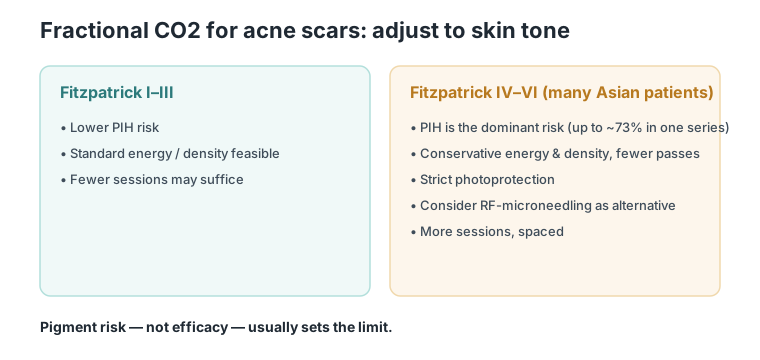
On darker phototypes, pigment risk rather than efficacy usually sets the ceiling on how aggressively fractional CO2 can be used.
Combination and adjuvant strategies
Because ablative fractional CO2 is effective but pigment- and downtime-limited, much of the recent evidence tests adjuvants that either boost remodeling or blunt the inflammatory aftermath:
- Platelet-rich plasma (PRP): A meta-analysis of 11 randomized trials (313 participants) found that adding PRP to ablative fractional CO2 laser significantly improved clinical response versus laser alone (odds ratio 2.56, 95% CI 1.37–4.78) and patient satisfaction (OR 3.38) [4].
- Hyaluronic acid dressing: A meta-analysis of 6 studies (623 patients) found that a post-laser HA dressing lowered ECCA scores further (mean difference −3.37), shortened crust formation and removal time, and reduced the incidence of hyperpigmentation versus laser alone (risk ratio 0.37, 95% CI 0.23–0.61) [5].
- Stem cell-derived exosomes: A double-blind, randomized, split-face trial reported greater ECCA-score reduction on the exosome-treated side than control (32.5% vs 19.9%, p < 0.01), with milder erythema and shorter downtime [6].
These adjuvants share a theme relevant to darker skin: several reduce downtime and pigmentary risk rather than only adding efficacy.
How it compares with other modalities
| Approach | Best-supported role | Key trade-off |
|---|---|---|
| Ablative fractional CO2 | Broad atrophic (rolling/boxcar) resurfacing; gold-standard framing [1] | Highest downtime and PIH risk, especially on darker skin [2] |
| Microneedling / RF-microneedling | Comparable improvement to ablative fractional in most studies [7] | Lower pigment risk on darker skin; often more sessions |
| TCA CROSS / subcision | Ice-pick and tethered rolling scars [1] | Focal, technique-dependent; usually combined with resurfacing |
A systematic review comparing needling with ablative fractional lasers found no statistically significant difference in 60% of studies, with both producing significant improvement [7]. The finding reinforces that scar type, skin tone, and downtime tolerance, not a single device label, should drive the plan.
Patient selection and who should defer
Commonly cited reasons to modify, delay, or avoid ablative fractional CO2 resurfacing include active local infection or inflammatory acne in the treatment area, recent isotretinoin use per clinician judgment, a history of keloid or hypertrophic scarring, and darker skin phototypes without a conservative, pigment-aware plan [1][2]. A realistic consultation sets expectations around multiple sessions, weeks of erythema, and the specific PIH risk for the patient's skin tone.
Bottom line
Ablative fractional CO2 laser is a well-supported, effective treatment for atrophic acne scars, but the honest 2026 picture is incremental improvement across several sessions, with post-inflammatory hyperpigmentation as the dominant constraint on darker and Asian skin. Conservative parameters, photoprotection, and evidence-backed adjuncts (HA dressing, PRP, exosomes) improve the efficacy-to-downtime ratio. For a full picture of how this fits alongside subcision, TCA CROSS, microneedling RF, and fillers, see our overview of atrophic acne scar types and treatment.
Common questions
- How many fractional CO2 laser sessions do acne scars need?
- Most published protocols describe one to three sessions spaced at monthly intervals, with outcomes assessed a few months after the final session. In a retrospective Asian cohort, three sessions were associated with better outcomes than one or two [2]. The exact number should be individualized at consultation based on scar type and skin tone.
- Does fractional CO2 laser cause hyperpigmentation on darker skin?
- Post-inflammatory hyperpigmentation (PIH) is the dominant risk on Fitzpatrick III–VI skin. In one Asian series, PIH affected roughly three-quarters of patients and lasted longer than three months in about a third [2]; in another Asian retrospective, PIH occurred in about 6% with conservative settings [3]. Conservative energy, fewer passes, sun protection, and pigment-directed aftercare reduce but do not eliminate the risk.
- How long is the downtime after fractional CO2 laser?
- Expect several days of redness, swelling, and crusting or 'sandpaper' texture as the microthermal zones heal, followed by weeks of residual erythema that can last longer than three months in a minority of patients [2]. Adjuncts such as hyaluronic acid dressings have been shown to shorten crust formation and removal time [5].
- Is fractional CO2 laser better than microneedling for acne scars?
- A systematic review comparing needling with ablative fractional lasers found no statistically significant difference in most studies, with both producing meaningful improvement [7]. Device choice depends on scar type, skin tone, downtime tolerance, and operator experience rather than a clear across-the-board winner.
- Which acne scars respond best to fractional CO2 laser?
- Atrophic scars, which represent the large majority of acne scarring, respond to ablative fractional resurfacing, but ice-pick scars often need combination approaches such as TCA CROSS or subcision, while broad rolling and boxcar scars tend to respond better to resurfacing [1]. A mixed-scar face usually needs more than one modality.
References
- Xu Y, Deng Y. Ablative Fractional CO2 Laser for Facial Atrophic Acne Scars (systematic review, 30 studies). — Facial Plastic Surgery, 2018 · PMID: 29304516 · DOI: 10.1055/s-0037-1606096
- Fang F et al. Treatment of acne scars with fractional CO2 laser in Asians: predicting factors associated with efficacy (Fitzpatrick III–IV). — Lasers in Medical Science, 2022 · PMID: 35220459 · DOI: 10.1007/s10103-022-03528-w
- Ochi H et al. Treatment of Facial Acne Scarring With Fractional Carbon Dioxide Laser in Asians: efficacy and complications (retrospective, 107 patients). — Dermatologic Surgery, 2017 · PMID: 28746258 · DOI: 10.1097/DSS.0000000000001219
- Aljefri YE et al. Ablative fractional CO2 laser combined with autologous platelet-rich plasma for atrophic acne scars: systematic review and meta-analysis (11 RCTs, 313 participants). — Dermatologic Therapy, 2022 · PMID: 36183145 · DOI: 10.1111/dth.15888
- Zhang J et al. Fractional CO2 laser combined with hyaluronic acid dressing for facial atrophic acne scars: systematic review and meta-analysis (6 studies, 623 patients). — Lasers in Medical Science, 2023 · PMID: 37723352 · DOI: 10.1007/s10103-023-03879-y
- Kwon HH et al. Human adipose stem cell-derived exosomes with fractional CO2 laser for acne scars: double-blind, randomized, split-face study. — Acta Dermato-Venereologica, 2020 · PMID: 33073298 · DOI: 10.2340/00015555-3666
- Nobari NN et al. Needling versus ablative fractional lasers (CO2, Er:YAG) for atrophic and hypertrophic scars: a systematic review. — Lasers in Medical Science, 2023 · PMID: 36749436 · DOI: 10.1007/s10103-022-03694-x