Terbinafine-resistant tinea: what Trichophyton indotineae changes
An emerging dermatophyte species is poorly responsive to terbinafine and cannot be identified without molecular testing. What the resistance data show and what they change in practice.
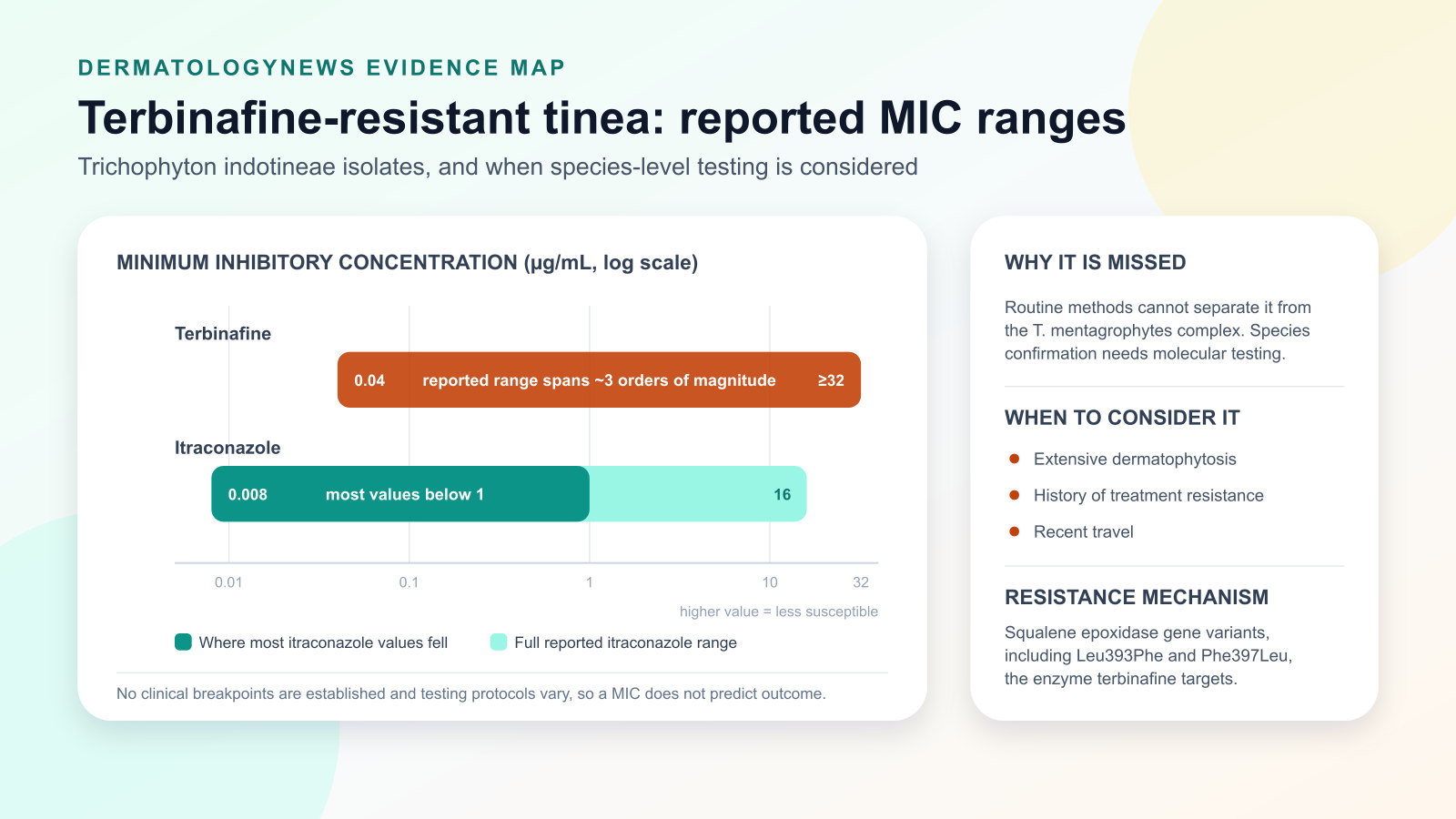
A dermatophyte species named Trichophyton indotineae has changed the assumption that superficial fungal skin infection reliably responds to terbinafine. The species is described as an emerging organism of global concern for its transmissibility and its antifungal drug resistance, and it cannot be separated from other members of the Trichophyton mentagrophytes complex without molecular diagnostic methods [2]. Reported terbinafine minimum inhibitory concentrations for these isolates span from 0.04 to 32 micrograms per millilitre or higher, with elevated values attributed to single-nucleotide variations in the squalene epoxidase gene, the target terbinafine acts on [3]. The first United States cases were reported from New York City for the period December 2021 through March 2023 [1].
Why this species is difficult to identify
Trichophyton indotineae sits within the T. mentagrophytes complex alongside T. mentagrophytes and T. interdigitale, and it has limited genetic and phenotypic differences from them [2]. A conventional laboratory workup that reports "dermatophyte" or names the complex does not answer the question that matters for treatment.
Confirming the species requires molecular methods, and access to those methods is uneven [2]. One scoping review proposes a practical trigger rather than universal testing: consider molecular diagnosis in patients presenting with extensive dermatophytosis, a history of treatment resistance, or recent travel [2]. That framing matters because most tinea is not caused by this organism, and testing every case is neither available nor warranted.
What the resistance data show
Susceptibility testing across published isolates has produced a wide and uneven picture.
- Terbinafine. Minimum inhibitory concentrations ranged from 0.04 to 32 micrograms per millilitre or above. The elevated values are attributed to variations in the squalene epoxidase gene: single changes including Leu393Phe, Leu393Ser, and Phe397Leu, and double changes including Leu393Phe with Ala448Thr and Phe397Leu with Ala448Thr [3].
- Itraconazole. Minimum inhibitory concentrations sat in a lower range, 0.008 to 16 micrograms per millilitre, with most values between 0.008 and under 1 [3].
- Interpretation is unsettled. Results are difficult to compare because testing protocols vary and no clinical breakpoints have been established for these organisms, so a laboratory number does not translate cleanly into a predicted outcome [3].
The species has also been reported as resistant to griseofulvin and to triazoles including fluconazole, itraconazole, voriconazole, and posaconazole in at least some isolates, which is why resistance here is better described as a spectrum than as a single drug problem [2].
What is used instead, and how strong that evidence is
A review that searched five databases through March 2024 and included only cases with molecular confirmation of the species reported the following pattern: itraconazole was a reasonable therapeutic choice, particularly at 200 mg per day for one to twelve weeks; voriconazole was also effective; terbinafine showed a reduced response rate; griseofulvin and fluconazole were not effective. Topical treatments were mostly ineffective as monotherapy but showed better results in combination with systemic therapy [4].
The important qualifier is the study design behind those statements. The available treatment evidence consists largely of case reports and case series rather than randomized controlled trials, and the same reviews that recommend itraconazole describe an unmet need for standardized clinical trials to establish treatment guidelines [3][4]. Itraconazole carries its own difficulties, including erratic absorption, potential drug interactions, side effects, and resistance in some isolates [2]. Options under investigation include super-bioavailable itraconazole formulations, third-generation triazoles, and combined oral and topical regimens [2].
One review also reported that mutational status was associated with different treatment-response profiles, suggesting that pairing susceptibility testing with mutational analysis could refine treatment selection [4]. That is a proposal supported by observation, not an established standard of care.
What this does and does not change for patients
Ordinary tinea remains common and still responds to standard treatment. Superficial fungal infection is widespread: one narrative review notes that in some communities superficial mycoses affect close to 70 percent of the population, with fungal infections affecting foot skin as tinea pedis and nails as onychomycosis, and lists climate, season, geography, occupation, and animal contact among the factors that shape risk [5]. Nothing in the resistance literature suggests that a first episode of athlete's foot needs molecular testing.
What changes is the interpretation of failure. Historically, tinea that did not clear on terbinafine was often attributed to incomplete treatment or reinfection. The presence of a genuinely poorly responsive species means that treatment failure now carries a second possible explanation, and repeating the same agent is not automatically the answer [2][3]. The reviews frame this as an argument for antifungal stewardship: prescribing deliberately, confirming diagnosis where the picture is atypical, and avoiding repeated empirical courses that select for resistance [2].
There is also a topical-steroid dimension worth naming. Combination creams containing a potent corticosteroid can suppress the inflammatory appearance of tinea while the infection extends, producing the extensive presentations that reviews associate with resistant disease [2].
Limitations of the current evidence
- The evidence base is small and mostly observational. Treatment recommendations rest on case reports and case series, not randomized trials, and the reviews say so explicitly [3][4].
- Laboratory results lack established breakpoints. Without clinical breakpoints, susceptibility values cannot be read as direct predictions of treatment outcome, and protocol variation limits comparison between studies [3].
- The literature is concentrated. Two of the four dermatology reviews cited here come from the same research group, so consistency between them reflects fewer independent sources than the citation count alone suggests [2][3]. The United States surveillance report is an independent public-health source [1], and one treatment review comes from a separate Italian group [4].
- Epidemiology is incomplete. Cases outside the Indian subcontinent have generally been linked to travel, with increasing reports of local spread, but surveillance coverage varies widely by country and true incidence is unknown [1][2].
- Species identification is not widely available. Recommending molecular confirmation is only useful where such testing exists and is reimbursed, which the reviews identify as a gap rather than a solved problem [2].
Bottom line
Trichophyton indotineae is a dermatophyte species that responds poorly to terbinafine, cannot be identified by routine laboratory methods, and has been reported in the United States since a New York City series covering December 2021 to March 2023 [1][2]. Resistance traces to squalene epoxidase gene variations, and reported terbinafine minimum inhibitory concentrations vary by nearly three orders of magnitude [3]. Itraconazole is the option with the most supporting reports, though that evidence is observational and the drug has its own limitations [2][3][4]. For most patients with ordinary tinea, none of this changes first-line care. It changes what should happen when that care does not work: reassessment and, where the presentation is extensive or recurrent, species-level diagnosis rather than another empirical course.
Common questions
- What is Trichophyton indotineae?
- It is a dermatophyte species, recognized relatively recently, that causes widespread and often treatment-resistant skin infection. It belongs to the Trichophyton mentagrophytes complex and has limited genetic and physical differences from its relatives, which is why routine laboratory methods do not distinguish it.
- Why does terbinafine fail against it?
- Terbinafine works by inhibiting squalene epoxidase, a fungal enzyme. Isolates with elevated terbinafine minimum inhibitory concentrations carry single-nucleotide variations in the squalene epoxidase gene, including Leu393Phe, Leu393Ser, and Phe397Leu, and some carry two such changes together. Reported terbinafine minimum inhibitory concentrations range widely, from 0.04 to 32 micrograms per millilitre or above.
- Has it been reported outside India?
- Yes. Cases outside the Indian subcontinent have generally been linked to international travel, though reports of local spread are increasing. The first United States cases were reported from New York City, covering December 2021 through March 2023.
- What treatment is used instead?
- Published evidence, largely case reports and case series rather than randomized trials, points to itraconazole, in one review at 200 mg per day for one to twelve weeks. Voriconazole has also been reported as effective. Griseofulvin and fluconazole were generally not effective, and topical treatment alone was mostly ineffective, though topical agents showed better results combined with systemic therapy. Treatment selection is a prescribing decision for a clinician.
- Should a patient with athlete's foot be worried about this?
- For most people, no. Ordinary tinea remains far more common and still responds to standard treatment. The situations that raise the question are extensive or widespread involvement, infection that has not responded to an adequate course of treatment, or relapse after apparent cure, particularly with a history of recent travel.
References
- Caplan AS, Chaturvedi S, Zhu Y, et al. Notes from the field: first reported U.S. cases of tinea caused by Trichophyton indotineae, New York City, December 2021-March 2023. — MMWR Morbidity and Mortality Weekly Report, 2023 · PMID: 37167192 · DOI: 10.15585/mmwr.mm7219a4
- Gupta AK, Susmita, Nguyen HC, et al. Trichophyton indotineae: epidemiology, antifungal resistance and antifungal stewardship strategies. — Journal of the European Academy of Dermatology and Venereology, 2025 · PMID: 40613321 · DOI: 10.1111/jdv.20810
- Gupta AK, Polla Ravi S, Wang T, et al. Antifungal resistance, susceptibility testing and treatment of recalcitrant dermatophytosis caused by Trichophyton indotineae: a North American perspective on management. — American Journal of Clinical Dermatology, 2023 · PMID: 37553539 · DOI: 10.1007/s40257-023-00811-6
- Sonego B, Corio A, Mazzoletti V, et al. Trichophyton indotineae, an emerging drug-resistant dermatophyte: a review of the treatment options. — Journal of Clinical Medicine, 2024 · PMID: 38930086 · DOI: 10.3390/jcm13123558
- Nowicka D, Nawrot U. Tinea pedis, an embarrassing problem for health and beauty: a narrative review. — Mycoses, 2021 · PMID: 34145648 · DOI: 10.1111/myc.13340