Energy-based lifting: how many sessions do the data support?
Standard microfocused ultrasound protocols are single-session. What the evidence says about repeating treatment, combining devices in one visit, and why patient and investigator ratings diverge.
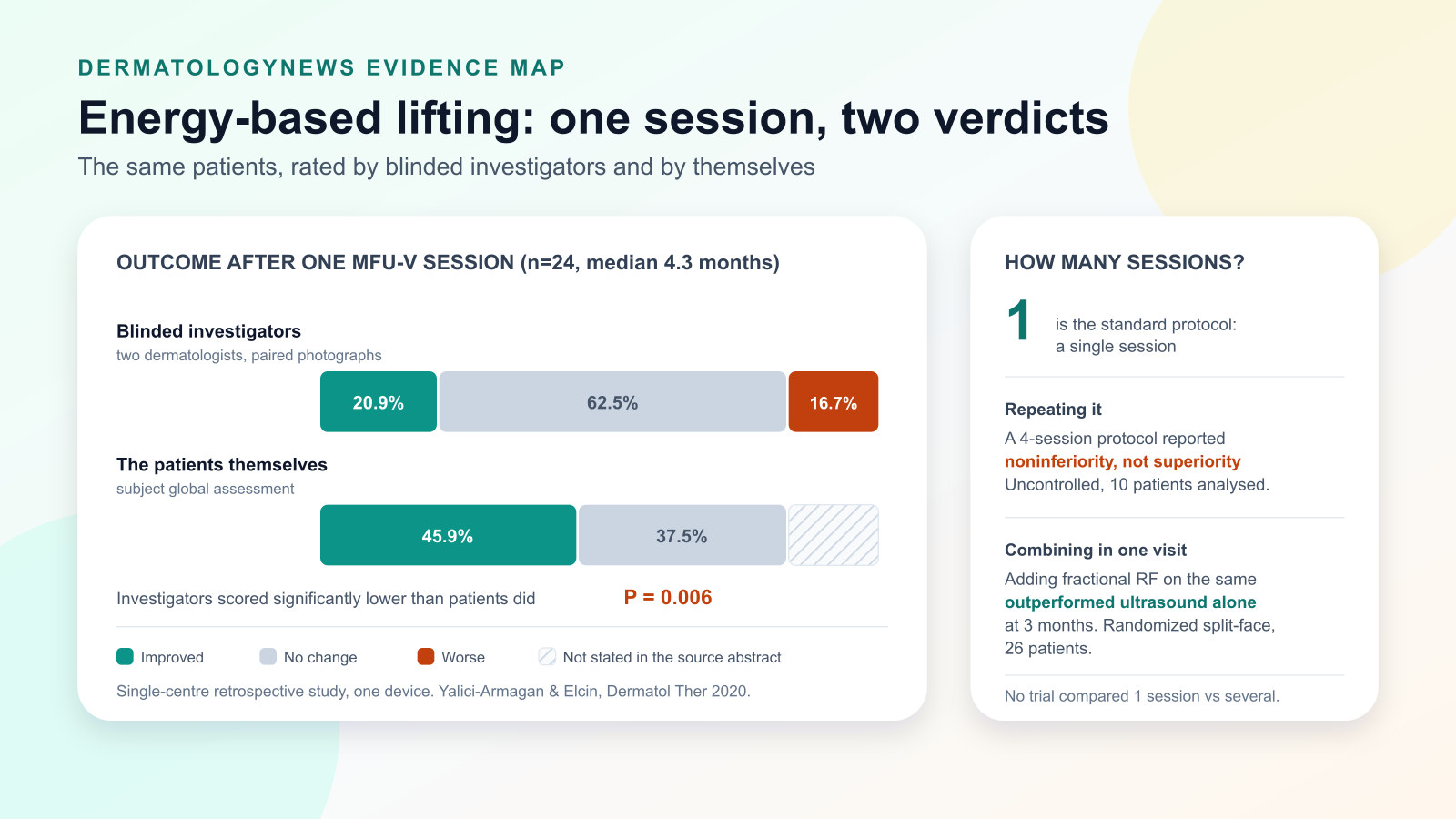
Standard protocols for microfocused ultrasound with visualization (MFU-V) are completed in a single session [2]. Yet the question patients ask most often, and the one clinics answer most variably, is how many treatments they should expect. The published evidence on that question is thinner than the confidence with which it is usually answered. One retrospective study found that a median of 4.3 months after a single treatment, blinded investigators rated 62.5 percent of patients as unchanged, while patients rated themselves considerably better than the investigators did [1]. An uncontrolled series of 10 analysed patients tested a multi-session protocol averaging four treatments, but did not establish noninferiority or superiority to a single session [2].
What the standard protocol actually is
The device protocols for MFU-V deliver treatment lines at set depths in one visit. When two clinicians published an alternative in 2023, delivering the same pan-facial treatment as a series of shorter, more intense visits, they opened by stating the baseline plainly: standard protocols are completed in a single session, and their motivation was that the single long session presented barriers to entry for a significant number of patients [2].
That framing matters for reading any repeat-treatment recommendation. Repetition is not the protocol; it is a departure from it, and the burden of evidence sits with the departure.
What one session produces, measured rather than impressed
A retrospective study followed 24 patients treated on the lower face. Patients were assessed a median of 4.3 months after one MFU-V session using paired pre-treatment and post-treatment photographs, rated by two blinded dermatologists on the Investigator Global Aesthetic Improvement Scale and by patients on the subject version [1].
| Assessment | Improved | No change | Worse |
|---|---|---|---|
| Blinded investigators | 20.9% | 62.5% | 16.7% |
| Patients themselves | 45.9% | 37.5% | not reported |
The difference between investigator and patient ratings was statistically significant (P = 0.006), with investigators scoring lower [1]. No serious adverse effects occurred.
The authors' own interpretation is worth quoting in substance: the gap suggested to them that photography-based assessment may not capture what patients perceive, and that better evaluation methods are needed [1]. That reading is fair, and it cuts both ways. Either photographs miss a real change, or patient self-assessment reflects expectation as well as outcome. Both possibilities are live, and neither supports selling a fixed course of repeat treatments on the assumption that more sessions accumulate visible benefit.
This was a single-centre retrospective study of 24 patients with one device, so it does not settle the question either. It does establish that a single session frequently produces no change that a blinded assessor can see.
Repeating the treatment: what has been tested
The multi-session protocol published in 2023 enrolled 12 participants with mild-to-moderate skin and fibromuscular laxity, each receiving one superficial and one deep pass per visit, averaging around 280 lines. Two were excluded after substantial weight gain, leaving 10 patients who underwent an average of four treatments [2].
Reported outcomes were positive: mean brow height increased by 1.7 mm, all patients and treating physicians rated an improvement in appearance, and independent physicians rated improvement in 87 percent of cases. Adverse events were transient, including superficial welts in five patients, and none were severe or permanent [2].
The authors described the protocol as noninferior based on comparisons with earlier studies [2]. The study enrolled patients at two Australian clinics and used an uncontrolled design with 10 analysed patients and follow-up delayed by pandemic scheduling. It did not establish statistical noninferiority, equivalence, or superiority over a single session.
A case series in a different anatomical setting reported that patients with Grade 3 chest and gluteal laxity improved by 2 grade points after two or three treatment sessions, but those sessions also increased the tissue layers treated and added a filler component, so session count is confounded with treatment intensity [5].
Combining in one visit has better evidence than repeating across visits
A randomized trial tested combination rather than repetition. A prospective, randomized, split-face study enrolled 26 patients with facial laxity. Every patient received one full-face MFU treatment, and one randomly assigned side additionally received microneedle fractional radiofrequency on the same day [3].
At 3 months, the combined side outperformed the control side on the Global Aesthetic Improvement Scale and the Wrinkle Severity Rating Scale. Imaging showed a significant reduction in subcutaneous fat thickness on the combined side, particularly at the masseter and mid-cheek, and over 90 percent of participants reported satisfaction. Side effects were mild and transient: erythema, purpura, and edema, all resolving without intervention [3].
Split-face randomization controls for individual variation, though this trial included only 26 patients and 3 months of follow-up.
A separate single-session combination approach has been tested off the face. In a prospective single-arm pilot of 12 women with upper-arm laxity, MFU-V followed by subdermal diluted or hyperdiluted calcium hydroxylapatite in one session produced significant improvement in cutometer measures of firmness and elasticity, sustained to 24 weeks [4]. A pilot study with no control arm establishes feasibility rather than comparative benefit.
The pattern across these studies is consistent: what is supported is treating more layers or more mechanisms within a visit, not simply returning for the same treatment again. Energy-based lifting devices differ in how they deliver energy: MFU-V targets discrete depths, while monopolar radiofrequency heats tissue more broadly.
Questions about energy-based lifting treatment sessions in Seoul
Before accepting a proposed schedule for energy-based lifting treatment sessions in Seoul, ask the clinician to explain the device, treatment areas, interval, and follow-up assessment. A clinic's published service description does not by itself establish the evidence for an individual treatment plan.
- Before the first session: Which findings from the consultation support this device and these treatment areas? What will be recorded so that later assessments can be compared with the starting point?
- Before booking another session: When will the result be assessed, how will change be measured, and what would justify further treatment? Ask whether the suggested interval comes from a study using the same device and treatment area or from the clinician's own experience.
- Before combining treatments: Which devices or products are proposed, on what day, and why? Ask how the evidence, limitations, and adverse effects discussed above apply to that particular combination.
Adverse events, limitations, and realistic expectations
- The studies are small. Sample sizes were 24, 10, 26, 12, and 4 patients. None was powered to detect modest differences between session counts.
- Only one used randomization. The split-face combination study is randomized; the rest are retrospective, single-arm, or case series [1][2][4][5].
- The five studies did not compare one session against several with blinded assessment.
- Follow-up is short. The longest structured follow-up here is 6 months [4], against a treatment marketed on collagen remodelling that unfolds over a longer horizon.
- Assessment method changes the answer. Blinded photographic rating and patient self-rating diverged significantly in the study that measured both [1].
- Adverse effects are usually transient but real. Reported events include erythema, purpura, edema, superficial welts, tenderness, and mild bruising, resolving within days [2][3].
- Body sites are not face data. Chest, buttock, and upper-arm findings do not transfer to facial treatment planning [4][5].
- Device and operator differ between studies. MFU-V is not one fixed intervention, and transducer selection, line count, and depth vary between the protocols described here.
Bottom line
The standard MFU-V protocol is a single session [2]. Repeating it is common practice but weakly evidenced: the multi-session study used an uncontrolled series of 10 analysed patients at two Australian clinics and did not establish noninferiority, equivalence, or superiority to a single session [2]. Meanwhile, a single session frequently produces no change a blinded assessor can detect, and patients rate their own results significantly higher than investigators do [1]. Where the evidence is comparatively stronger is combination within a visit, supported by a randomized split-face study [3]. A reasonable approach is assessment first, a defined interval before judging the result, and a decision about further treatment based on measured change rather than on a course purchased in advance. Pre-treatment assessment should clarify the device, target areas, risks, and follow-up plan.
Common questions
- How many microfocused ultrasound sessions are standard?
- One. Standard protocols for microfocused ultrasound with visualization are completed in a single session, a point stated directly by the authors of a multi-session protocol who were proposing an alternative to it. Repeat treatment is common in practice, but the single session is what the standard protocol specifies.
- Does having more sessions produce a better result?
- The authors described their multi-session protocol as noninferior based on an uncontrolled series of 10 analysed patients and comparisons with earlier studies. This does not establish statistical noninferiority, equivalence, or superiority over a single session.
- Why did my results look smaller to my doctor than to me?
- That gap has been measured. In a retrospective study of 24 patients assessed a median of 4.3 months after a single treatment, blinded investigators rated 20.9 percent as improved and 62.5 percent as unchanged, while patients rated 45.9 percent of themselves as improved. The difference between investigator and patient ratings was statistically significant, with investigators scoring lower.
- Is combining two devices in one visit better than returning for another session?
- The combination evidence is stronger than the repetition evidence, though both are limited. A randomized split-face study of 26 patients found that adding microneedle fractional radiofrequency to microfocused ultrasound on the same day outperformed ultrasound alone at 3 months. No comparable randomized study supports repeating the same treatment instead.
- How should I decide about a second treatment?
- Reasonable inputs are an objective assessment rather than an impression, the time elapsed since the first treatment, whether the first produced a measurable change, and what a clinician expects a second to add. Because tissue response varies and the evidence for repetition is weak, a plan built on a fixed repeat interval sold in advance is not supported by the published data.
References
- Yalici-Armagan B, Elcin G. Evaluation of microfocused ultrasound for improving skin laxity in the lower face: a retrospective study. — Dermatologic Therapy, 2020 · PMID: 32770566 · DOI: 10.1111/dth.14132
- Corduff N, Lowe S. Hi5 protocol for the use of microfocused ultrasound with visualization. — Plastic and Reconstructive Surgery Global Open, 2023 · PMID: 37583398 · DOI: 10.1097/GOX.0000000000005184
- Wang R, Peng G, Chen Y, et al. Combined novel microfocused ultrasound and microneedle fractional radiofrequency system for multilayered facial rejuvenation: a prospective, randomized, and split-face study. — Journal of Cosmetic Dermatology, 2025 · PMID: 40980871 · DOI: 10.1111/jocd.70455
- Ramirez S, Puah IBK. Effectiveness of combined microfocused ultrasound with visualization and subdermal calcium hydroxyapatite injections for the management of brachial skin laxity. — Journal of Cosmetic Dermatology, 2021 · PMID: 34716645 · DOI: 10.1111/jocd.14573
- Casabona G. Combined calcium hydroxylapatite plus microfocused ultrasound for treating skin laxity of the chest and buttocks. — Journal of Drugs in Dermatology, 2022 · PMID: 35005869 · DOI: 10.36849/JDD.2022.6368