Hypochlorous acid face spray: what the evidence shows
Hypochlorous acid face spray is popular, but human evidence mainly comes from wound care. See what HOCl may do, what remains unproven, and safety limits.
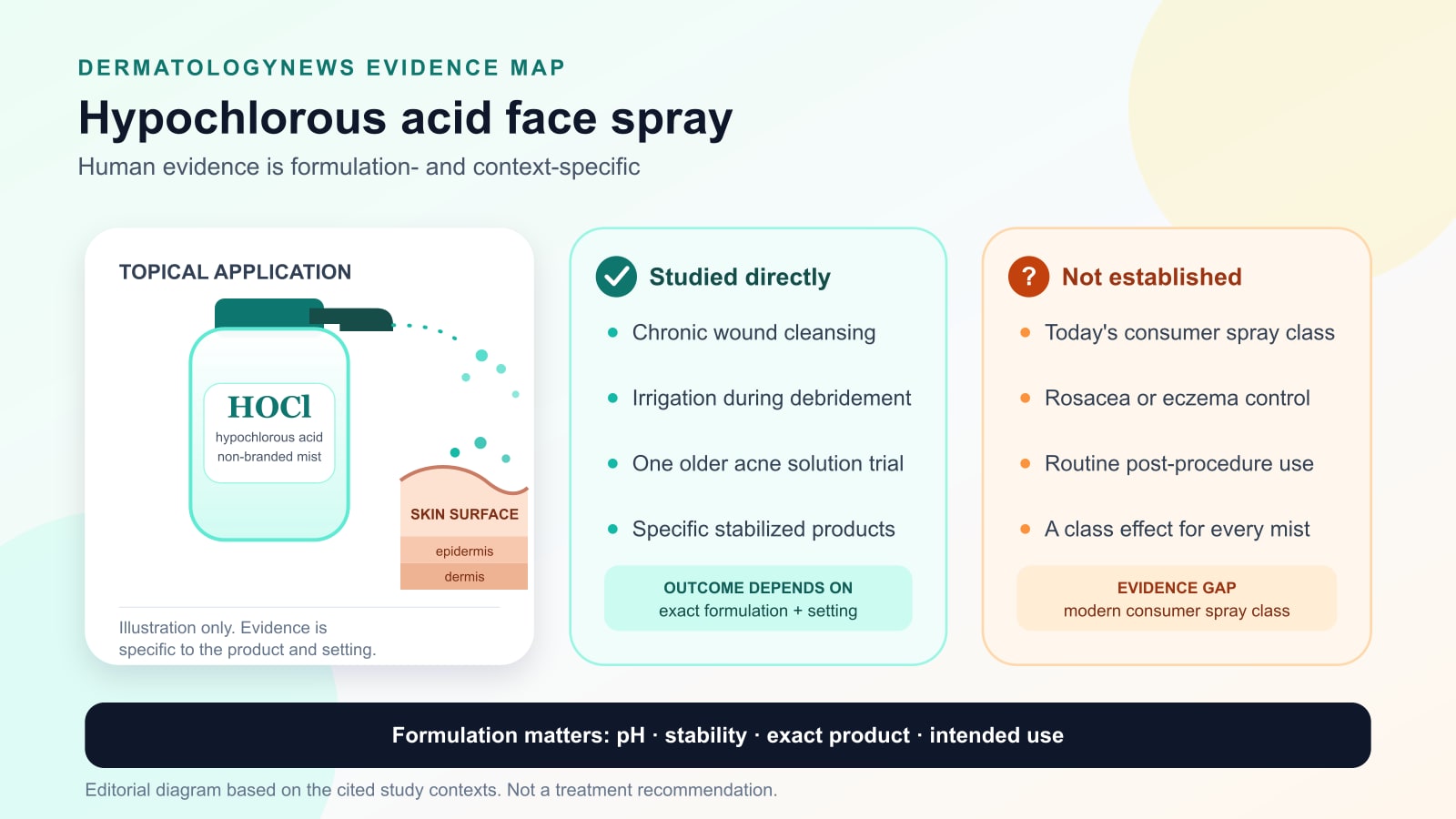
Hypochlorous acid face spray is marketed for acne-prone, red, or sensitive skin. Hypochlorous acid, shortened to HOCl, has antimicrobial activity in specific topical formulations [1]. One directly relevant facial study exists: a 2009 randomized trial of a particular superoxidized solution for inflammatory acne [5]. The other human studies cited here concern chronic wounds [2][3][4], and a 2018 narrative review focuses on specific formulations [1]. Together, they do not show that today's consumer sprays work as a class for acne, rosacea, or eczema.
The practical takeaway is narrow: each result belongs to the exact formulation and use that researchers tested. A facial spray should not replace diagnosis or established treatment.
What is hypochlorous acid?
HOCl is a reactive chlorine species with antimicrobial activity. Topical formulations have been studied in settings including facial acne, wound cleansing, and chronic ulcer care. A 2018 narrative review also described possible anti-inflammatory effects, but it focused on a particular stabilized formulation and emphasized that pH and formulation stability affect the physical and chemical behavior of HOCl after application [1].
The review's funding and disclosure notes state that no project grants were provided, but both authors received IntraDerm Pharmaceuticals consultant honoraria for data review and manuscript accuracy and had served as advisors and research consultants. That relationship and the narrative design matter when weighing it as product-class evidence [1].
What the human studies actually tested
The most useful way to read the HOCl literature is to separate the finding from the claim it cannot support.
| Evidence | What the study or review found | What it does not establish |
|---|---|---|
| 2018 narrative review | Summarized topical HOCl research, emphasized one stabilized formulation, and reported that pH and stability affect product behavior. It disclosed author consultant honoraria [1]. | A shared effect across consumer sprays or independent product-class evidence. |
| 2009 facial-acne trial | Randomized 89 people with inflammatory acne to a superoxidized solution, benzoyl peroxide, or placebo. Excellent or good responses were more frequent than with placebo; categorical response proportions did not differ statistically from benzoyl peroxide [5]. | Non-inferiority to benzoyl peroxide, current consumer sprays, recurrence, scarring, or long-term use. |
| 2024 first-in-human study | Tested HOCl plus acetic acid in chronic leg ulcers: a randomized single-dose phase of 20 participants and an open-label repeated-dose phase of 8. Safety and tolerability were primary outcomes [2]. | Facial efficacy, long-term daily use, or HOCl alone. |
| 2016 chronic-wound study | Compared HOCl with saline during ultrasound-assisted debridement in 17 adults. Tissue bacterial counts were lower before closure, but bacterial count is a surrogate rather than a healing outcome [3]. | Routine facial misting. |
| 2006 venous-ulcer study | Added HOCl washes for 20 ulcers that had not reached a prespecified response after three weeks of compression [4]. | Controlled benefit for facial skin; there was no concurrent randomized face-spray comparison. |
What the facial evidence can and cannot show
Acne: one older formulation-specific trial
The 2009 trial directly studied facial inflammatory acne. Participants had 10 to 50 papules or pustules and no nodulocystic lesions. The tested solution produced better categorical improvement than placebo; response proportions did not differ statistically from benzoyl peroxide, but this was not a non-inferiority trial, and the authors called for a larger sample [5].
That result does not validate sprays with different concentrations, pH, stabilizers, excipients, or labels. It also does not answer blackheads, relapse, scarring, or long-term use. One trial cannot establish a class effect.
For a separate review of established acne options, see our guide to topical retinoids.
Rosacea and eczema: mechanism is not evidence
The cited studies do not directly test consumer facial HOCl sprays for rosacea or eczema. A plausible antimicrobial or anti-inflammatory mechanism is not demonstrated clinical benefit, and redness, bumps, scaling, burning, and itch can have different causes.
Our phenotype-based rosacea guide explains why treatment depends on the specific feature. A spray should not delay evaluation of eye symptoms, rapidly worsening inflammation, crusting, pain, or suspected infection.
After procedures: wound evidence is not an aftercare protocol
Wound-care evidence does not prove that an HOCl face spray is appropriate after a laser, injection, peel, or other procedure. Follow the treating clinician's aftercare plan and the exact product label rather than general social-media advice.
How to assess a product claim
A useful product claim identifies what was tested. Ask:
- Was the research performed on the same formulation and concentration?
- Was the product used on facial skin, a chronic wound, or in a laboratory experiment?
- Did the study test the condition named in the marketing claim?
- Was HOCl tested alone or with another active ingredient?
- Was the outcome safety, bacterial count, symptom relief, or disease improvement?
- Was there an appropriate comparison group and enough follow-up to answer the question?
Published human studies report formulation-specific outcomes in facial acne and chronic-wound settings. They do not establish a class effect for consumer face sprays.
Safety, limitations, and realistic expectations
The 2024 wound study made safety and tolerability its primary outcomes and reported that its HOCl and acetic acid formulation was well tolerated [2]. The other primary studies did not establish tolerability across consumer facial sprays. Because pH and stability matter, home mixing, decanting, or use outside labeled storage and expiry instructions adds uncertainty [1].
Choose a product labeled for the intended skin use, follow its directions, and stop for persistent stinging, swelling, rash, or worsening redness. Avoid the eyes unless the product is labeled for ocular use. A mist is not a substitute for prescribed acne, rosacea, eczema, infection, or wound care.
The evidence base has several clear limitations:
- Three primary studies concern chronic wounds [2][3][4]; direct facial-acne evidence is one older formulation-specific trial [5].
- Sample sizes were small, and some wound-study designs lacked a concurrent control group [3][4].
- The 2024 study tested an HOCl and acetic acid combination, not a typical face mist [2].
- The 2018 narrative review centered on a specific stabilized technology and disclosed consultant honoraria, so it cannot establish an independent class effect for all HOCl products [1].
- These sources do not provide direct evidence that today's consumer spray category treats rosacea or eczema, or that every spray treats acne.
Bottom line
HOCl has antimicrobial activity in specific formulations. One 2009 acne trial and several small wound studies reported formulation-specific clinical, tolerability, bacterial-count, or healing observations [2][3][4][5]. These heterogeneous findings do not establish a class effect for today's consumer face sprays.
Judge the exact formulation and label rather than the ingredient name alone. A consumer mist is not a replacement for diagnosis or established treatment, and the evidence reviewed here does not establish it as a treatment for rosacea or eczema.
Common questions
- Does hypochlorous acid face spray treat acne?
- One 2009 randomized trial reported improvement with a specific superoxidized solution for mild to moderate inflammatory acne. It did not test today's consumer face-spray category, so one formulation-specific trial does not show that every HOCl mist treats acne.
- Is hypochlorous acid face spray proven for rosacea or eczema?
- No. The human studies reviewed here do not test consumer hypochlorous acid face sprays for rosacea or eczema. Antimicrobial activity in a wound or laboratory setting does not by itself prove benefit for either condition, and the formulation tested matters.
- Can every hypochlorous acid spray be expected to work the same way?
- No. Published research indicates that pH and formulation stability affect topical HOCl. Findings from one stabilized product or a wound-care combination cannot be transferred automatically to every facial spray.
- Can hypochlorous acid spray replace a prescription?
- No. A facial spray may be considered an optional skin-care adjunct, but the studies reviewed here do not support replacing prescribed treatment for acne, rosacea, eczema, infection, or a wound.
References
- Del Rosso JQ, Bhatia N. Status Report on Topical Hypochlorous Acid: Clinical Relevance of Specific Formulations, Potential Modes of Action, and Study Outcomes. — Journal of Clinical and Aesthetic Dermatology, 2018 · PMID: 30588272
- Fazli MM et al. A First-in-Human Randomized Clinical Study Investigating the Safety and Tolerability of Stabilized Hypochlorous Acid in Patients with Chronic Leg Ulcers. — Advances in Wound Care, 2024 · PMID: 38780759 · DOI: 10.1089/wound.2024.0040
- Hiebert JM, Robson MC. The Immediate and Delayed Post-Debridement Effects on Tissue Bacterial Wound Counts of Hypochlorous Acid Versus Saline Irrigation in Chronic Wounds. — Eplasty, 2016 · PMID: 28123629
- Selkon JB et al. Evaluation of hypochlorous acid washes in the treatment of chronic venous leg ulcers. — Journal of Wound Care, 2006 · PMID: 16669304 · DOI: 10.12968/jowc.2006.15.1.26861
- Tirado-Sanchez A, Ponce-Olivera RM. Efficacy and tolerance of superoxidized solution in the treatment of mild to moderate inflammatory acne: a double-blinded, placebo-controlled, parallel-group, randomized clinical trial. — Journal of Dermatological Treatment, 2009 · PMID: 19459079 · DOI: 10.1080/09546630902973995