Inverse psoriasis in skin folds: treatment options and what the evidence shows
Inverse psoriasis forms smooth red plaques in skin folds. What the evidence shows for steroid, nonsteroidal and systemic treatment, and which rashes look alike.
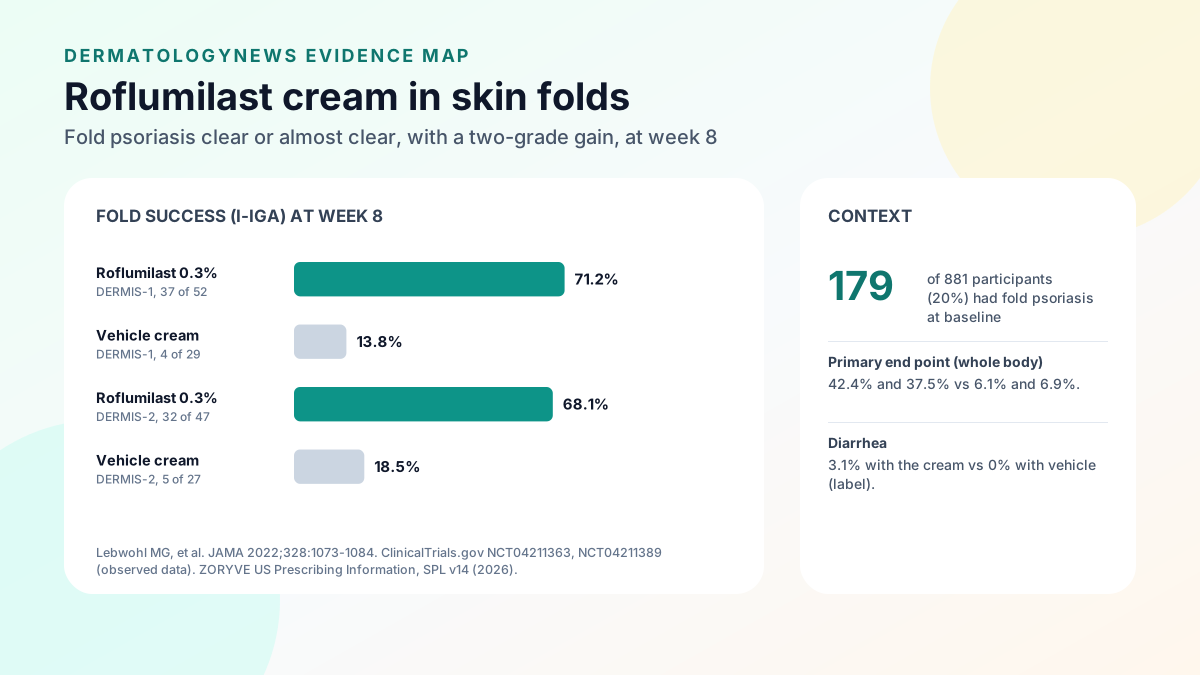
Inverse psoriasis, also called intertriginous or flexural psoriasis, is psoriasis that develops in skin folds: most often the groin, then the skin under the breasts, around the anus, behind the ears, the armpits and the navel [4]. Warmth and moisture change how it looks. The plaques are smooth, shiny and red, usually without the silvery scale of plaques on the elbows or knees, and a crack often runs through the middle [4]. Estimates of how common it is vary widely: 3% to 36% of people with psoriasis in one review [4], and about 79% in another [3]. Fold skin is thin and occluded, so it absorbs topical medicines more readily [3]. That is why treatment relies on milder steroids for short courses and on nonsteroidal creams for longer use [3]. In two 8-week trials of roflumilast 0.3% cream, 71.2% and 68.1% of patients with fold involvement reached clear or almost clear fold skin with at least a two-grade improvement, against 13.8% and 18.5% with a vehicle cream [1].
What inverse psoriasis looks like
Plaques in the folds are sharply outlined and can become macerated, and friction can produce new plaques where skin rubs against skin [4]. Sweating and constant skin-to-skin contact may make them worse [4]. Shallow erosions are common and bring itching, burning and irritation [4]. Ordinary plaque psoriasis elsewhere on the body may be present at the same time [4]. Because these areas are sensitive, many people do not mention the rash until a clinician asks about it [3].
Rashes in skin folds that look similar
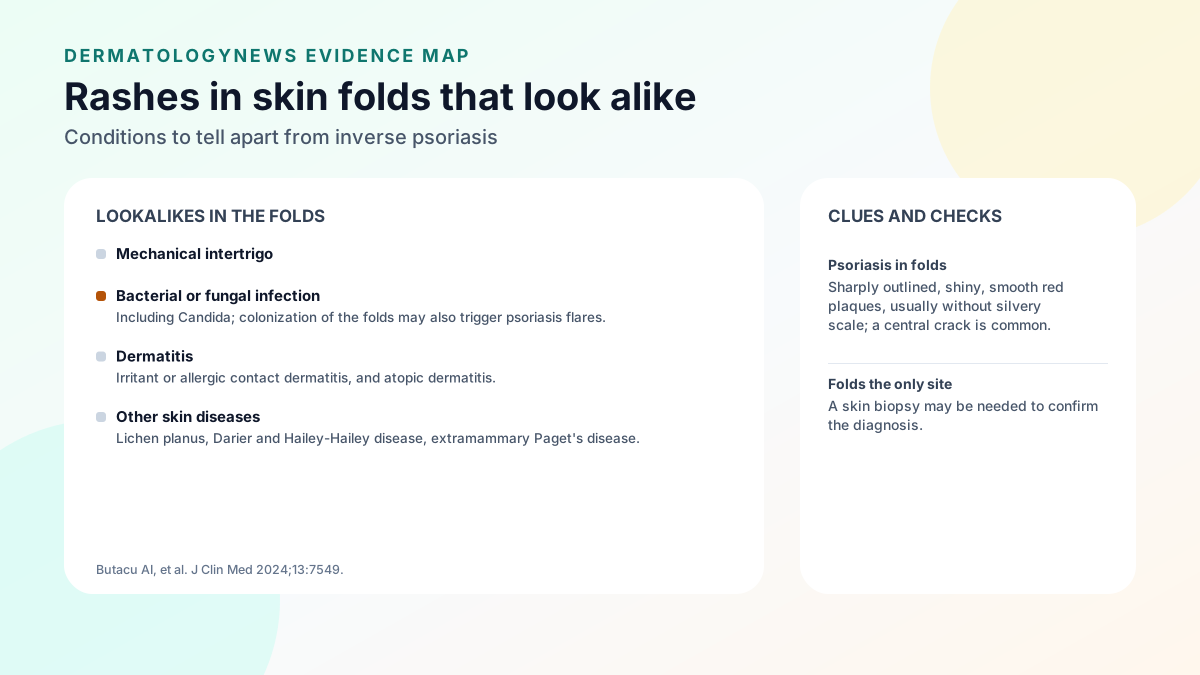
A red rash in a fold is not always psoriasis. The 2024 review lists these conditions as the main lookalikes [4]:
- Mechanical intertrigo.
- Bacterial or fungal infection, including Candida.
- Irritant or allergic contact dermatitis and atopic dermatitis.
- Lichen planus, Darier disease and Hailey-Hailey disease.
- Extramammary Paget's disease.
When the folds are the only area involved, the diagnosis can be hard to make, and a skin biopsy is sometimes needed [4]. Infection and psoriasis can also overlap: Candida and bacterial colonization of the folds may trigger psoriasis flares [4]. Antifungal treatment may help intertrigo, but the 2021 review found little to suggest that it relieves the symptoms of inverse psoriasis itself [3]. Groin fungal infections that no longer respond to the usual tablets are covered in our article on terbinafine-resistant tinea, and eczema treatment in our review of lebrikizumab and nemolizumab.
Treatment options and the strength of their evidence
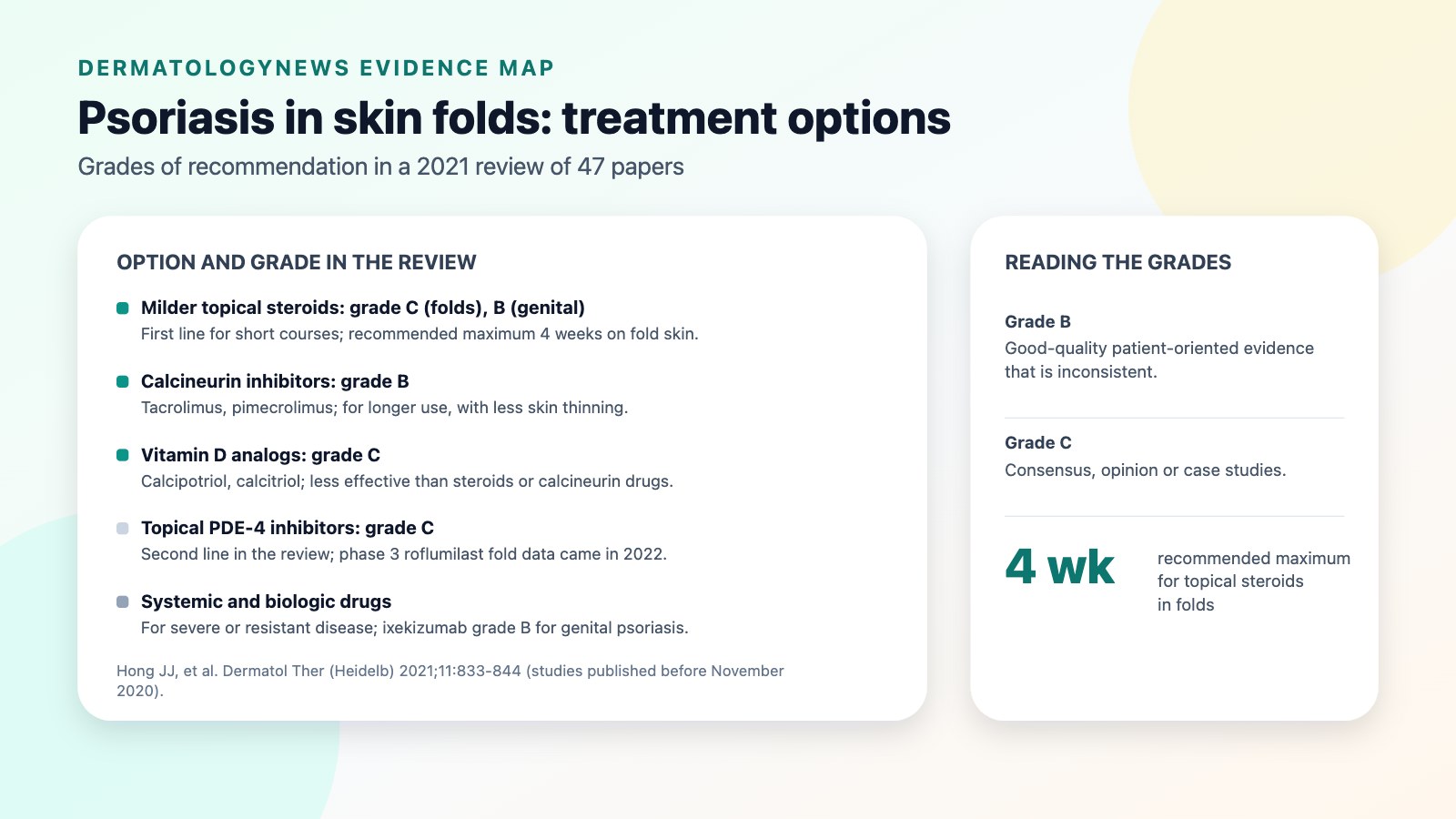
A 2021 treatment review of genital and fold psoriasis grades each option using the American Academy of Dermatology approach: grade B rests on good-quality but inconsistent patient-oriented evidence, and grade C on consensus, opinion or case studies [3]. It covers studies published before November 2020, so it predates the phase 3 roflumilast trials [3][1].
| Option | Grade in the 2021 review | What the review reports |
|---|---|---|
| Low- to mid-potency topical corticosteroids | C for inverse, B for genital psoriasis | First line for short courses; recommended maximum 4 weeks [3] |
| Topical calcineurin inhibitors (tacrolimus, pimecrolimus) | B | Used for longer maintenance, with a lower risk of skin thinning [3] |
| Topical vitamin D analogs (calcipotriol, calcitriol) | C | Less effective than steroids or calcineurin inhibitors [3] |
| Coal tar preparations | B | Second line, alone or with a topical steroid [3] |
| Topical PDE-4 inhibitors (crisaborole, roflumilast) | C | Second line in the review; phase 3 roflumilast data came later [3][1] |
| Biologics and other systemic drugs | Ixekizumab B for genital psoriasis | For severe or resistant disease [3] |
Both calcineurin inhibitors have placebo-controlled trials in fold psoriasis. After 8 weeks, improvement in the physician's global assessment was 65.2% with tacrolimus versus 31.5% with placebo, and 71% of patients using pimecrolimus 1% cream twice daily had clear or almost clear skin versus 21% with placebo [3]. Systemic treatment is usually reserved for severe or resistant disease, but an International Psoriasis Council consensus has recognized that psoriasis in special sites such as the genitals may warrant it even when only a small area is affected [3].
Roflumilast cream: the trial data for skin folds
Roflumilast is a phosphodiesterase-4 (PDE-4) inhibitor. Its 0.3% cream was tested against a vehicle cream in two phase 3 trials, DERMIS-1 and DERMIS-2, in 881 participants whose plaque psoriasis covered 2% to 20% of the body [1]. Both trials received funding from Arcutis Biotherapeutics [5]. After 8 weeks of once-daily use, 42.4% and 37.5% of the roflumilast groups reached the primary end point, clear or almost clear skin with at least a two-grade improvement, compared with 6.1% and 6.9% of the vehicle groups [1].
Fold involvement was analyzed as a secondary end point, using a fold-specific 5-point score from 0 (clear) to 4 (severe) [5]. At baseline, 179 participants (20%) had fold psoriasis of at least mild severity [2]. Among those assessed at week 8, 37 of 52 (71.2%) versus 4 of 29 (13.8%) in DERMIS-1, and 32 of 47 (68.1%) versus 5 of 27 (18.5%) in DERMIS-2, reached clear or almost clear fold skin with at least a two-grade improvement [1][5]. The US label reports the same analysis as 71.5% versus 13.8% and 67.5% versus 17.4% [2].
The current US label lists the 0.3% cream for plaque psoriasis, including intertriginous areas, in patients 2 years of age and older, and gives June 2026 as the date of that section's latest change [2]. For children aged 2 to 5, the label's safety data come from an open-label trial of up to 24 weeks [2]. The cream is applied once daily and rubbed in completely, and it is not for use in the eyes, mouth or vagina [2].
Genital psoriasis
Genital involvement is common: up to 63% of people with psoriasis develop genital lesions at some point [3], and in 2% to 5% the genitals are the only site of skin psoriasis [4]. Itching is the most frequently reported symptom, along with burning and pain during sex [4]. Lookalikes on genital skin also include lichen sclerosus and precancerous or cancerous changes of the vulva in women, and irritative balanitis, Zoon's balanitis and erythroplasia of Queyrat in men [4].
General measures in the 2024 review are gentle, soap-free cleansers and loose clothing to reduce friction, with low-potency topical steroids for 2 to 4 weeks [4]. Placebo-controlled trials of systemic drugs have reported genital end points, including these two. In the ixekizumab trial summarized in the 2021 review, 73% of the 75 patients randomized to ixekizumab had clear or almost clear genital skin at week 12 [3]. In ICONIC-TOTAL, among participants with at least moderate genital psoriasis, 76.5% on the oral drug icotrokinra versus 21.4% on placebo reached clear or almost clear genital skin at 16 weeks [6]. That trial and the label it supports are covered in our article on icotrokinra (Icotyde).
Adverse effects, limitations and realistic expectations
- Topical steroids on fold skin. Occlusion in the folds increases steroid penetration, and the review's short-course limit is set to reduce the risk of skin thinning, small visible blood vessels and stretch marks [3].
- Calcineurin inhibitors and vitamin D analogs. Calcineurin inhibitors can cause burning and mild itching, and vitamin D analogs cause more irritation than calcineurin inhibitors [3].
- Roflumilast cream. In the label's pooled 8-week data, diarrhea (3.1% versus 0%) and headache (2.4% versus 1.0%) were the reactions that most exceeded vehicle, and 1.0% versus 1.3% stopped treatment because of a reaction [2].
- Thin evidence for folds. Most grades in the 2021 review are B or C [3]. The roflumilast fold result comes from about a fifth of the participants, over 8 weeks, against vehicle rather than another active treatment [1][2].
Questions to bring to the appointment
- Could this be a fungal or bacterial infection, intertrigo or contact dermatitis instead, and would a scraping or biopsy help [4]?
- How long should I use a steroid on fold skin, and what do I switch to afterwards [3]?
- Is a nonsteroidal option such as tacrolimus, pimecrolimus or roflumilast cream suitable for maintenance [2][3]?
- If genital skin is involved and creams are not enough, would systemic treatment be considered even though the affected area is small [3]?
Bottom line
Inverse psoriasis forms smooth, shiny red plaques in skin folds and is easily mistaken for infection, intertrigo or dermatitis [4]. A 2021 review lists short courses of milder topical steroids, calcineurin inhibitors and vitamin D analogs as first-line options [3]. Roflumilast 0.3% cream now has fold-specific trial data: in DERMIS-1 and DERMIS-2, 71.2% and 68.1% of patients with fold involvement reached clear or almost clear fold skin with at least a two-grade improvement at 8 weeks, against 13.8% and 18.5% with vehicle [1].
Common questions
- What does inverse psoriasis look like?
- Inverse psoriasis forms sharply outlined, smooth, shiny red plaques in skin folds, usually without the silvery scale seen on elbows and knees, and a crack often runs through the middle [4]. The groin folds are the most common site, followed by the skin under the breasts, around the anus, behind the ears, the armpits and the navel [4].
- What is the first treatment for psoriasis in skin folds?
- A 2021 treatment review lists low- to mid-potency topical corticosteroids for short courses, topical calcineurin inhibitors and topical vitamin D analogs as first-line options for mild-to-moderate inverse and genital psoriasis [3]. The review grades the steroid recommendation for inverse psoriasis C, meaning it rests mainly on consensus, opinion or case studies [3].
- How long can I use a steroid cream on psoriasis in skin folds?
- The 2021 review gives a recommended maximum of 4 weeks for topical steroids on genital and fold skin [3]. Topical calcineurin inhibitors are the option the review describes for longer maintenance [3].
- Is inverse psoriasis a fungal infection?
- No. Inverse psoriasis is psoriasis, but fungal and bacterial infections are among the conditions that look like it, together with intertrigo, contact dermatitis, atopic dermatitis and several rarer diseases [4]. Candida and bacterial colonization of the folds may also trigger flares, and a skin biopsy may be needed when folds are the only area involved [4].
References
- Lebwohl MG, Kircik LH, Moore AY, et al. Effect of Roflumilast Cream vs Vehicle Cream on Chronic Plaque Psoriasis: The DERMIS-1 and DERMIS-2 Randomized Clinical Trials. — JAMA, 2022;328(11):1073-1084 · PMID: 36125472 · DOI: 10.1001/jama.2022.15632
- ZORYVE (roflumilast) cream. US Prescribing Information and Patient Information. — Arcutis Biotherapeutics, labeling via DailyMed (U.S. National Library of Medicine); SPL version 14, effective July 20, 2026; NDA 215985
- Hong JJ, Mosca ML, Hadeler EK, Brownstone ND, Bhutani T, Liao WJ. Genital and Inverse/Intertriginous Psoriasis: An Updated Review of Therapies and Recommendations for Practical Management. — Dermatology and Therapy, 2021;11(3):833-844 · PMID: 33914293 · DOI: 10.1007/s13555-021-00536-6
- Butacu AI, Toma C, Negulet IE, et al. Updates on Psoriasis in Special Areas. — Journal of Clinical Medicine, 2024;13(24):7549 · PMID: 39768472 · DOI: 10.3390/jcm13247549
- DERMIS-1 (NCT04211363) and DERMIS-2 (NCT04211389) trial records. — ClinicalTrials.gov, U.S. National Library of Medicine
- Gooderham M, Lain E, Bissonnette R, et al. Targeted Oral Peptide Icotrokinra for Psoriasis Involving High-Impact Sites. — NEJM Evidence, 2025;4(12):EVIDoa2500155 (ICONIC-TOTAL; received funding from Johnson & Johnson) · PMID: 41191932 · DOI: 10.1056/EVIDoa2500155