Icotyde (icotrokinra) for psoriasis: what the trials and the label show
Icotrokinra (Icotyde) is a once-daily tablet that blocks the IL-23 receptor. What the phase 3 trials, the US label and the labels of other psoriasis pills show.
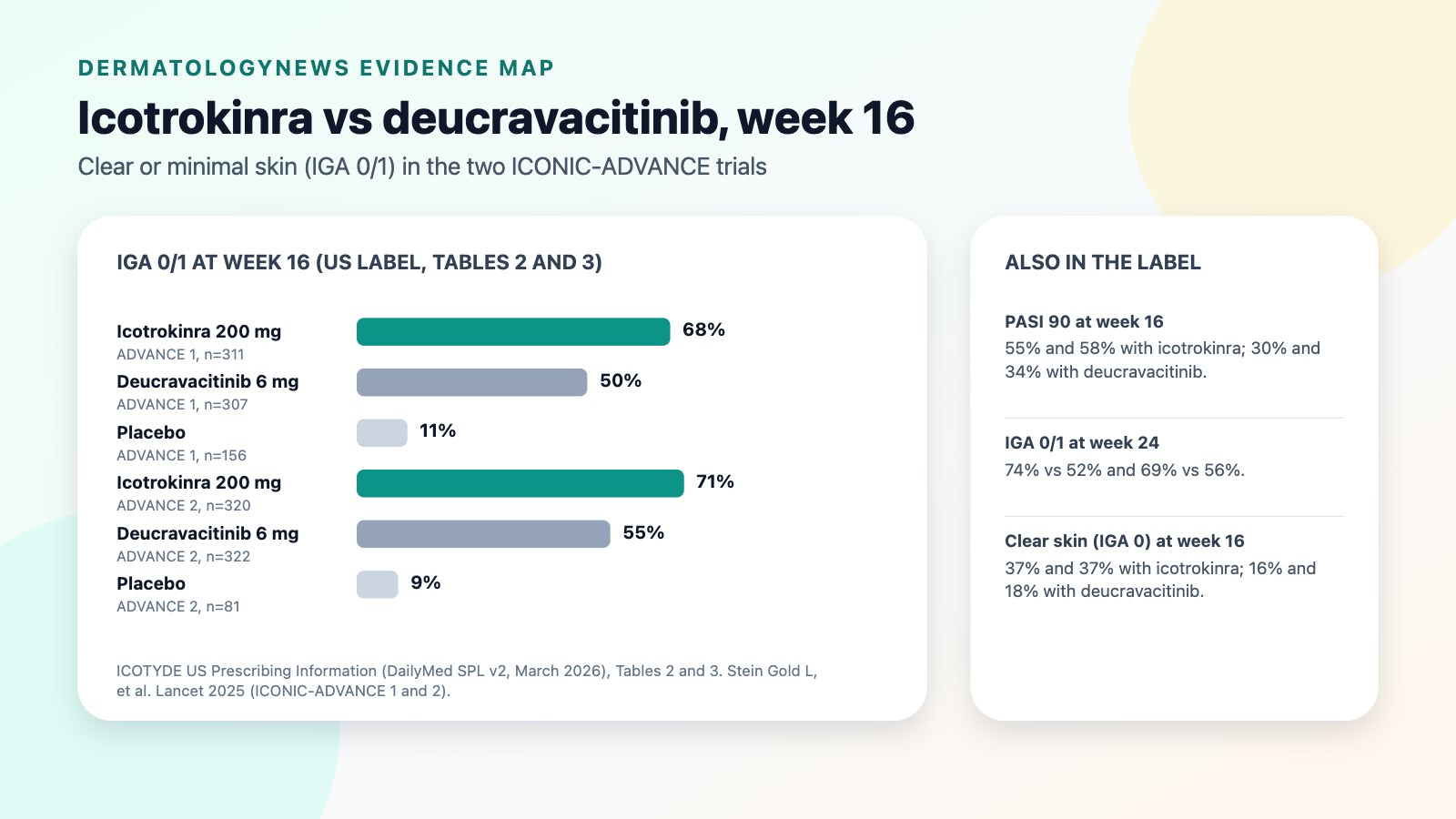
Icotrokinra, brand name Icotyde, is a 13-amino-acid peptide taken as a once-daily tablet. It binds the interleukin-23 (IL-23) receptor and blocks IL-23 signaling [1], a pathway that injected monoclonal antibodies against IL-23 and IL-12 already target [3]. The US label lists it for moderate-to-severe plaque psoriasis in adults and in children 12 years and older who weigh at least 40 kg and are candidates for systemic therapy or phototherapy [1]. At week 16 in the label's trial data, 65% of participants in ICONIC-LEAD reached clear or minimal skin with at least a two-grade improvement, against 8% on placebo [1]. In the two ICONIC-ADVANCE trials, the figures were 68% and 71% with icotrokinra, 50% and 55% with the oral drug deucravacitinib, and 11% and 9% with placebo [1]. The tablet is taken on waking on an empty stomach, at least 30 minutes before food [1].
How icotrokinra works and how it is taken
IL-23 is a cytokine involved in inflammatory and immune responses. Icotrokinra blocks it from binding its receptor and inhibits the IL-23-dependent release of inflammatory cytokines; in an exploratory analysis it lowered blood levels of IL-17A, IL-17F and IL-22 [1]. Antibodies against IL-23 and IL-12 work well in psoriasis but have to be given by injection or infusion [3].
The label's instructions are specific [1]:
- Dose: one 200 mg tablet once daily.
- Timing: on waking, on an empty stomach, with water, waiting at least 30 minutes before eating. A high-fat meal lowered total exposure to the drug by 43% and peak levels by 59%.
- Swallowing: whole, not crushed, split or chewed; for people who have trouble swallowing tablets, the tablet can be dispersed in at least 120 mL (4 ounces) of water.
- Missed dose: take it as soon as possible, then return to the usual schedule the next day.
- Before starting: consider testing for tuberculosis and complete age-appropriate vaccinations; avoid live vaccines during treatment.
- Kidneys: exposure was 2.47 times higher with moderate and 2.78 times higher with severe kidney impairment, and the label advises monitoring for adverse reactions when eGFR is below 60 mL/min.
What the phase 3 trials showed
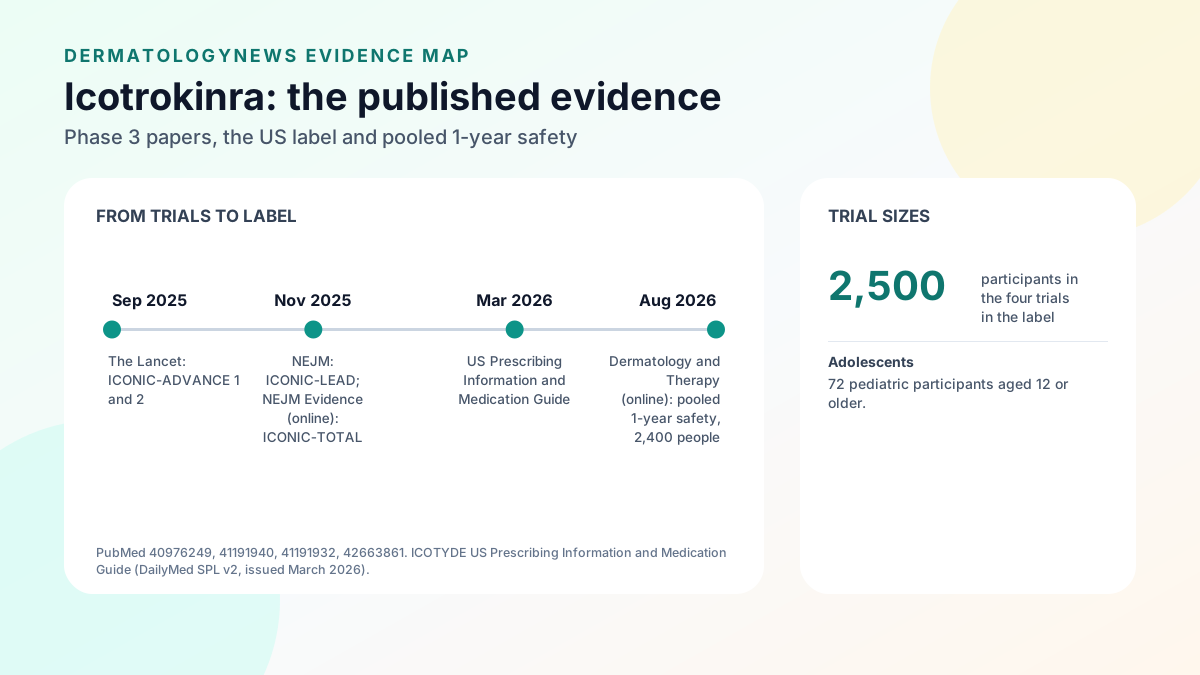
The label summarizes four randomized, double-blind trials with 2,500 participants, 2,428 adults and 72 adolescents [1]. The main measure at week 16 was clear or minimal skin on the Investigator's Global Assessment with at least a two-grade improvement (IGA 0/1); three of the trials also used a 90% improvement in the Psoriasis Area and Severity Index (PASI 90) [1].
Against placebo: ICONIC-LEAD
ICONIC-LEAD enrolled 684 adults and adolescents with psoriasis covering at least 10% of the body [1][2]. At week 16, 65% on icotrokinra versus 8% on placebo reached IGA 0/1, and 50% versus 4% reached PASI 90 [1]. Completely clear skin (IGA 0) was reached by 33% versus 1% [1]. Among the 66 adolescents, IGA 0/1 rates were 84% versus 27% [1].
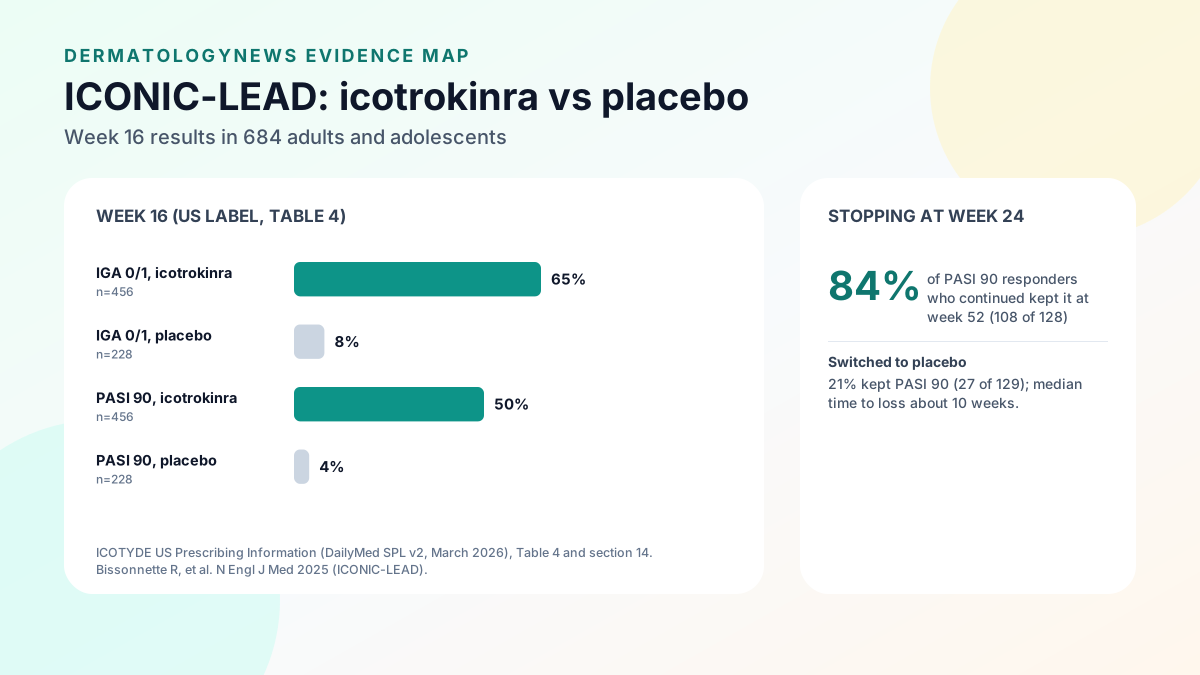
The trial also tested stopping treatment. Adults who had responded by week 24 were randomized again to continue icotrokinra or switch to placebo [1]. Among those with PASI 90 at week 24, 84% (108 of 128) who continued kept PASI 90 at week 52, compared with 21% (27 of 129) switched to placebo, who lost the response after a median of about 10 weeks [1].
Against deucravacitinib: ICONIC-ADVANCE 1 and 2
The two ICONIC-ADVANCE trials enrolled 1,505 adults and compared icotrokinra with placebo and with deucravacitinib 6 mg once daily, an oral TYK2 inhibitor with the brand name Sotyktu [1][6]. The comparison with deucravacitinib was a secondary end point [1].
| Week 16 result | Icotrokinra | Deucravacitinib | Placebo |
|---|---|---|---|
| IGA 0/1, ICONIC-ADVANCE 1 | 68% | 50% | 11% |
| IGA 0/1, ICONIC-ADVANCE 2 | 71% | 55% | 9% |
| PASI 90, ICONIC-ADVANCE 1 | 55% | 30% | 4% |
| PASI 90, ICONIC-ADVANCE 2 | 58% | 34% | 1% |
Source: US Icotyde label, Tables 2 and 3 [1]. At week 24, IGA 0/1 rates were 74% versus 52% in the first trial and 69% versus 56% in the second [1].
Scalp, genital, hand and foot psoriasis: ICONIC-TOTAL
ICONIC-TOTAL enrolled 311 people aged 12 and older with at least moderate psoriasis of the scalp, genitals or hands and feet and a body surface area of at least 1% [4]. At week 16, 56.7% on icotrokinra versus 5.8% on placebo reached overall IGA 0/1 [4]. Rates of clear or almost clear skin at each site were 65.9% versus 10.6% for the scalp and 76.5% versus 21.4% for the genitals; for the hands and feet, 41.7% versus 26.1% was not a significant difference (P = .144) [4]. Treatment of psoriasis in skin folds and the genital area is covered in our article on inverse psoriasis.
Side effects and safety data
In the label's pooled 16-week data (1,296 on icotrokinra, 568 on placebo), the adverse reactions listed as more common than with placebo were headache (4.1% versus 3.3%), nausea (1.2% versus 0.5%), cough (1.2% versus 0.2%), fungal infections (1.1% versus 0%) and fatigue (1.0% versus 0.5%) [1]. Serious infections occurred in 0.2% versus 0.4% [1]. Less common reactions included gastritis and abdominal discomfort, and one person with underlying risk factors died of upper gastrointestinal bleeding; the label states that a relationship to the drug is not established [1]. Anti-drug antibodies developed in 9.6% through week 52, none neutralizing and without a clinically relevant effect [1].
A pooled analysis of all four trials followed 2,400 people on icotrokinra for 1,840 participant-years through week 52 [5]. The rates per 100 participant-years were 167 for adverse events, 4.6 for serious adverse events, 76 for infections and 3.0 for adverse events leading to discontinuation [5]. Through week 24, infection rates were 81 per 100 participant-years with icotrokinra versus 119 with deucravacitinib [5].
The label lists no contraindications [1]. Human pregnancy data are insufficient to evaluate risk, and there is a pregnancy safety study; there are no data on breastfeeding [1].
How the three psoriasis pills compare on their labels
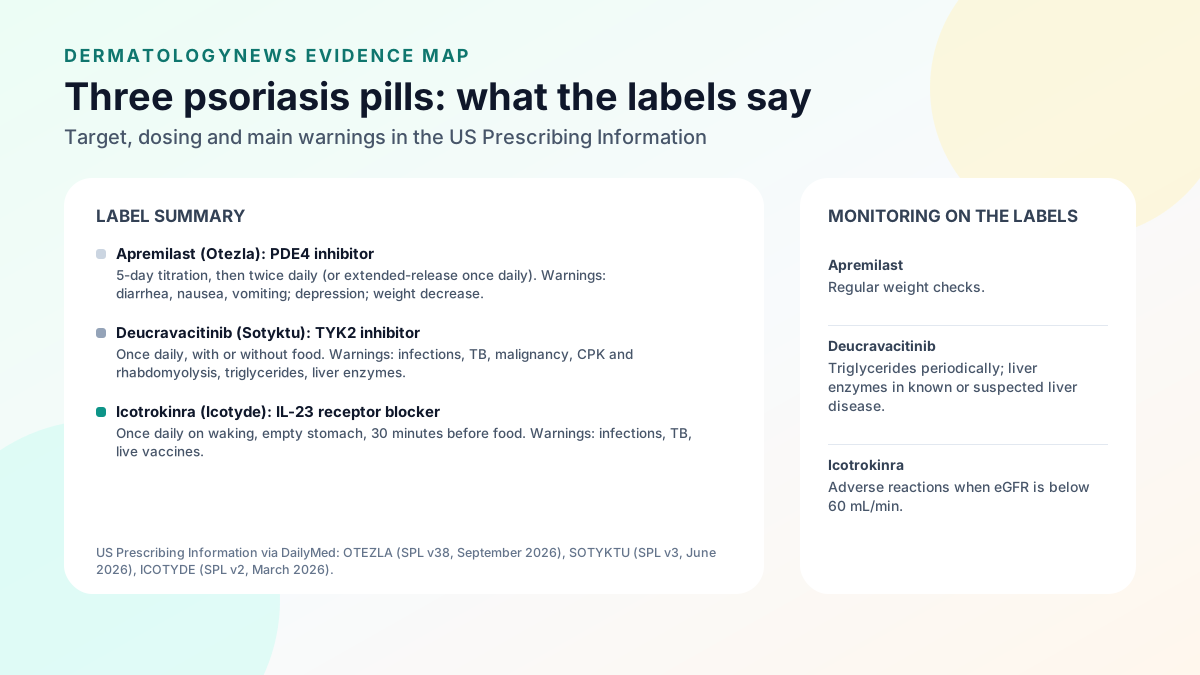
Apremilast, deucravacitinib and icotrokinra are oral drugs aimed at specific steps of psoriasis inflammation. Their US labels differ in target, dosing and warnings [1][6][7]:
| Label item | Apremilast (Otezla) | Deucravacitinib (Sotyktu) | Icotrokinra (Icotyde) |
|---|---|---|---|
| Target | PDE4 inhibitor | TYK2 inhibitor (JAK family) | IL-23 receptor blocker |
| Psoriasis population | Adults who are candidates for phototherapy or systemic therapy; moderate to severe disease from age 6 and 20 kg | Adults with moderate-to-severe disease who are candidates for systemic therapy or phototherapy | Moderate-to-severe disease from age 12 and 40 kg, candidates for systemic therapy or phototherapy |
| Dosing | 5-day titration, then twice daily (or an extended-release tablet once daily) | Once daily, with or without food | Once daily on waking, empty stomach, 30 minutes before food |
| Main warnings | Diarrhea, nausea and vomiting; depression; weight decrease | Infections; tuberculosis testing; malignancy; muscle breakdown with raised CPK; raised triglycerides and liver enzymes | Infections; tuberculosis; live vaccines |
| Monitoring named in the label | Body weight | Triglycerides; liver enzymes in known or suspected liver disease | Adverse reactions when eGFR is below 60 mL/min |
The deucravacitinib label also carries a precaution on potential risks related to JAK inhibition, and TYK2 is a member of the JAK family [6]; JAK inhibitor tablets in another skin disease are covered in our article on alopecia areata. The labels caution that adverse reaction rates from different drugs' trials cannot be compared directly [1][6][7].
Limitations and realistic expectations
- Short follow-up. The placebo-controlled comparisons last 16 weeks, the deucravacitinib comparison 24 weeks and the pooled safety data 52 weeks; the ICONIC-LEAD authors note that longer-term data are needed for a complete benefit-risk picture [1][2][5].
- One sponsor. ICONIC-LEAD, ICONIC-ADVANCE and ICONIC-TOTAL all received funding from Johnson & Johnson [2][3][4].
Questions to bring to the prescriber
- Does my psoriasis count as moderate to severe, and am I a candidate for systemic therapy or phototherapy, as the label requires [1]?
- Can I take a tablet every morning on an empty stomach and wait 30 minutes before eating [1]?
- Do I need tuberculosis testing or vaccinations before starting [1]?
- How would a daily tablet compare with an injected biologic for my scalp or genital involvement [4]?
- Does my kidney function, a planned pregnancy or breastfeeding change the choice [1]?
Bottom line
Icotrokinra is a once-daily peptide tablet that blocks the IL-23 receptor [1]. At week 16 in the label's data, 65% of participants on icotrokinra in ICONIC-LEAD and 68% and 71% in the two ICONIC-ADVANCE trials reached clear or minimal skin with at least a two-grade improvement, against 8%, 11% and 9% on placebo and 50% and 55% on deucravacitinib [1]. The pooled 1-year safety data show event rates per 100 participant-years of 4.6 for serious adverse events and 76 for infections [5].
Common questions
- What is Icotyde?
- Icotyde is the brand name of icotrokinra, a 13-amino-acid peptide taken as a tablet that binds the interleukin-23 receptor and blocks interleukin-23 signaling [1]. The US label lists it for moderate-to-severe plaque psoriasis in adults and in children 12 years and older who weigh at least 40 kg and are candidates for systemic therapy or phototherapy [1].
- How do you take Icotyde?
- The label's dose is one 200 mg tablet once daily, taken on waking on an empty stomach with water, waiting at least 30 minutes before eating [1]. The tablet is swallowed whole, or dispersed in at least 120 mL of water for people who have trouble swallowing tablets [1]. A high-fat meal lowered exposure to the drug by 43% [1].
- Does Icotyde work better than Sotyktu?
- In the two ICONIC-ADVANCE trials, 68% and 71% of adults on icotrokinra reached clear or minimal skin with at least a two-grade improvement at week 16, compared with 50% and 55% on deucravacitinib (Sotyktu) and 11% and 9% on placebo [1].
- What are the side effects of Icotyde?
- In the label's pooled 16-week data, headache (4.1% versus 3.3% with placebo), nausea, cough, fungal infections and fatigue occurred more often than with placebo [1]. Serious infections occurred in 0.2% versus 0.4% [1]. The label lists no contraindications and carries warnings about infections, tuberculosis and live vaccines [1].
References
- ICOTYDE (icotrokinra) tablets, for oral use. US Prescribing Information and Medication Guide. — Janssen Biotech, labeling via DailyMed (U.S. National Library of Medicine); SPL version 2, effective March 17, 2026; NDA 220149
- Bissonnette R, Soung J, Hebert AA, et al. Oral Icotrokinra for Plaque Psoriasis in Adults and Adolescents. — New England Journal of Medicine, 2025;393(18):1784-1795 (ICONIC-LEAD) · PMID: 41191940 · DOI: 10.1056/NEJMoa2504187
- Stein Gold L, Armstrong AW, Bissonnette R, et al. Once-daily oral icotrokinra versus placebo and once-daily oral deucravacitinib in participants with moderate-to-severe plaque psoriasis (ICONIC-ADVANCE 1 & 2): two phase 3, randomised, placebo-controlled and active-comparator-controlled trials. — The Lancet, 2025;406(10510):1363-1374 · PMID: 40976249 · DOI: 10.1016/S0140-6736(25)01576-4
- Gooderham M, Lain E, Bissonnette R, et al. Targeted Oral Peptide Icotrokinra for Psoriasis Involving High-Impact Sites. — NEJM Evidence, 2025;4(12):EVIDoa2500155 (ICONIC-TOTAL) · PMID: 41191932 · DOI: 10.1056/EVIDoa2500155
- Lebwohl MG, Gooderham M, Warren RB, et al. Safety of Icotrokinra Through 1 Year for the Treatment of Moderate-to-Severe Plaque Psoriasis and Psoriasis Affecting High-Impact Sites: Pooled Results Across the ICONIC-LEAD, ICONIC-TOTAL, and ICONIC-ADVANCE 1 and 2 Phase 3 Trials. — Dermatology and Therapy, 2026;16(10):5049-5068 · PMID: 42663861 · DOI: 10.1007/s13555-026-01885-w
- SOTYKTU (deucravacitinib) tablets, for oral use. US Prescribing Information. — E.R. Squibb & Sons, labeling via DailyMed (U.S. National Library of Medicine); SPL version 3, effective June 30, 2026; NDA 214958
- OTEZLA (apremilast) tablets, for oral use. US Prescribing Information. — Amgen, labeling via DailyMed (U.S. National Library of Medicine); SPL version 38, effective September 2, 2026; NDA 205437