What is dermatographia, and what treats it in 2026?
Dermatographia, or skin writing, raises welts where skin is scratched. When it needs treatment, how it is tested, and what the 2026 Rhapsido approval adds.
Dermatographia, also called dermatographism or skin writing, becomes a condition worth treating when the welts that rise after scratching or rubbing also itch or burn and keep coming back [2][4]. Second-generation antihistamines come first [3]. Since October 2026, remibrutinib (Rhapsido) has been FDA-approved for adults whose symptoms persist despite H1 antihistamines [1][9].
Doctors call this form symptomatic dermographism; older names are urticaria factitia and dermographic urticaria. It is the most common chronic inducible urticaria, a group of hives with a definite trigger, here friction on the skin [2][3][4]. The wheals usually appear within 1 to 5 minutes and last about 30 minutes [2].
Dermatographia or a normal skin response?
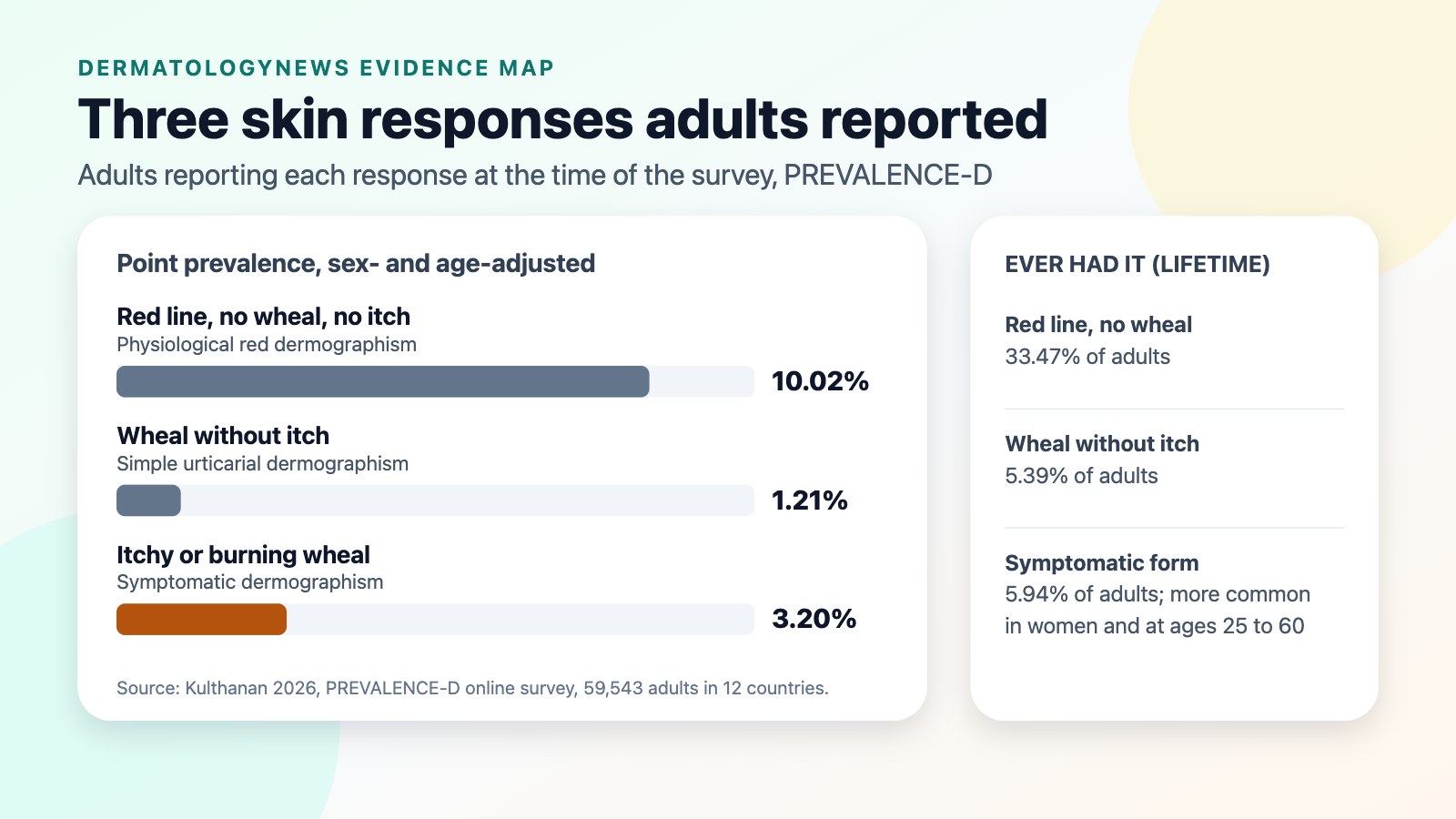
The PREVALENCE-D survey asked adults in 19 countries, with pictures, whether they recognized any of three skin responses to firm stroking; its international estimates pool 59,543 participants from 12 of those countries [2]:
| Response reported | What appears | Itch or burning | Now | Ever |
|---|---|---|---|---|
| Physiological red dermographism | A red line, no raised wheal | No | 10.02% | 33.47% |
| Simple urticarial dermographism | A raised wheal | No | 1.21% | 5.39% |
| Symptomatic dermographism | A raised wheal | Yes | 3.20% | 5.94% |
Sex- and age-adjusted estimates from PREVALENCE-D [2].
The red line is a normal vascular reaction to friction, and the 2016 consensus on inducible urticaria calls a wheal without itch a common physiological variant [2][4]. Guideline treatment advice concerns the symptomatic form, defined by friction-induced wheals that cause symptoms plus a positive provocation test [2][3][4]. Women reported it more often than men (3.39% versus 3.02%), and it was most common at ages 25 to 60 (3.80%); country estimates ranged from 0.72% in Iran to 11.70% in Thailand [2].
What causes dermatographia?
The trigger is friction: stroking, scratching, scrubbing or rubbing. Wheals follow the line of a scratch, or form broader patches where friction covers a wider area, such as the palms after using a screwdriver [2][4]. In severe cases loose clothing or unnoticed scratching is enough, which can make the condition look like chronic spontaneous urticaria, the form without a definite trigger [3].
Why some people react this way is not fully understood [2]. Urticaria is driven mainly by mast cells, which release histamine and other mediators [3]. An IgE-dependent mechanism is suspected in symptomatic dermographism, because people with it have higher total IgE levels and improve with omalizumab, an anti-IgE antibody [2][6]. The condition tends to last: the 2016 consensus gives an average duration of 6.5 years, with wide variation [4].
How is dermatographia diagnosed?
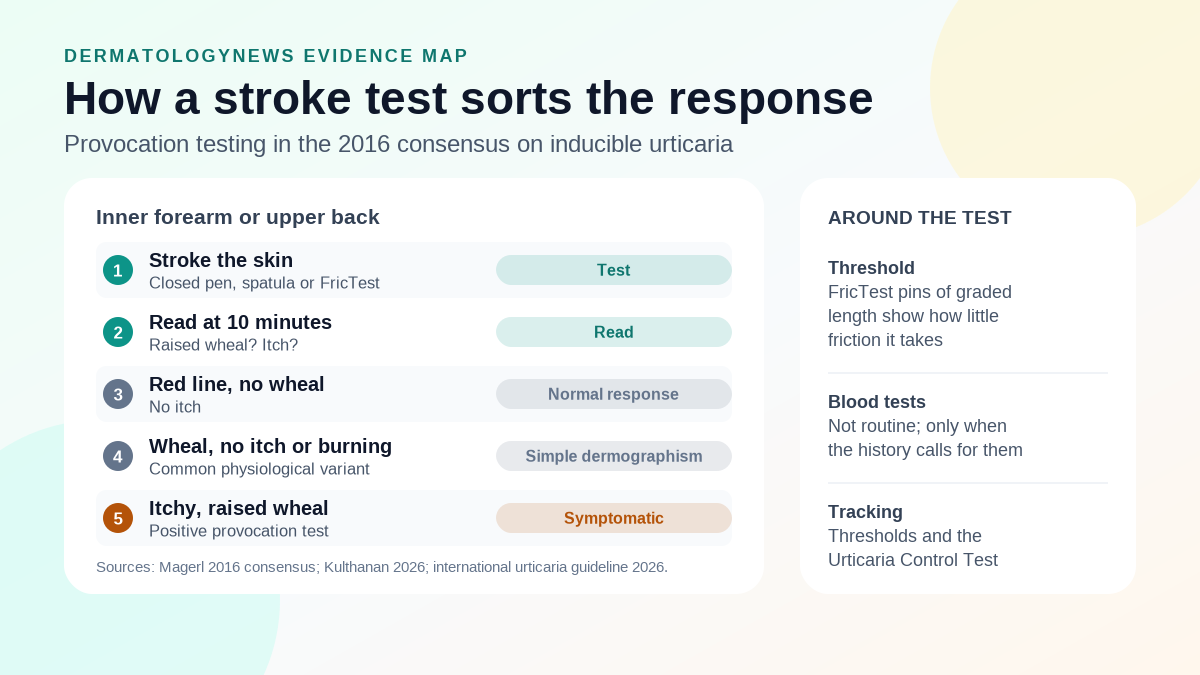
The international guideline recommends a provocation test to diagnose chronic inducible urticaria [3]:
- Stroke test: a smooth, blunt object such as a closed ballpoint pen or a wooden spatula is stroked across the inner forearm or upper back. An itchy, raised wheal within 10 minutes is a positive test; a wheal without itch indicates simple dermographism [4].
- Threshold test: the FricTest, a plastic comb with four tips 3.0 to 4.5 mm long, applies graded friction. A pin's response counts as positive when an itchy wheal at least 3 mm wide appears within 10 minutes [4]. The guideline uses these thresholds and the Urticaria Control Test, a short questionnaire, to track the disease [3].
- Antihistamines before testing: they can suppress the reaction. The consensus advises pausing them for at least 3 days when the patient can tolerate it, so ask the testing clinic whether and when to pause yours [4].
- Blood tests: not routine; a blood count and ESR or CRP are added only when the history calls for them [3].
When to see a clinician
See a clinician for wheals that itch or burn after rubbing and keep returning [4], for hives that have come and gone for more than 6 weeks, the guideline's definition of chronic urticaria, and for symptoms that a standard antihistamine dose does not control [3]. Hives that also appear without rubbing can mean chronic spontaneous urticaria as well, since the two can occur together [3]. Single wheals that last longer than a day need a check, because ordinary wheals fade within 30 minutes to 24 hours and the guideline uses wheal duration to rule out conditions such as urticarial vasculitis [3]. Deeper swelling (angioedema) is rare in symptomatic dermographism [4]. If your tongue or throat swells, or you have trouble breathing, seek emergency help immediately [11].
Itch without welts has other causes; see our article on winter itch and asteatotic eczema.
Treatment: what the guidelines recommend
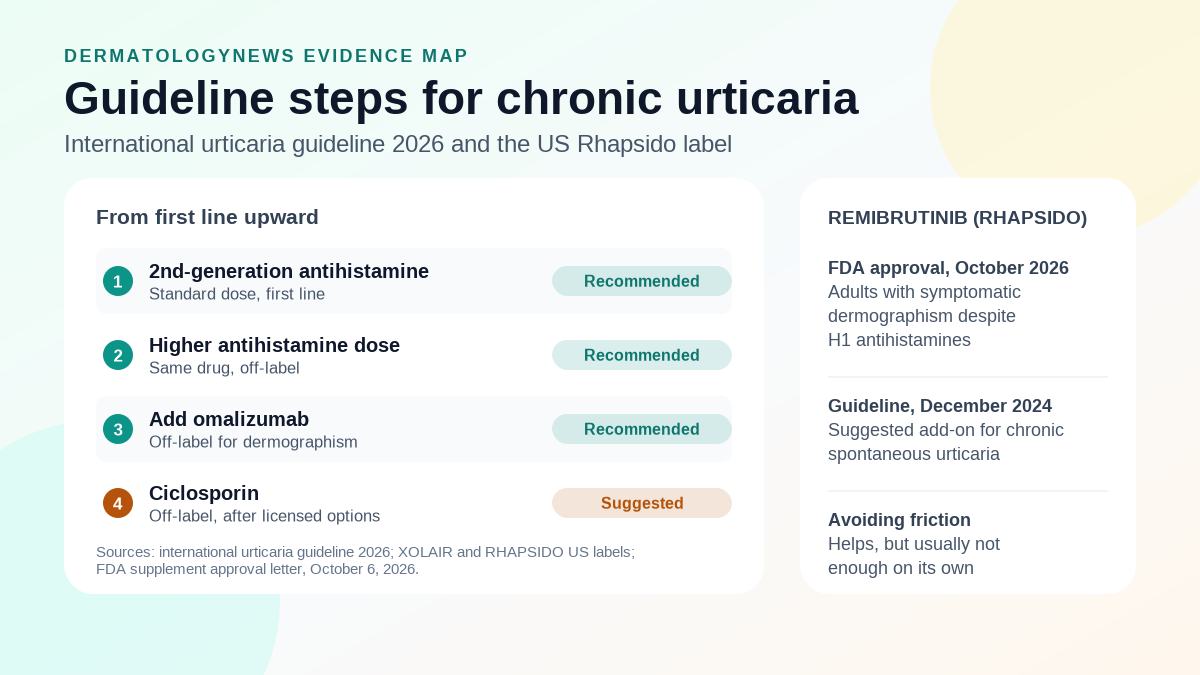
The guideline aims at complete symptom control with the lowest effective treatment until the disease is gone; current drugs control the reaction rather than cure it [3]. Avoiding friction helps but is usually not enough on its own [3].
Antihistamines first
The first-line treatment for all urticaria, a strong recommendation, is a second-generation H1 antihistamine at the standard dose; these drugs are generally less likely to cause drowsiness than older antihistamines [3]. In a systematic review of 23 studies in symptomatic dermographism (15 randomized trials, 430 adults), second-generation antihistamines were effective and well tolerated in every study, while first-generation ones had variable efficacy and significant side effects [5]. The guideline recommends against first-generation antihistamines as routine first-line treatment [3].
For inducible urticaria, the guideline suggests taking the antihistamine daily or before expected trigger exposure, depending on the triggers [3]. If the standard dose does not work, a clinician may raise it up to fourfold, which is off-label; the guideline recommends this before other treatments and advises against higher doses [3]. The 2020 review found no study of up-dosing in symptomatic dermographism itself [5]. Further improvement is not expected after 1 to 2 weeks of an antihistamine [3]. Adding an H2 antihistamine improved the response in dermatographism studies, though an H2 antihistamine alone did not work [5]; the guideline makes no recommendation either way [3].
When antihistamines are not enough
For chronic urticaria that does not respond to high-dose antihistamines, the guideline recommends adding omalizumab, an injected anti-IgE antibody [3]. Omalizumab is FDA-approved for chronic spontaneous urticaria; its use for symptomatic dermographism is off-label, although a randomized placebo-controlled trial found it effective [6][10]. Its label carries a boxed warning for anaphylaxis, so treatment starts in a healthcare setting with observation afterward [10]. Ciclosporin, also off-label, is suggested only when licensed treatments fail or are unavailable [3]. Phototherapy for 1 to 3 months can be added to antihistamines, with caution because ultraviolet light is carcinogenic; nifedipine has been shown not to work [3].
What the October 2026 approval of remibrutinib (Rhapsido) changes
On October 6, 2026, the FDA approved remibrutinib for adults with symptomatic dermographism who remain symptomatic despite H1 antihistamine treatment [9]. It had been approved for chronic spontaneous urticaria in September 2025 [3]. The 2026 guideline, agreed in December 2024, suggests remibrutinib as an add-on for chronic spontaneous urticaria and predates the dermographism approval [3].
Remibrutinib blocks Bruton's tyrosine kinase (BTK), a signaling protein in mast cells and basophils, and with it their release of histamine and other mediators [1]. The label dose is one 25 mg tablet twice daily, with or without food, swallowed whole; a missed dose is skipped, not made up. The label lists no contraindications [1].
What the RemIND trial showed
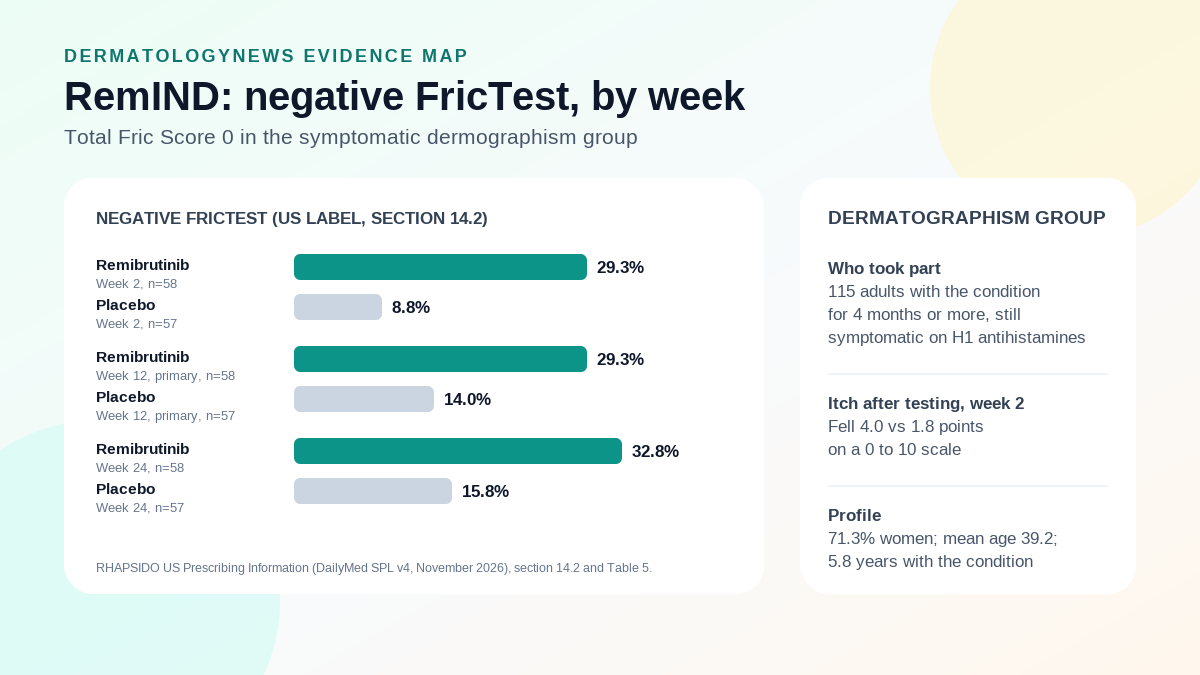
RemIND, a Novartis-sponsored trial, enrolled 362 people with three kinds of inducible urticaria [8]. Its dermatographism group included 115 adults who had had the condition for at least 4 months and still had symptoms on an H1 antihistamine at randomization, with a Total Fric Score of 3 or 4 on the FricTest and itch of at least 5 out of 10 after provocation [1][8]. They were 71.3% women, with a mean age of 39.2 years and 5.8 years of disease on average [1]. For 24 weeks they took remibrutinib (58) or placebo (57), double-blind, alongside their antihistamine; both groups then took open-label remibrutinib to week 52 [1].
The primary end point was complete response at week 12: a Total Fric Score of 0, that is, a negative FricTest in which none of the four pins produced a positive wheal [1][4].
| Label end point | Remibrutinib (n=58) | Placebo (n=57) | Estimated treatment difference (95% confidence interval) |
|---|---|---|---|
| Negative FricTest, week 2 | 29.3% | 8.8% | 20.5 percentage points (6.6 to 34.4) |
| Negative FricTest, week 12 (primary) | 29.3% | 14.0% | 15.0 percentage points (0.3 to 29.7) |
| Negative FricTest, week 24 | 32.8% | 15.8% | 15.6 percentage points (0.3 to 30.9) |
| Itch after provocation (0 to 10 scale), change at week 2 | −4.0 points | −1.8 points | −2.2 points (−3.2 to −1.2) |
US Rhapsido label, section 14.2 and Table 5 [1]. All four end points were statistically significant, and the week-12 results were consistent regardless of baseline total IgE [1].
Side effects and label warnings
Bleeding is the label's main warning: bleeding of the skin or mucous membranes occurred in 9% of people on remibrutinib in clinical trials [1]. In the pooled 24-week chronic spontaneous urticaria trials, bleeding events occurred in 9% versus 2% on placebo, mostly petechiae (tiny red or purple spots, 4%) and bruising (2%); none was severe, none was linked with low platelet counts, and 0.5% stopped treatment because of bleeding [1]. The published REMIX trials reported petechiae in 3.8% versus 0.3% [7]. Bleeding in the dermatographism trial was consistent with these data [1].
Report signs of bleeding to the prescriber promptly: bruising, red or purple skin marks, pink or brown urine, red or black stools, or headache, dizziness, confusion or weakness [1]. The label tells prescribers to interrupt remibrutinib if bleeding occurs and for 3 to 7 days pre- and post-surgery or invasive procedures, depending on the procedure and the bleeding risk; if a procedure is planned, ask the prescriber for stop and restart dates [1]. Antithrombotic drugs may raise the bleeding risk further; anticoagulants were not allowed in the trials, while aspirin up to 100 mg and clopidogrel up to 75 mg a day were [1].
Other points from the label [1]:
- Common adverse reactions in the 24-week chronic spontaneous urticaria trials were nasopharyngitis (11% versus 9%), bleeding (9% versus 2%), headache (7% versus 6%), nausea (3% versus 2%) and abdominal pain (3% versus 2%); safety in the dermatographism trial was consistent.
- Vaccines and medicines: live vaccines should be avoided, as should strong or moderate CYP3A4 inhibitors and inducers. The prescriber may monitor certain medicines more closely, including digoxin, because small changes in their levels can cause serious side effects.
- Liver: remibrutinib should be avoided in mild, moderate or severe hepatic impairment.
- Pregnancy, breastfeeding and age: human pregnancy data are insufficient (malformations occurred in rabbits at 141 times the human exposure, and there is a pregnancy registry); there are no breastfeeding data; use in children is not established, and only 2 people aged 65 or older took part in the dermatographism trial.
Limitations and realistic expectations
- Most participants did not reach a negative FricTest. At week 12, 29.3% on remibrutinib did, and the lower end of the confidence interval for the difference from placebo was 0.3 percentage points [1].
- One manufacturer-sponsored trial. The dermatographism data come from 115 adults with a 24-week placebo-controlled period [1][8]. The table uses the FDA label; as of November 24, 2026, RemIND results had appeared only as conference abstracts, not as a full peer-reviewed report.
- Thin antihistamine evidence. Most treatment studies in symptomatic dermographism were single-center, old, small and unrepeated [5].
- Self-reported prevalence. PREVALENCE-D was an online survey with no participants from Africa, and people with symptoms may have been more willing to take part, which could overstate the figures [2].
- Unpredictable course. Urticaria can remit at any time, so the guideline advises reviewing the need for treatment every 3 to 6 months [3].
Questions to ask at the appointment
- Would a stroke test or FricTest confirm symptomatic dermographism, and should I pause my antihistamine before it [4]?
- Should I take my antihistamine every day or before activities that rub my skin, and when would a higher dose make sense [3]?
- Am I a candidate for remibrutinib, and how does it fit with my other medicines, especially blood thinners [1]?
- I have a procedure planned. When should I stop remibrutinib, and when can I restart it [1]?
Bottom line
Dermatographia is a raised line where the skin is stroked or scratched; it needs treatment when the wheals itch or burn and keep returning, the symptomatic form that an adjusted 3.20% of adults in the PREVALENCE-D survey reported [2][4]. A stroke test or FricTest read at 10 minutes confirms it [4]. Second-generation antihistamines come first; if the usual dose fails, a clinician may raise it or add omalizumab [3]. Since October 6, 2026, remibrutinib has been FDA-approved for adults still symptomatic on H1 antihistamines; in its trial, 29.3% versus 14.0% had a negative FricTest at week 12, and bleeding is its main warning [1][9].
Common questions
- What is dermatographia?
- Dermatographia, also called dermatographism or skin writing, is a raised line (a wheal) where the skin is stroked, scratched or rubbed. When the wheals itch or burn and keep coming back, it is symptomatic dermographism, the most common chronic inducible urticaria [2][4]. A red line, or a raised line that neither itches nor burns, is a normal skin response [2][4].
- How is dermatographia diagnosed?
- A clinician strokes the inner forearm or upper back with a smooth, blunt object such as a closed ballpoint pen, or with a FricTest, and checks after 10 minutes; an itchy, raised wheal confirms symptomatic dermographism [4]. Ask the testing clinic whether and when to pause antihistamines beforehand [4]. Blood tests are not routine [3].
- What is the treatment for dermatographia?
- A second-generation H1 antihistamine at the standard dose comes first. If that does not control symptoms, a clinician may raise the dose up to fourfold (off-label) and then add omalizumab, which is FDA-approved for chronic spontaneous urticaria and off-label for dermographism [3][10]. Since October 2026, remibrutinib (Rhapsido) has been FDA-approved for adults with symptomatic dermographism who remain symptomatic despite H1 antihistamines [1][9].
- How well does Rhapsido work for dermatographia?
- In the 115-adult dermatographism group of the RemIND trial, 29.3% on remibrutinib and 14.0% on placebo had a negative FricTest at week 12, and 32.8% and 15.8% at week 24, according to the FDA label [1].
- What are the side effects of Rhapsido?
- In the label's 24-week trials in chronic spontaneous urticaria, nasopharyngitis (11% versus 9% with placebo), bleeding (9% versus 2%), headache, nausea and abdominal pain were more common than with placebo; none of the bleeding was severe [1]. Report bleeding promptly. If a procedure is planned, ask the prescriber when to stop and restart; the label tells prescribers to interrupt treatment for 3 to 7 days pre- and post-surgery or invasive procedures [1].
- How long does dermatographia last?
- Often for years: the 2016 consensus on inducible urticaria gives an average duration of 6.5 years, with wide variation [4]. Urticaria can remit at any time, so the international guideline advises reviewing the need for treatment every 3 to 6 months [3].
References
- RHAPSIDO (remibrutinib) tablets, for oral use. US Prescribing Information and Patient Information. — Novartis Pharmaceuticals, labeling via DailyMed (U.S. National Library of Medicine); revised October 2026, SPL version 4, effective November 16, 2026; NDA 218436
- Kulthanan K, Bernstein JA, Rudenko M, et al. The Prevalence of Symptomatic Dermographism: Results of the International UCARE PREVALENCE-D Study. — Allergy, 2026;81(2):468-479 · PMID: 40944435 · DOI: 10.1111/all.70047
- Zuberbier T, Ansari ZA, Abdul Latiff AH, et al. The International Guideline for the Definition, Classification, Diagnosis and Management of Urticaria. — Allergy, 2026;81(8):2582-2632 (GA²LEN international urticaria guideline, consensus conference December 2024) · PMID: 41649409 · DOI: 10.1111/all.70210
- Magerl M, Altrichter S, Borzova E, et al. The definition, diagnostic testing, and management of chronic inducible urticarias - The EAACI/GA(2) LEN/EDF/UNEV consensus recommendations 2016 update and revision. — Allergy, 2016;71(6):780-802 · PMID: 26991006 · DOI: 10.1111/all.12884
- Kulthanan K, Ungprasert P, Tuchinda P, et al. Symptomatic Dermographism: A Systematic Review of Treatment Options. — Journal of Allergy and Clinical Immunology: In Practice, 2020;8(9):3141-3161 · PMID: 32473421 · DOI: 10.1016/j.jaip.2020.05.016
- Maurer M, Schütz A, Weller K, et al. Omalizumab is effective in symptomatic dermographism-results of a randomized placebo-controlled trial. — Journal of Allergy and Clinical Immunology, 2017;140(3):870-873.e5 · PMID: 28389391 · DOI: 10.1016/j.jaci.2017.01.042
- Metz M, Giménez-Arnau A, Hide M, et al. Remibrutinib in Chronic Spontaneous Urticaria. — New England Journal of Medicine, 2025;392(10):984-994 (REMIX-1 and REMIX-2) · PMID: 40043237 · DOI: 10.1056/NEJMoa2408792
- A 52-week multi-center, randomized, double-blind, placebo controlled, basket study with an open-label extension to investigate the efficacy, safety, and tolerability of remibrutinib (LOU064) in chronic inducible urticaria (CINDU) in adults inadequately controlled by H1-antihistamines (RemIND). — ClinicalTrials.gov, NCT05976243; sponsor Novartis Pharmaceuticals
- FDA. Supplement approval letter, NDA 218436/S-001: Rhapsido (remibrutinib) tablets, new indication for symptomatic dermographism in adults who remain symptomatic despite use of H1 antihistamine. — U.S. Food and Drug Administration, Center for Drug Evaluation and Research; signed October 6, 2026
- XOLAIR (omalizumab) injection, for subcutaneous use. US Prescribing Information. — Genentech, labeling via DailyMed (U.S. National Library of Medicine); SPL version 32, effective August 13, 2026
- American College of Allergy, Asthma and Immunology. Anaphylaxis: causes, symptoms and treatment. — ACAAI patient information, reviewed March 24, 2025