Hidradenitis suppurativa treatment: the 2026 AAD guideline
Which hidradenitis suppurativa treatments the joint AAD–HSF guideline of 2026 recommends strongly or conditionally, what the biologic trials found and which drugs are FDA-approved.
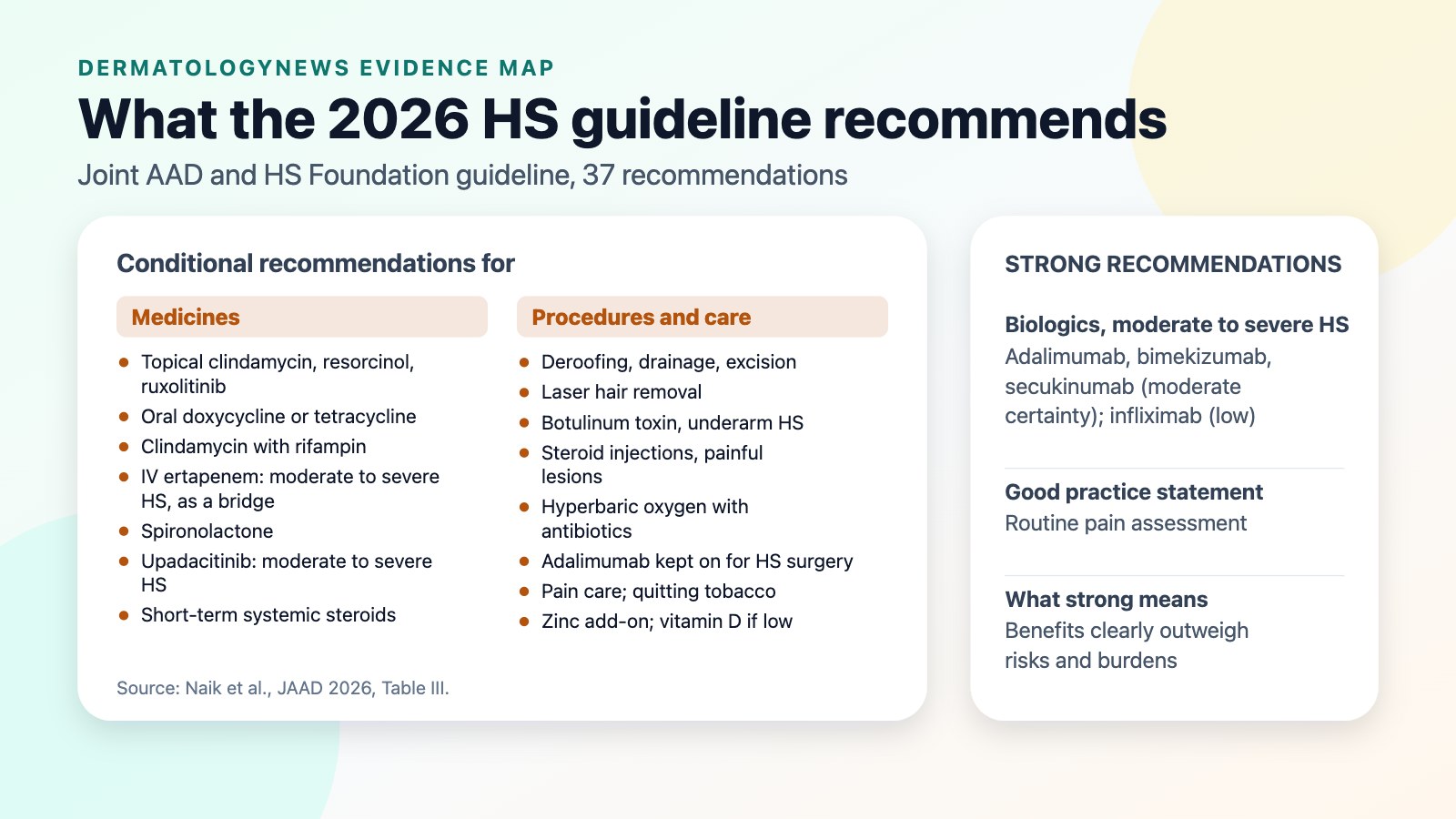
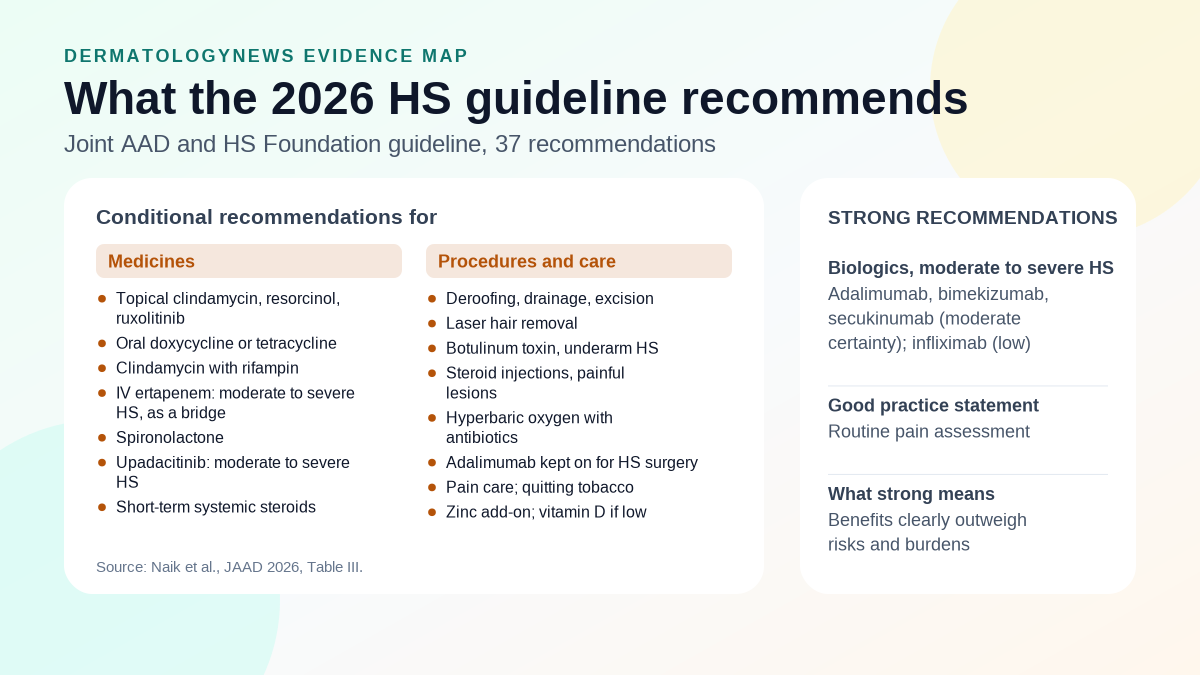
For hidradenitis suppurativa treatment, the 2026 joint American Academy of Dermatology–Hidradenitis Suppurativa Foundation guideline strongly recommends four biologics, adalimumab, bimekizumab, infliximab and secukinumab, for moderate-to-severe disease, and routine pain assessment [1]. Antibiotics, topical treatments, upadacitinib, spironolactone and several procedures carry conditional recommendations, where the right choice depends on each patient's priorities [1].
Hidradenitis suppurativa (HS) is a chronic, relapsing inflammatory skin disease with recurrent painful nodules, abscesses and tunnels, mainly in skin folds such as the armpits, inner thighs and groin [1][2]. It affects an estimated 0.7% to 1.5% of people worldwide, and diagnosis takes 7 to 10 years on average [1]. Early lesions are often mistaken for acne or an infection [2]. The guideline, published online in the Journal of the American Academy of Dermatology on October 20, 2026, is the first joint guideline from the two organizations [2]. It covers adults, adolescents and children over age 9 [1]. Its work group ran a systematic review, rated the certainty of evidence with the GRADE approach and made 37 recommendations [1].
What do strong and conditional recommendations mean?
A strong recommendation means the benefits clearly outweigh the risks and burdens, and it applies to most patients in most circumstances [1]. A conditional recommendation means benefits are closely balanced with risks and burdens: it applies to most patients, but the most appropriate choice may differ with each patient's values [1]. Good practice statements count as strong recommendations [1].
The guideline also grades the certainty of the evidence behind each recommendation as high, moderate, low or very low. Certainty describes confidence in the data, not how useful a treatment is in practice, and the guideline treats the strength of a recommendation as the main clinical direction [1].
| Option | Strength [1] | Certainty [1] |
|---|---|---|
| Adalimumab, bimekizumab, secukinumab, in moderate to severe HS | Strong for | Moderate |
| Infliximab, in moderate to severe HS | Strong for | Low |
| Routine pain assessment | Good practice statement | Not graded |
| Topical clindamycin, resorcinol, ruxolitinib | Conditional for | Low |
| Oral doxycycline, tetracycline, clindamycin with rifampin | Conditional for | Very low |
| Ertapenem, in moderate to severe HS | Conditional for | Very low |
| Spironolactone | Conditional for | Very low |
| Upadacitinib, in moderate to severe HS | Conditional for | Low |
| Short-term systemic corticosteroids, in moderate to severe HS | Conditional for | Very low |
| Deroofing, incision and drainage, excision, laser hair removal, botulinum toxin, intralesional triamcinolone, hyperbaric oxygen added to antibiotics | Conditional for | Very low |
| Continuing adalimumab around HS surgery | Conditional for | Low |
| Supportive pain management; tobacco cessation | Conditional for | Very low |
| Clinician-guided zinc as an add-on; vitamin D replacement when levels are low | Conditional for | Very low |
| Acitretin, isotretinoin, etanercept; methotrexate or azathioprine as active therapy | Conditional against | Very low |
| Guselkumab, risankizumab, vilobelimab, avacopan | Conditional against | Low |
| Radiotherapy in children and adolescents | Against (good practice statement) | Not graded |
| Combined oral contraceptive pills, finasteride, radiotherapy in general, weight reduction, GLP-1 medicines, specific diets | Insufficient evidence | Not graded |
Open the recommendations figure at full size
Biologics: the four strong recommendations
The four biologics are antibodies that act on the immune system. Adalimumab and infliximab block tumor necrosis factor; secukinumab blocks interleukin-17A, and bimekizumab blocks interleukin-17A and interleukin-17F [4][6][9][11].
Three of them, adalimumab, secukinumab and bimekizumab, were tested against placebo in six phase 3 trials, and the guideline rates the certainty of their evidence as moderate [1][4][5][6]. The trials measured HiSCR50: at least a 50% drop in the combined count of abscesses and inflammatory nodules, with no increase in either the abscess count or the draining tunnel count [4][6]:
- Adalimumab (PIONEER I and II). In 307 and 326 patients, 40 mg weekly produced a response at week 12 in 41.8% and 58.9%, against 26.0% and 27.6% with placebo. Improvements in lesions, pain and the modified Sartorius severity score were significant in PIONEER II only [4]. The chart shows these weekly groups.
- Secukinumab (SUNSHINE and SUNRISE). In 541 and 543 patients, who agreed to use an over-the-counter antiseptic on affected areas daily, 300 mg every 2 weeks produced a response at week 16 in 45% and 42%, against 34% and 31% with placebo. Dosing every 4 weeks reached 42% in SUNSHINE, which was not significantly different from placebo, and 46% in SUNRISE, which was. Responses were sustained to week 52 [5]. The chart shows the every-2-weeks groups.
- Bimekizumab (BE HEARD I and II). In 505 and 509 patients, 320 mg every 2 weeks produced a response at week 16 in 48% and 52%, against 29% and 32% with placebo. Dosing every 4 weeks also met the primary endpoint in BE HEARD II, at 54% against 32%. Responses were maintained or increased to week 48 [6]. The chart shows the every-2-weeks groups.
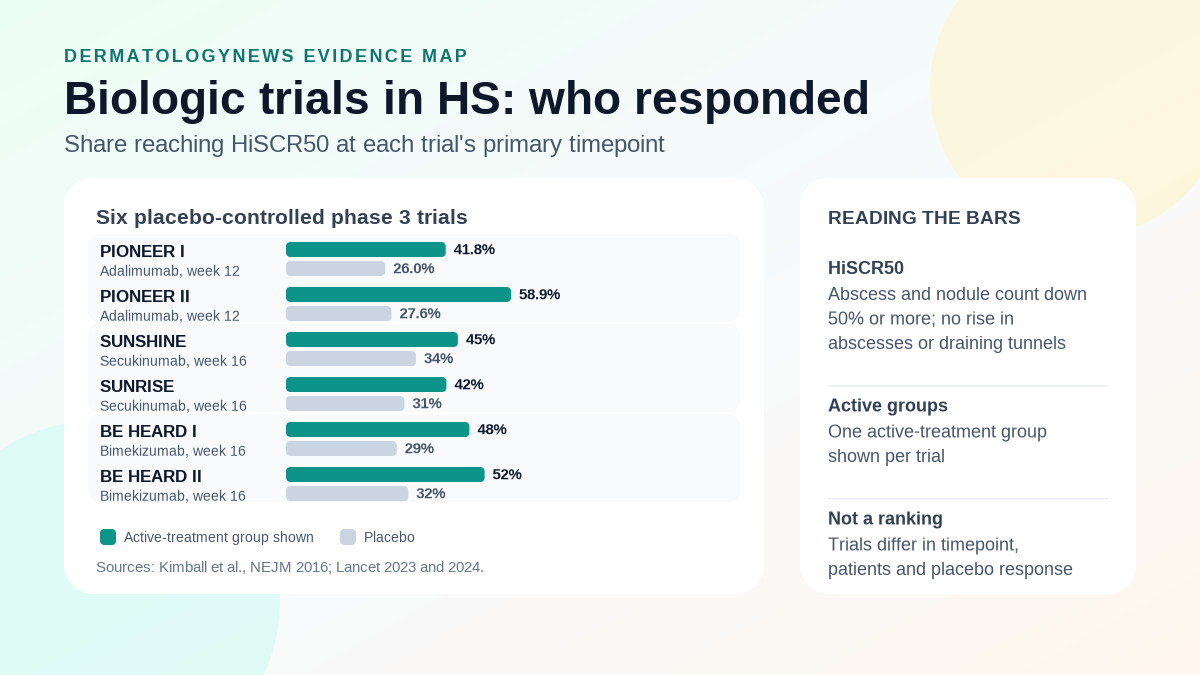
The guideline calls the comparative efficacy of the approved biologics unsettled: three network meta-analyses reached differing conclusions, and head-to-head trials are still needed [1].
Infliximab, given by intravenous infusion, is used off-label for HS: the Remicade label, revised in February 2025, does not list it [11]. The guideline recommends infliximab strongly despite low certainty evidence [1]. Its one randomized trial, in 33 people, found more excellent outcomes on a physician global assessment at week 8 with infliximab than with placebo, while a 50% drop in the HS Severity Index, a different measure from HiSCR, was not significantly more common; seven cohort studies of 132 patients add observational data [1]. The panel based the strong recommendation on the unmet need in treatment-refractory HS, large benefits across several outcomes, low potential risks and patients' likely preferences [1].
Which biologics are FDA-approved for HS?
Three of the four strongly recommended biologics have an HS indication on a US label, checked in November 2026. Humira (adalimumab) is indicated for moderate to severe HS in patients 12 years and older, Cosentyx (secukinumab) in adults and children 12 and older, and Bimzelx (bimekizumab) in adults [7][9][10]. For adolescents, the Humira and Cosentyx dosing tables start at a body weight of 30 kg (66 lb) [7][9]. Labels can differ between products of the same drug: the label of Abrilada, an adalimumab biosimilar, lists HS for adults only [8].
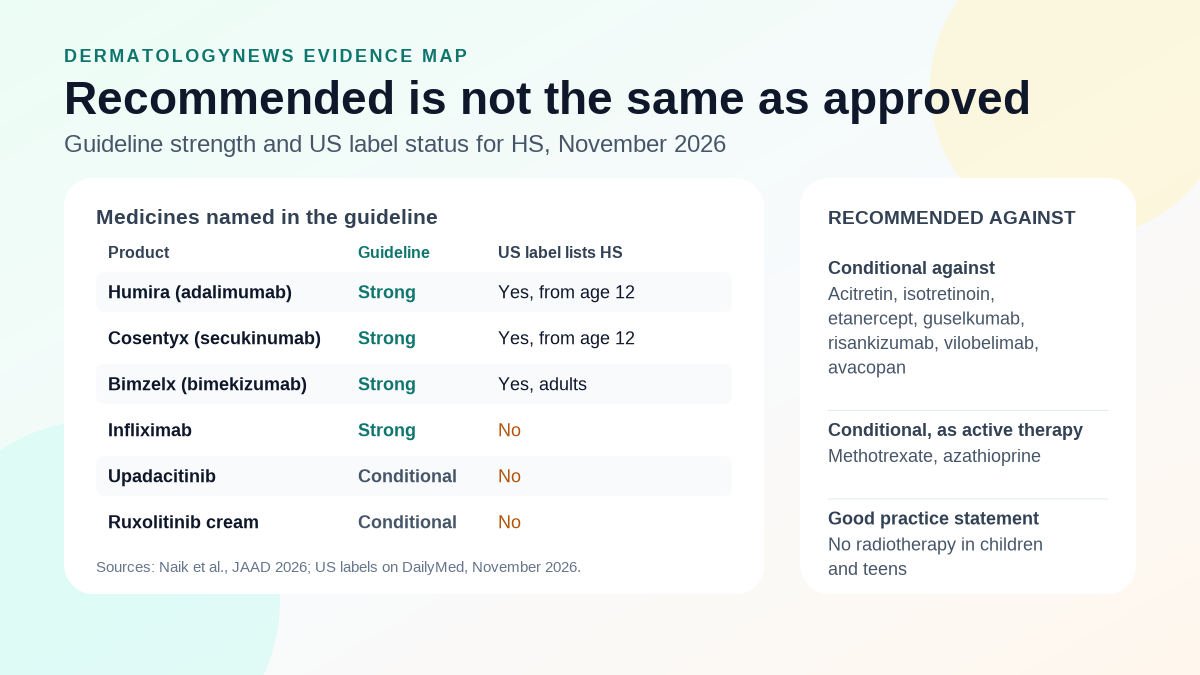
A guideline recommendation is not an approval, and insurers set their own coverage rules. The guideline states that step therapy, in which an insurer requires other treatments to be tried before it covers the one a physician prescribes, lacks evidence of clinical benefit and is associated with treatment delays and worse outcomes [1].
Antibiotics, topical treatments and other medicines
The guideline makes conditional recommendations for these medicines [1]:
- Topical treatments. Clindamycin, resorcinol and ruxolitinib cream, on low certainty evidence from studies in mild to moderate HS [1]. Ruxolitinib cream is a JAK inhibitor approved for atopic dermatitis and nonsegmental vitiligo; its US label, revised in June 2026, does not list HS and carries a boxed warning [13].
- Oral antibiotics. Doxycycline, tetracycline, and clindamycin combined with rifampin, on very low certainty evidence [1]. Rifampin interacts with many medicines, so interactions need checking [1].
- Intravenous ertapenem. Only for moderate to severe HS, typically after other treatments have not worked, and as a bridge to longer-term treatment, to limit antibiotic use [1]. It means daily infusions, usually through a catheter, and catheter clots and infections were among the reported complications [1].
- Spironolactone, a hormonal medicine, on very low certainty evidence from case series in 323 women, most of whom also had other treatments [1].
- Upadacitinib, an oral JAK inhibitor, for moderate to severe HS, on low certainty evidence [1]. In its one randomized trial, in 68 patients, response and pain relief were more common than in historical controls but no different from the trial's own placebo group; a phase 3 trial is ongoing [1]. Its use in HS is off-label: the Rinvoq label, revised in June 2026, does not list HS and carries the class boxed warning for oral JAK inhibitors, covering serious infections, mortality, malignancy, major adverse cardiovascular events and thrombosis [1][12].
- Short-term systemic corticosteroids, for moderate to severe HS, on very low certainty evidence, with treatment kept short to limit the risks of long-term steroid use [1].
The guideline conditionally recommends against acitretin and isotretinoin, the biologics etanercept, guselkumab, risankizumab and vilobelimab, and avacopan [1]. It also conditionally recommends against methotrexate and azathioprine as active HS therapy, although either may be used with a TNF inhibitor to prevent or manage anti-drug antibodies [1]. The panel found too little evidence to recommend combined oral contraceptive pills or finasteride specifically as HS treatment [1].
Procedures for abscesses and tunnels
The guideline conditionally recommends these procedures, each on very low certainty evidence [1]:
- Deroofing, which opens and flattens tunnels, for recurrent or persistently symptomatic lesions. Recurrence after deroofing, 10% to 33% in studies, was comparable to that after excision [1].
- Incision and drainage for acutely painful abscesses. Patients view it positively, but recurrence is higher than after excision or deroofing [1].
- Local or regional excision for persistent or recurrent symptomatic lesions. In case series, recurrence after wide excision ranged from 0% to 20% with under 2 years of follow-up and from 19% to 70% with 3 to 7.4 years [1].
- Laser hair removal. The supporting trials used an alexandrite laser; a trial of the Nd:YAG laser found no difference from no treatment [1].
- Botulinum toxin for underarm HS. In one randomized trial it improved pain and quality of life without a significant change in lesion counts [1].
- Intralesional triamcinolone, a steroid injection, for acutely painful lesions. Its randomized trial found no difference from placebo in pain or time to resolution, while case series reported improvement [1].
- Hyperbaric oxygen added to systemic antibiotics. Cost, travel and the small number of hyperbaric centers can limit access [1].
For people with moderate to severe HS who already take adalimumab and need HS surgery, the guideline conditionally recommends continuing adalimumab, on low certainty evidence: in the supporting trial, adalimumab given with wide excision of underarm or groin HS did not increase wound infections, complications or bleeding [1]. People taking adalimumab who are planning surgery should confirm their medication plan with both their dermatologist and their surgeon.
The evidence on radiotherapy for HS is insufficient, and the guideline recommends against radiotherapy in children and adolescents as a good practice statement, citing long-term risks such as cancer and infertility [1].
Pain, smoking, weight and supplements
Clinicians should routinely ask about pain, a good practice statement; 61% of people with HS report moderate to severe pain [1]. HS treatments may reduce pain but rarely relieve it enough, so the guideline conditionally recommends supportive pain management alongside disease-directed treatment, on very low certainty evidence [1]:
- Acute pain: warm or cool compresses, topical lidocaine, acetaminophen, nonsteroidal anti-inflammatory drugs, steroid injections into the lesion, incision and drainage, and short courses of systemic steroids. If acute pain remains severe despite other treatment, a clinician may consider a short course of an opioid after discussing its risks [1].
- Chronic pain: serotonin-norepinephrine reuptake inhibitors, tricyclic antidepressants, gabapentin, pregabalin, psychotherapy and better wound care, with a team that can include pain medicine, psychiatry and palliative care when pain does not respond [1].
For people who use tobacco, the guideline conditionally recommends quitting to improve the response to treatment; tobacco use was linked with poorer responses to antibiotics and secukinumab [1]. The evidence was insufficient to recommend weight reduction, GLP-1 or GLP-1/GIP medicines, or specific diets (intermittent fasting, Mediterranean, yeast exclusion or dairy-free) as HS treatment [1]. The guideline still calls weight management and a heart-healthy diet important for heart and metabolic health in people with HS [1].
It conditionally recommends clinician-guided oral zinc as an add-on, and vitamin D replacement when levels are low, both on very low certainty evidence [1]. Zinc doses used for HS exceed the recommended dietary allowance, so clinicians monitor for side effects and copper deficiency [1].
Choosing between antibiotics, biologics and procedures
HS care often combines systemic, procedural and supportive treatment, and high-quality evidence on the optimal timing and sequence of these treatments is lacking [1]. The guideline calls for shared decision-making that weighs:
- Severity. Biologics, ertapenem, upadacitinib and short-term systemic steroids are recommended for moderate to severe HS, which the guideline says should not require documenting severity with a specific scoring tool before treatment [1]. For mild disease, evidence is sparse and no FDA-approved therapy exists; the topical treatments were studied in mild to moderate HS [1].
- Lesions. Deroofing and excision are for recurrent or persistent lesions, and incision and drainage or steroid injections for acutely painful ones [1].
- Values. For conditional options, the most appropriate choice can differ from one patient to the next [1].
- Other conditions. Treatment choice should take account of medical and psychiatric conditions, which the guideline advises screening for [1].
- Cost. Affordability, insurance coverage and out-of-pocket costs belong in the decision, including lower-cost options among the recommended treatments [1].
Is there a cure for hidradenitis suppurativa?
There is currently no cure for HS. Treatment can help prevent new lumps and abscesses, treat existing ones, clear infection and relieve pain [3]. In the biologic trials, a response meant at least a 50% drop in the combined count of abscesses and inflammatory nodules, with no increase in abscesses or draining tunnels [4][6]. That is a minimum improvement, not clearance; a stricter 75% response was also reached more often with bimekizumab and secukinumab than with placebo [1]. After surgery, a share of patients see lesions return, more often with longer follow-up [1].
Adverse events, limitations and realistic expectations
- Placebo groups improve too. Between 26% and 34% of placebo patients reached HiSCR50 in the six trials, and the gain in the active groups shown ranged from about 11 to 31 percentage points [4][5][6]. The guideline links high placebo responses to the waxing and waning course of HS [1].
- A response may not last. In an extension study, continuing secukinumab after week 52 did not significantly reduce the risk of more abscesses or nodules through week 104 compared with switching to placebo [1].
- Label warnings. The Humira and Remicade labels carry a boxed warning for serious infections and malignancy [7][11]. The Cosentyx and Bimzelx labels warn about infections, call for tuberculosis evaluation before treatment and carry warnings about inflammatory bowel disease; the Bimzelx label also warns about suicidal ideation and behavior [9][10]. Upadacitinib and ruxolitinib cream carry JAK inhibitor boxed warnings [12][13].
- Trial safety. In the placebo-controlled weeks, serious adverse events and stopping because of side effects were not more common with adalimumab, secukinumab or bimekizumab than with placebo [1]. Common side effects included upper respiratory infections and headache, and oral and vulvovaginal candidiasis with bimekizumab [1].
- Industry funding. AbbVie, Novartis and UCB funded the trials of their own drugs [4][5][6].
- Much of the evidence is weak. Every conditional recommendation rests on low or very low certainty evidence, often from case series [1].
Questions to ask at the appointment
- How severe is my HS, and which of the guideline's options fit [1]?
- Is a biologic right for me, and is the product you suggest FDA-approved for HS at my age [7][8][9][10][11]?
- Would deroofing or excision help the areas that keep coming back [1]?
- I take adalimumab and need HS surgery: should I keep taking it [1]?
- How will my pain be assessed and treated [1]?
- Should my vitamin D level be checked, and would zinc help [1]?
Bottom line
The 2026 joint AAD–HSF guideline strongly recommends adalimumab, bimekizumab and secukinumab, on moderate certainty evidence, and infliximab, on low certainty evidence, for moderate-to-severe hidradenitis suppurativa, together with routine pain assessment [1]. Topical treatments, oral antibiotics, ertapenem as a bridge, spironolactone, upadacitinib, short-term steroids, several procedures, tobacco cessation, pain management, add-on zinc and vitamin D replacement when levels are low are conditional options chosen with the patient [1]. In the phase 3 trials, about 42% to 59% of patients in the active groups shown reached HiSCR50 at week 12 or 16, against 26% to 34% on placebo [4][5][6]. Humira, Cosentyx and Bimzelx list HS on their US labels; infliximab, upadacitinib and ruxolitinib cream do not [7][9][10][11][12][13].
Common questions
- What treatments does the 2026 AAD guideline recommend for hidradenitis suppurativa?
- It strongly recommends adalimumab, bimekizumab, infliximab and secukinumab for moderate-to-severe HS, and routine pain assessment as a good practice statement [1]. Conditional recommendations cover topical clindamycin, resorcinol and ruxolitinib; oral doxycycline, tetracycline, and clindamycin with rifampin; intravenous ertapenem for moderate to severe HS, usually as a bridge after other treatments; spironolactone; upadacitinib; short-term systemic corticosteroids; several procedures; tobacco cessation; supportive pain management; clinician-guided zinc as an add-on; and vitamin D replacement when levels are low [1].
- Is there a cure for hidradenitis suppurativa?
- There is currently no cure for HS. Treatment can help prevent new lumps and abscesses, treat existing ones, clear infection and relieve pain [3]. In the phase 3 biologic trials, a response meant at least a 50% drop in the combined count of abscesses and inflammatory nodules, with no increase in abscesses or draining tunnels; about 42% to 59% of patients in the active groups reached it at week 12 or 16, against 26% to 34% on placebo [4][5][6].
- Are antibiotics still recommended for HS?
- Yes, conditionally and on very low certainty evidence. The guideline conditionally recommends topical clindamycin and oral doxycycline, tetracycline, and clindamycin with rifampin [1]. Intravenous ertapenem is reserved for moderate to severe HS, typically after other treatments have not worked, as a bridge to longer-term therapy [1].
- Which biologics are FDA-approved for hidradenitis suppurativa?
- Checked in November 2026, the US labels of Humira (adalimumab) and Cosentyx (secukinumab) list moderate to severe HS from age 12, and Bimzelx (bimekizumab) lists it for adults [7][9][10]. Labels can differ between products of the same drug; one adalimumab biosimilar lists HS for adults only [8]. Infliximab is strongly recommended by the guideline, but its label does not list HS, and the labels of upadacitinib and ruxolitinib cream, revised in June 2026, do not list it either [11][12][13].
- Does losing weight or quitting smoking help hidradenitis suppurativa?
- For people who use tobacco, the guideline conditionally recommends quitting to improve the response to treatment [1]. It found insufficient evidence to recommend weight reduction, GLP-1 medicines or specific diets as HS treatment, while calling weight management and a heart-healthy diet important for heart and metabolic health [1].
References
- Naik HB, Yeung H, Frazer-Green L, et al. Joint American Academy of Dermatology-Hidradenitis Suppurativa Foundation guidelines of care for the management of hidradenitis suppurativa. — Journal of the American Academy of Dermatology, 2026 (published online October 20, 2026); full text in the Hidradenitis Suppurativa Foundation's reading edition · PMID: 42900024 · DOI: 10.1016/j.jaad.2026.08.125
- American Academy of Dermatology. First joint guidelines of care for hidradenitis suppurativa issued by American Academy of Dermatology and Hidradenitis Suppurativa Foundation. — American Academy of Dermatology news release, October 20, 2026
- American Academy of Dermatology. Hidradenitis suppurativa: Overview. — American Academy of Dermatology patient information, last updated October 20, 2026
- Kimball AB, Okun MM, Williams DA, et al. Two Phase 3 Trials of Adalimumab for Hidradenitis Suppurativa. — New England Journal of Medicine, 2016;375(5):422-434 (PIONEER I and II; sponsor: AbbVie) · PMID: 27518661 · DOI: 10.1056/NEJMoa1504370
- Kimball AB, Jemec GBE, Alavi A, et al. Secukinumab in moderate-to-severe hidradenitis suppurativa (SUNSHINE and SUNRISE): week 16 and week 52 results of two identical, multicentre, randomised, placebo-controlled, double-blind phase 3 trials. — Lancet, 2023;401(10378):747-761 (SUNSHINE and SUNRISE; sponsor: Novartis Pharma) · PMID: 36746171 · DOI: 10.1016/S0140-6736(23)00022-3
- Kimball AB, Jemec GBE, Sayed CJ, et al. Efficacy and safety of bimekizumab in patients with moderate-to-severe hidradenitis suppurativa (BE HEARD I and BE HEARD II): two 48-week, randomised, double-blind, placebo-controlled, multicentre phase 3 trials. — Lancet, 2024;403(10443):2504-2519 (BE HEARD I and II; sponsor: UCB Pharma) · PMID: 38795716 · DOI: 10.1016/S0140-6736(24)00101-6
- HUMIRA (adalimumab) injection, for subcutaneous use. US Prescribing Information. — AbbVie, FDA-approved labeling via DailyMed (U.S. National Library of Medicine); revised December 2025, SPL version 2154
- ABRILADA (adalimumab-afzb) injection, for subcutaneous use. US Prescribing Information. — Pfizer, FDA-approved labeling via DailyMed (U.S. National Library of Medicine); SPL version 8, published May 11, 2026
- COSENTYX (secukinumab) injection. US Prescribing Information. — Novartis, FDA-approved labeling via DailyMed (U.S. National Library of Medicine); effective November 16, 2026, SPL version 32
- BIMZELX (bimekizumab-bkzx) injection, for subcutaneous use. US Prescribing Information. — UCB, FDA-approved labeling via DailyMed (U.S. National Library of Medicine); effective November 5, 2026, SPL version 15
- REMICADE (infliximab) for injection, for intravenous use. US Prescribing Information. — Janssen Biotech, FDA-approved labeling via DailyMed (U.S. National Library of Medicine); revised February 2025, SPL version 37
- RINVOQ (upadacitinib) extended-release tablets and RINVOQ LQ oral solution. US Prescribing Information. — AbbVie, FDA-approved labeling via DailyMed (U.S. National Library of Medicine); revised June 2026, SPL version 101
- OPZELURA (ruxolitinib) cream, for topical use. US Prescribing Information. — Incyte, FDA-approved labeling via DailyMed (U.S. National Library of Medicine); revised June 2026, SPL version 14