Toenail fungus treatment: what the trials and labels show
Complete cure rates for toenail fungus treatments in their US labels, why a lab test comes first, what lasers are cleared to do, and the 2026 British guideline.
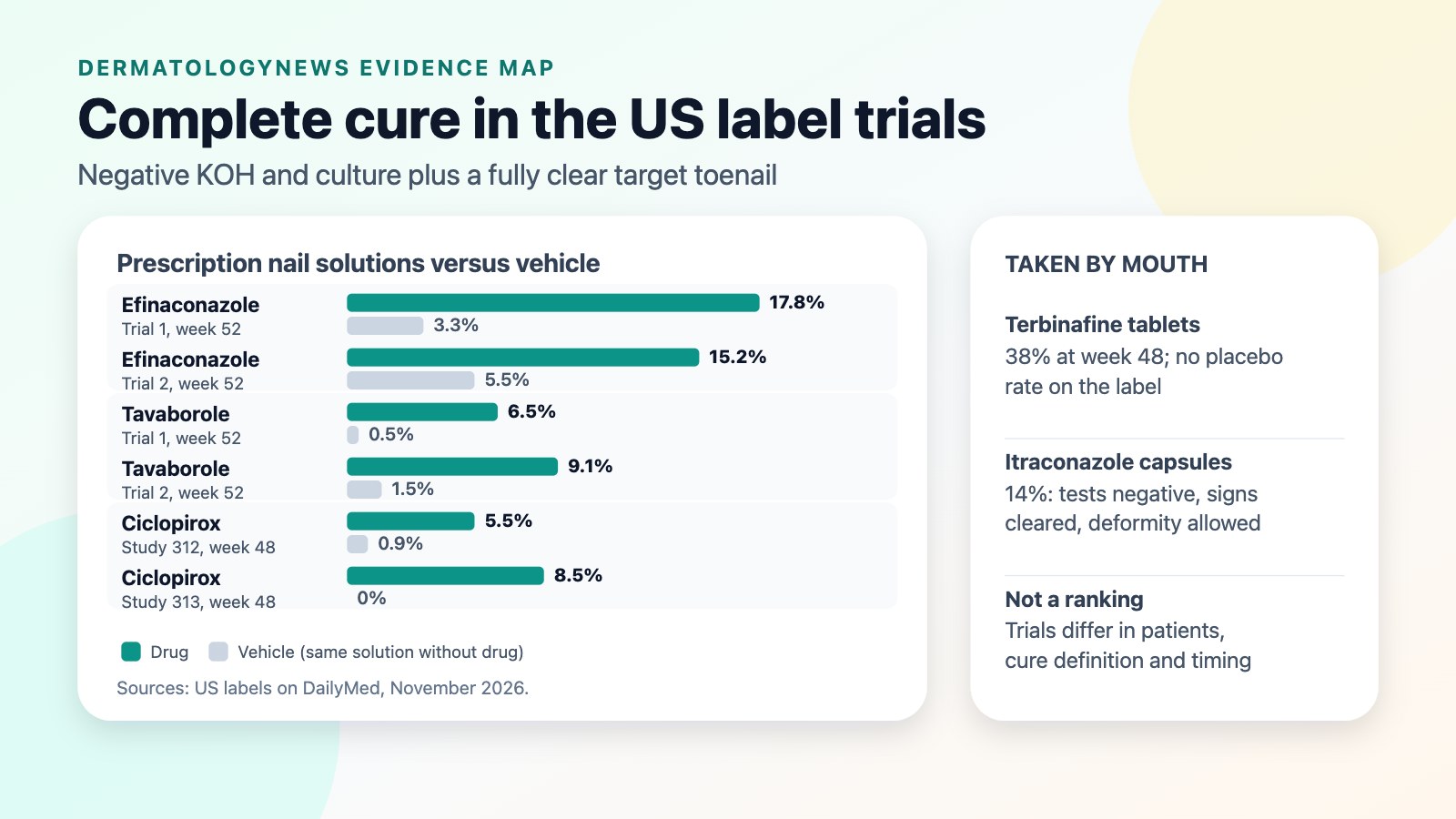
Under the British Association of Dermatologists' 2026 guideline, toenail fungus treatment starts with a lab test; for adults who need tablets and have no history of liver disease, terbinafine is first-line, and a nail solution or no treatment suits some people [1]. In terbinafine's US label trial, 38% had negative tests and a fully clear nail at week 48 [2].
Toenail fungus, or onychomycosis, is a fungal infection of the nail. Most cases are caused by dermatophytes, the group of fungi that also causes athlete's foot, above all Trichophyton rubrum; in the UK, 85% to 90% of nail infections are due to dermatophytes [1][11]. It becomes more common with age, and the guideline puts its prevalence as high as 35% in people older than 65 [1]. Risk factors include increasing age, peripheral vascular disease, trauma, heavy sweating, diabetes, psoriasis, HIV and occlusive footwear [1]. The guideline, published online in the British Journal of Dermatology on October 22, 2026, covers adults, children and young people and makes 44 recommendations [1].
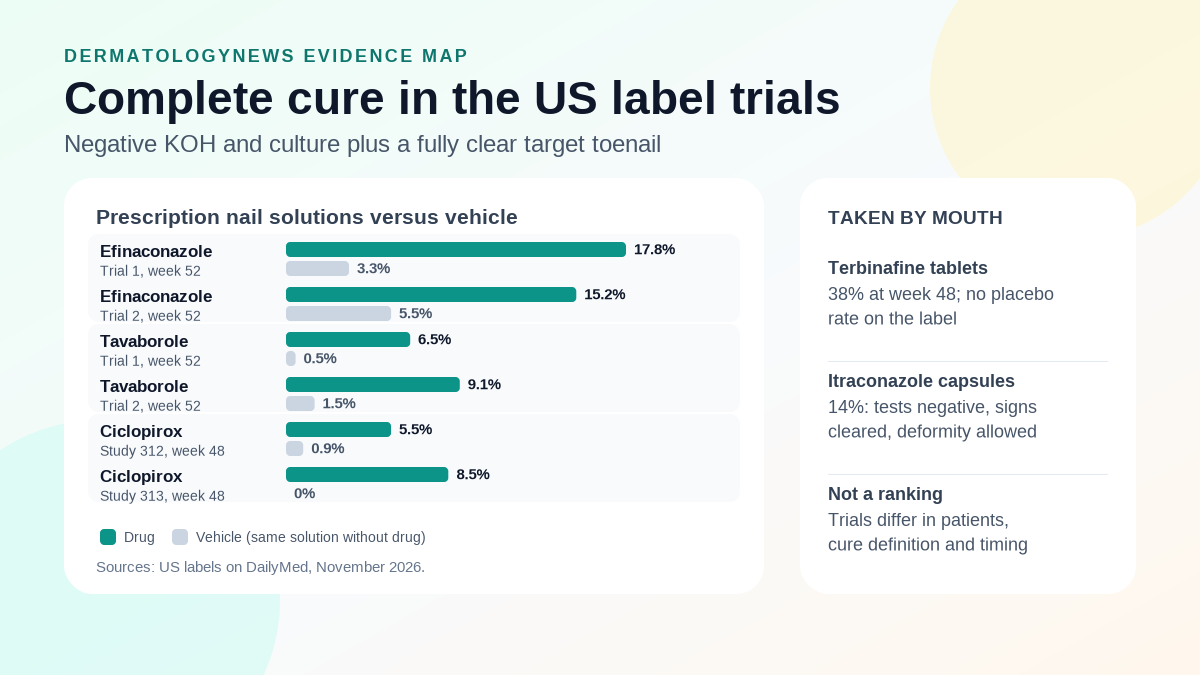
Open the complete cure figure at full size
Why a lab test comes first
The guideline strongly recommends confirming the infection in the laboratory with a potassium hydroxide (KOH) preparation and direct microscopy, and using microscopy and culture, where available, to guide an early decision in clinic [1]. It states that laboratory confirmation of a clinical diagnosis must be obtained before treatment is started [1]. The US labels of terbinafine and itraconazole say the same: nail specimens for a KOH preparation, fungal culture or nail biopsy should be obtained to confirm the diagnosis before treatment [2][3].
The guideline also suggests PCR for dermatophyte DNA as a supplementary test, a point-of-care lateral flow test, and examination of nail clippings under the microscope when suspicion is high but the fungal tests are negative [1]. If the infection starts under the nail near its base (proximal subungual infection), or affects both fingernails and toenails, it advises checking the person's immune status [1].
Which treatment for which nail
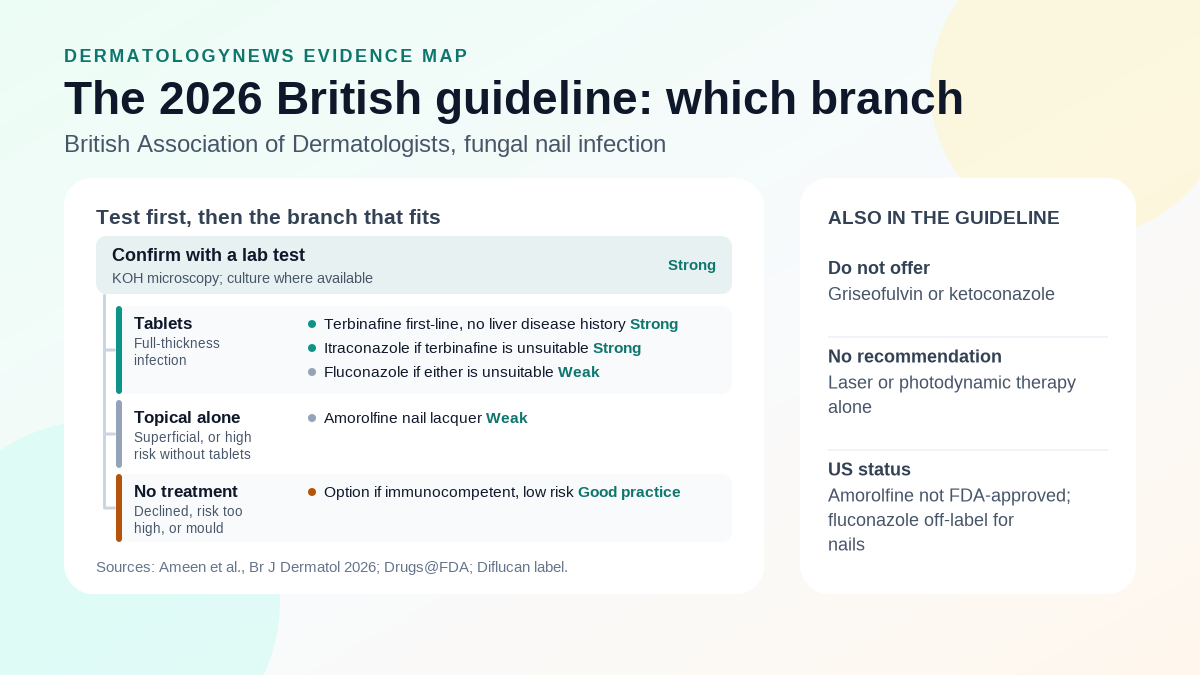
The guideline's summary table matches the treatment to the type of infection [1]:
- No treatment. An option when the person declines treatment, when the risks of tablets outweigh the benefit, or for hard-to-treat infections such as those caused by moulds [1]. In discussion with the patient, it can also be considered for immunocompetent people not at risk of complications [1].
- Topical treatment alone. For superficial infection, such as superficial white onychomycosis, and for high-risk infection, for example in people with weakened immunity, when tablets are contraindicated or not tolerated [1].
- Tablets. For infection through the full thickness of the nail [1].
- Additions. Tablets combined with a topical treatment, and debridement, removing as much diseased nail as possible, can be added to increase efficacy [1].
What "complete cure" means in the trials
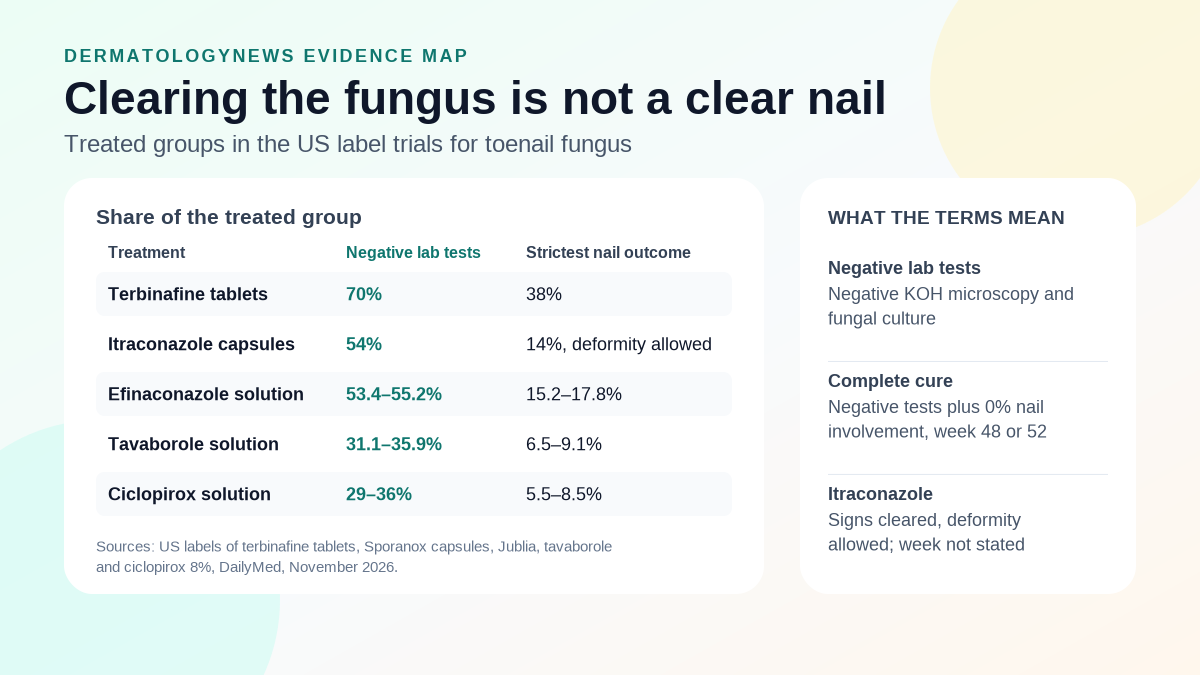
The label trials report three kinds of outcome, and they are easy to mix up [2][3][4][5][6]:
- Mycological cure: negative KOH microscopy and negative fungal culture. The fungus is no longer detected, but the nail can still look abnormal.
- Complete cure: mycological cure plus a fully clear target nail, with 0% of the nail still involved. This is the strictest measure. The itraconazole label instead reports negative tests plus clearance of infection signs, with residual nail deformity allowed [3].
- In-between measures: "complete or almost complete cure" (no more than 5% or 10% of the nail affected, with negative tests) and the oral labels' "effective treatment" and "overall success" each loosen the nail criterion in their own way.
In every label, far more people had negative tests than reached the strictest nail outcome [2][3][4][5][6]. One reason is time. The terbinafine label notes that the optimal clinical effect is seen some months after mycological cure and the end of treatment, the time healthy nail needs to grow out [2]. The guideline adds that, even after successful treatment, a nail may never look as it did before [1].
Toenail fungus treatments compared: what the US labels show
| Option and US indication for nails | Treatment length on the label | Cure in the label's trials | Label ages |
|---|---|---|---|
| Terbinafine tablets: dermatophyte infection | 12 weeks, once daily | 38% with negative tests and a fully clear nail at week 48; no placebo rate given [2] | Not established in children |
| Itraconazole capsules (Sporanox): dermatophyte infection, in people without weakened immunity | 12 weeks, once daily | 14% with negative tests and infection signs cleared, residual deformity allowed; week not stated [3] | Not established in children |
| Efinaconazole 10% solution (Jublia): T. rubrum and T. mentagrophytes | 48 weeks, once daily | 17.8% and 15.2% complete cure, against 3.3% and 5.5% with vehicle, at week 52 [4] | 6 and older; pediatric use established |
| Tavaborole 5% solution: T. rubrum or T. mentagrophytes | 48 weeks, once daily | 6.5% and 9.1% complete cure, against 0.5% and 1.5% with vehicle, at week 52 [5] | 6 and older; pediatric use established |
| Ciclopirox 8% solution: T. rubrum, mild to moderate, no lunula involvement, intact immunity | Up to 48 weeks, daily, with professional removal of loose nail | 5.5% and 8.5% complete cure, against 0.9% and 0% with vehicle, at week 48; significant in one of two trials [6] | 12 and older, based on adult data; no pediatric trials |
| Lasers (510(k)-cleared) | Not applicable | No cure claim: cleared "for the temporary increase of clear nail" [7] | Not applicable |
Complete cure means negative KOH and culture plus 0% involvement of the target nail; vehicle is the same solution without the drug; each "against" compares the two groups of the same trial, and the topical trials enrolled adults. Indications, treatment lengths and ages are from the same labels [2][3][4][5][6]. The trials differ in who took part, how cure was judged and when, so the rows are not a ranking.
Tablets: terbinafine first, itraconazole second
In the US, terbinafine tablets are labeled for nail infection due to dermatophytes, and itraconazole capsules for toenail infection due to dermatophytes in people without weakened immunity [2][3]. When an adult needs oral treatment and has no history of liver disease, the guideline strongly recommends terbinafine as a first-line option [1]. It strongly recommends itraconazole when terbinafine is contraindicated or not tolerated, and suggests considering fluconazole when terbinafine or itraconazole is contraindicated or not tolerated [1]. In the US, fluconazole for nail infection is off-label: its label lists no nail infection [10]. The guideline recommends against griseofulvin and ketoconazole, citing limited efficacy and liver toxicity concerns [1]. Griseofulvin's US label still lists nail infection, with treatment for at least 6 months for toenails [11].
Terbinafine. In the first toenail trial on the label, 12 weeks of treatment followed by 36 weeks without it, 70% had negative lab tests, 59% had negative tests with a clear nail or more than 5 mm of new unaffected nail, and 38% had negative tests with 0% nail involvement [2]. Among those evaluated at least 6 months after clinical cure and at least a year after treatment, about 15% relapsed [2]. Terbinafine is contraindicated in chronic or active liver disease. The label calls for liver tests before treatment and recommends periodic tests during it, because liver failure, some cases leading to transplant or death, has occurred in people with and without liver disease [2]. Anyone who develops persistent nausea, loss of appetite, tiredness, vomiting, right upper abdominal pain, yellow skin or eyes, dark urine or pale stools should stop terbinafine and contact the prescriber immediately [2]. Taste or smell disturbance can be severe and can last more than a year or be permanent; depressive symptoms, serious skin reactions such as Stevens-Johnson syndrome and DRESS, lupus and thrombotic microangiopathy have also been reported [2]. In the placebo-controlled trials, headache (12.9% versus 9.5%), diarrhea (5.6% versus 2.9%), rash (5.6% versus 2.2%), liver enzyme abnormalities (3.3% versus 1.4%) and taste disturbance (2.8% versus 0.7%) were among the most frequent events [2].
Itraconazole. In three placebo-controlled studies in which 110 people took itraconazole capsules for 12 weeks, 54% had negative lab tests, 35% had overall success and 14% had negative tests with clearance of infection signs, residual nail deformity allowed [3]. Of those with overall success, 21% relapsed [3]. Its boxed warning says it should not be used for nail infection in people with evidence of ventricular dysfunction, such as congestive heart failure or a history of it, and lists many medicines that must not be taken with it, because raised levels of some of them can cause a potentially fatal heart rhythm [3]. Rare cases of serious liver toxicity, including liver failure and death, have occurred, some in the first week [3]. The label says it should not be used for nail infection during pregnancy or by women planning a pregnancy, and lists hearing loss and neuropathy among its warnings [3].
Prescription nail solutions
Three prescription solutions have US labels for toenail infection, each limited to the fungi and patients listed in the table [4][5][6]. Their trials enrolled adults whose target toenail was 20% to 50% involved (efinaconazole), 20% to 60% (tavaborole) or 20% to 65% (ciclopirox), all without involvement of the lunula, the pale half-moon at the base of the nail [4][5][6]. The efinaconazole and tavaborole trials also excluded nails with a dermatophytoma, a localized mass of fungus in the nail [4][5].
- Efinaconazole 10% (Jublia). In two 52-week trials, 17.8% and 15.2% reached complete cure, against 3.3% and 5.5% with vehicle, and 55.2% and 53.4% had negative lab tests [4]. Ingrown toenail (2.3% versus 0.7%) and skin inflammation (2.2% versus 0.2%), blisters (1.6% versus 0%) or pain (1.1% versus 0.2%) at the application site were the most common side effects [4].
- Tavaborole 5%. Complete cure was 6.5% and 9.1%, against 0.5% and 1.5% with vehicle, and negative lab tests 31.1% and 35.9% [5]. Peeling skin (2.7% versus 0.3%) and ingrown toenail (2.5% versus 0.3%) were the most common side effects [5].
- Ciclopirox 8%. Complete cure was 5.5% and 8.5%, against 0.9% and 0% with vehicle, statistically significant in one of the two trials [6]. The label makes it part of a program in which a professional removes loose, infected nail as often as monthly and the patient trims the nails weekly; people with diabetes or numbness in their toes or fingers should talk to their health care provider before trimming nails or removing nail material [6]. Redness around the nail was reported in 5% with ciclopirox and 1% with vehicle [6].
All three solutions are flammable [4][5][6]. The only topical medicine the guideline recommends by name is amorolfine nail lacquer, suggested for superficial or distal infection when tablets are contraindicated or not tolerated [1]; amorolfine has no FDA approval [12]. The guideline found insufficient evidence to recommend tioconazole or clotrimazole, and suggests debulking the infected nail, for example by clipping, as an add-on to tablets or a topical solution [1].
Over-the-counter creams and sprays for athlete's foot are a different product. The FDA's labeling rule for these over-the-counter antifungals includes the direction "This product is not effective on the scalp or nails" [9].
Do lasers cure toenail fungus?
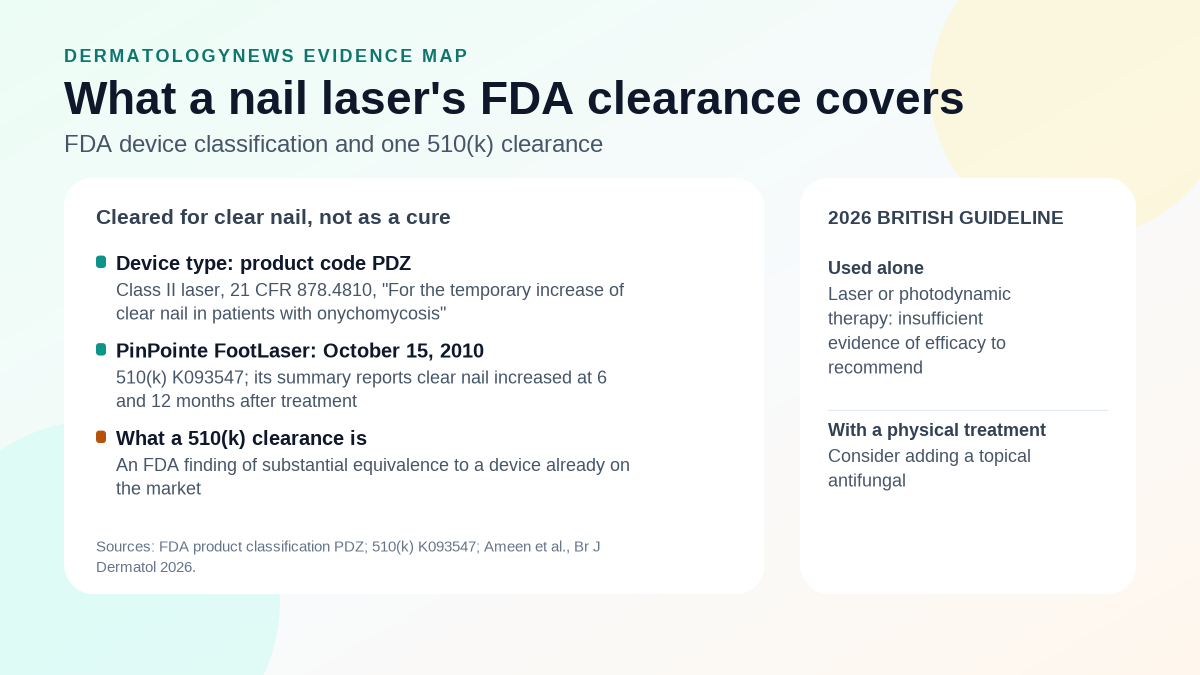
Lasers for nail fungus are FDA-cleared for a temporary increase of clear nail, not as a cure. The FDA classifies these devices as class II lasers under 21 CFR 878.4810, product code PDZ, and defines the device type "For the temporary increase of clear nail in patients with onychomycosis (e.g., dermatophytes Trichophyton rubrum and T mentagrophytes, and/or yeasts Candida albicans, etc.)" [7]. The PinPointe FootLaser, cleared on October 15, 2010, was indicated "for use for the temporary increase of clear nail in patients with onychomycosis"; its 510(k) summary describes it as "safe and effective for use for the temporary increase of clear nail at 6 and 12 months following treatment" [8]. A 510(k) clearance means the FDA found a device substantially equivalent to one already on the market [8].
The 2026 guideline found insufficient evidence of efficacy to recommend laser treatment alone, and the same for photodynamic therapy alone [1]. It suggests adding a topical antifungal when a physical treatment is used [1].
Children, diabetes and weakened immunity
- Children. The guideline advises examining children for athlete's foot and checking family members as a possible source [1]. It suggests amorolfine for superficial or distal infection and recommends against griseofulvin [1]. For children aged 1 to 11 and young people aged 12 to 17 with several nails affected or the nail matrix involved, it suggests off-label tablets, decided together with parents or carers and with specialist advice [1]. In the US, efinaconazole and tavaborole are labeled from age 6; the ciclopirox label considers it safe from age 12 on the basis of adult data, without pediatric trials; and the labels of terbinafine tablets and itraconazole capsules state that use in children is not established [2][3][4][5][6].
- Diabetes. The guideline advises weighing the risk of foot infection and ulcers case by case, strongly recommends terbinafine for dermatophyte infection, and suggests an azole for mould or Candida nail infection in people without congestive heart failure [1].
- Weakened immunity. It strongly recommends terbinafine or fluconazole rather than itraconazole, because itraconazole carries a higher risk of drug interactions, particularly with antiretroviral therapy [1].
- Older people. The guideline found too little evidence to name an ideal medicine for people over 70 [1].
When treatment fails or the infection returns
If the nail does not respond to terbinafine or itraconazole taken by mouth, the guideline suggests antifungal susceptibility testing [1].
Infection can come back. In the label trials, about 15% of the terbinafine-treated people evaluated after clinical cure relapsed, as did 21% of the itraconazole-treated people with overall success [2][3]. To prevent recurrence, the guideline advises replacing or sanitizing contaminated footwear and wearing properly fitted shoes, and wearing sandals in public showers, spas and swimming pools [1]. For people most at risk, it advises spraying antifungal onto shoe insoles once a week or twice a month after complete cure [1].
Limitations and realistic expectations
- Thin numbers for the oral treatments. The terbinafine label gives no placebo rate for complete cure, and the itraconazole figures come from 110 treated people [2][3].
- Milder nails in the topical trials. The solutions were tested in adults on nails with limited involvement and no lunula involvement, so the figures may not apply to more extensive infection or to children [4][5][6].
- A British guideline for US readers. Amorolfine, the guideline's named topical, has no FDA approval, and fluconazole for nails is off-label in the US [10][12].
- Slow visible results. A clear nail takes months to grow out, and some nails never look as they did before [1][2].
Questions to ask at the appointment
- Did testing confirm a fungal infection [1]?
- Did the lab identify which fungus is present [1]?
- Which liver tests will I have before and during terbinafine, and which symptoms mean I should stop it and call you at once [2]?
- Is the infection limited enough for a nail solution, or does it reach the lunula at the base of the nail [4][5][6]?
- What do you expect the nail to look like at the end, and when [1][2]?
- If I am offered laser treatment, what does its FDA clearance actually cover [7]?
Bottom line
Toenail fungus treatment starts with a lab test. When an adult needs tablets and has no history of liver disease, the 2026 British guideline recommends terbinafine first-line and itraconazole as the alternative, while a superficial infection can be treated topically and some people choose no treatment [1]. On the US labels, 38% had negative tests and a fully clear nail at week 48 after terbinafine, and 5.5% to 17.8% reached complete cure in the trials of the nail solutions [2][4][5][6]. Lasers are FDA-cleared only for a temporary increase of clear nail [7], and nails can take months to look normal, or may never fully do so [1][2].
Common questions
- What is the most effective treatment for toenail fungus?
- When an adult needs oral treatment and has no history of liver disease, the British Association of Dermatologists' 2026 guideline recommends terbinafine tablets as a first-line option, once a lab test confirms the infection; itraconazole is the alternative when terbinafine is contraindicated or not tolerated [1]. In terbinafine's US label trial, 38% had negative lab tests and a fully clear nail at week 48 [2]. Superficial infections can be treated with a nail solution or lacquer alone, and some people choose no treatment [1].
- How long does toenail fungus treatment take?
- On their US labels, terbinafine tablets and itraconazole capsules are taken for 12 weeks for toenails, and the nail solutions efinaconazole and tavaborole are applied daily for 48 weeks; ciclopirox is applied for up to 48 weeks [2][3][4][5][6]. The nail takes longer to look normal: the terbinafine label notes that the optimal clinical effect comes some months after the fungus is cleared and treatment has stopped, as healthy nail grows out [2].
- Do lasers cure toenail fungus?
- Their FDA clearance does not claim a cure. The FDA device type for these lasers is defined "for the temporary increase of clear nail in patients with onychomycosis" [7], and the 2026 British guideline found insufficient evidence of efficacy to recommend laser or photodynamic therapy alone [1].
- Do over-the-counter creams work on toenail fungus?
- The FDA's labeling rule for over-the-counter antifungal products for athlete's foot, jock itch and ringworm includes the direction "This product is not effective on the scalp or nails" [9]. The FDA-approved options for nail infection are prescription antifungals taken by mouth or applied to the nail [2][3][4][5][6].
- Why do I need a test before toenail fungus treatment?
- The 2026 British guideline says laboratory confirmation must be obtained before treatment is started, usually by KOH preparation with direct microscopy and, where available, culture [1]. The US labels of terbinafine and itraconazole likewise call for nail specimens for a KOH preparation, fungal culture or nail biopsy to confirm the diagnosis first [2][3].
- Is terbinafine safe for the liver?
- Terbinafine is not for people with chronic or active liver disease. Its label calls for liver tests before treatment and recommends periodic liver tests during it, because liver failure, some cases leading to transplant or death, has occurred in people with and without liver disease [2]. Anyone taking it who develops persistent nausea, loss of appetite, tiredness, vomiting, right upper abdominal pain, yellow skin or eyes, dark urine or pale stools should stop terbinafine and contact the prescriber immediately [2].
References
- Ameen M, Alband N, Bhatti K, et al. British Association of Dermatologists guideline for managing fungal nail infection (onychomycosis) 2026. — British Journal of Dermatology, 2026;195(6):920-929 (published online October 22, 2026) · PMID: 42910426 · DOI: 10.1093/bjd/ljag318
- Terbinafine tablets, for oral use. US Prescribing Information and Medication Guide. — Aurobindo Pharma, labeling via DailyMed (U.S. National Library of Medicine); revised January 2022, SPL version 20, effective April 18, 2024; ANDA 078297
- SPORANOX (itraconazole) capsules. US Prescribing Information. — Janssen Pharmaceuticals, labeling via DailyMed (U.S. National Library of Medicine); revised July 2026, SPL version 31; NDA 020083
- JUBLIA (efinaconazole) topical solution, 10%. US Prescribing Information and Patient Information. — Bausch Health US, labeling via DailyMed (U.S. National Library of Medicine); revised July 2025, SPL version 21; NDA 203567
- Tavaborole topical solution, 5%. US Prescribing Information. — Encube Ethicals, labeling via DailyMed (U.S. National Library of Medicine); SPL version 7, effective September 15, 2025; ANDA 211297
- Ciclopirox topical solution, 8% (nail lacquer). US Prescribing Information. — Padagis, labeling via DailyMed (U.S. National Library of Medicine); SPL version 8, effective January 24, 2023; ANDA 077623
- FDA. Device classification, product code PDZ: lasers for temporary increase of clear nail in patients with onychomycosis (21 CFR 878.4810, class II). — U.S. Food and Drug Administration, Center for Devices and Radiological Health, Total Product Life Cycle database; page updated November 23, 2026
- FDA. 510(k) K093547: PinPointe FootLaser, 510(k) summary, indications for use and substantial equivalence letter. — U.S. Food and Drug Administration; cleared October 15, 2010 (letter corrected May 13, 2013)
- 21 CFR 333.250: Labeling of antifungal drug products (over-the-counter topical antifungal drug products). — Code of Federal Regulations, Title 21, via the Electronic Code of Federal Regulations
- DIFLUCAN (fluconazole) tablets and oral suspension. US Prescribing Information. — Pfizer, labeling via DailyMed (U.S. National Library of Medicine); revised March 2025, SPL version 57; NDA 019949 (tablets) and NDA 020090 (oral suspension)
- Ultramicrosize griseofulvin tablets, USP. US Prescribing Information. — Amneal Pharmaceuticals, labeling via DailyMed (U.S. National Library of Medicine); SPL version 8, effective December 20, 2025; ANDA 204371
- FDA. Drugs@FDA: FDA-approved drugs (search for amorolfine). — U.S. Food and Drug Administration, Center for Drug Evaluation and Research; searched November 29, 2026