Masseter Botox: what phase 3 trials show about jaw slimming
Masseter Botox is off-label in the US. What placebo-controlled trials found on jaw slimming, how long it lasted, its side effects and the FDA review.
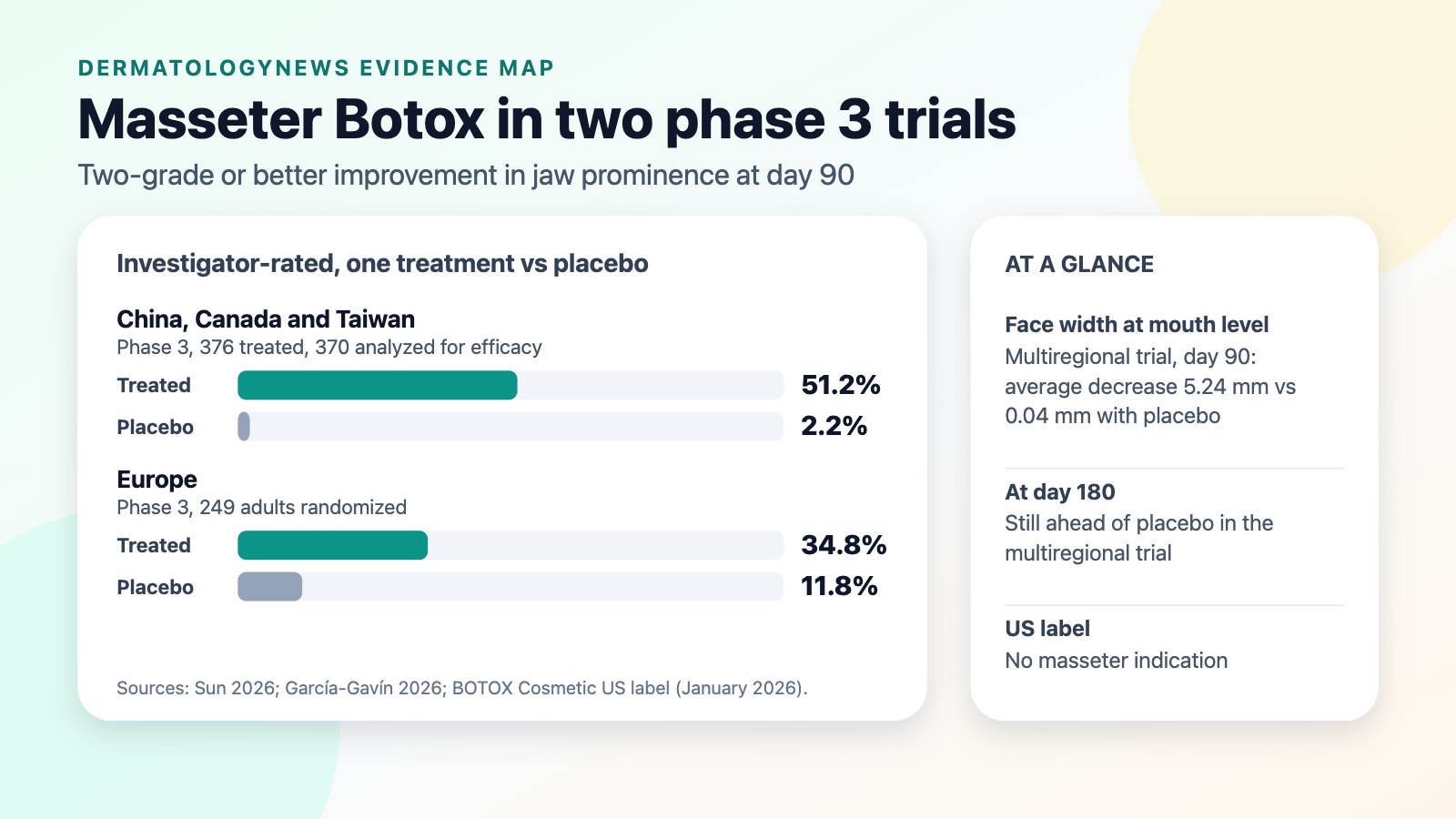
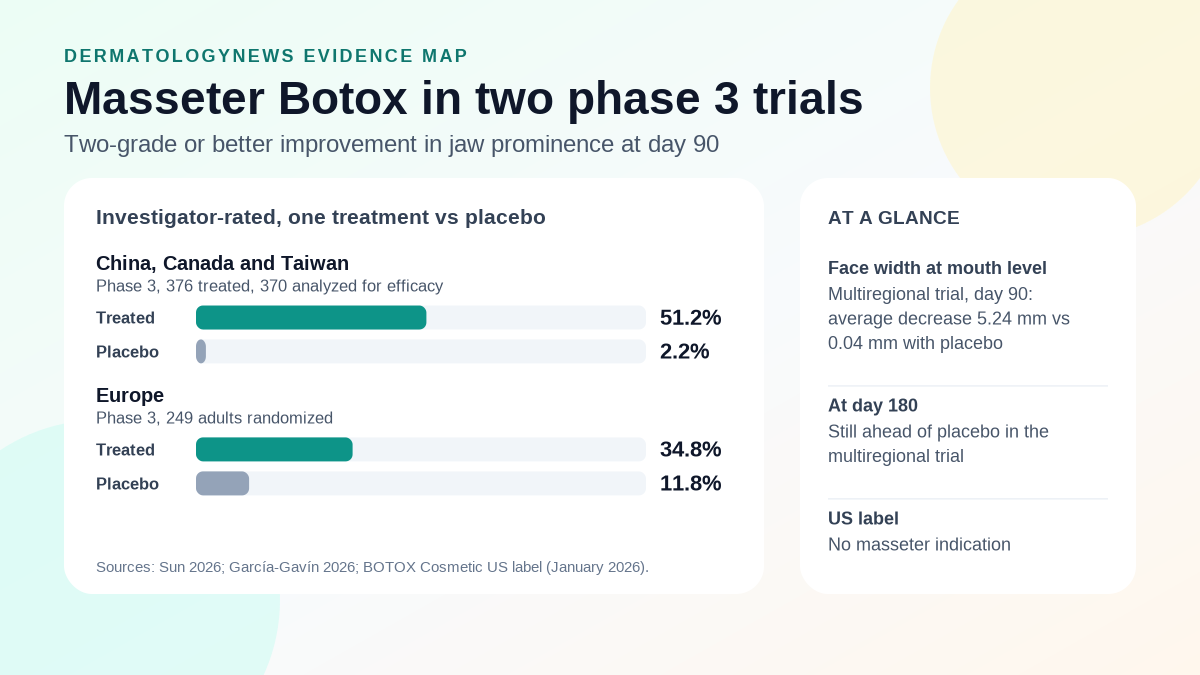
In placebo-controlled trials, masseter Botox (onabotulinumtoxinA) narrowed the lower face, with the effect peaking around 3 months. In a phase 3 trial of adults with marked or very marked prominence, 51.2% of treated participants improved by two or more grades on a jaw-prominence scale at day 90, against 2.2% on placebo [1]. The use is off-label in the US [2].
The treatment targets masseter muscle prominence: enlarged chewing muscles at the angle of the jaw that give the lower face a wide, square or trapezoidal shape [1][4]. Toxin injected into the muscle weakens it for a time, the muscle loses bulk, and the lower face looks slimmer; the effect is temporary [6].
What did the phase 3 trials find?
The multiregional phase 3 trial enrolled adults at 21 centers in China, Canada and Taiwan between 2019 and 2022 [1]. All had marked or very marked prominence, grade 4 or 5 on the 5-grade Masseter Muscle Prominence Scale, which investigators score by looking at and feeling the muscle at rest and with the jaw clenched [1]. Of 377 randomized, 376 received a single treatment totaling 72 units across both masseters, given as three injections into each muscle, or placebo [1]. The trials tested onabotulinumtoxinA, sold as BOTOX Cosmetic, whose units cannot be compared with or converted into those of other botulinum toxin products [2].
At day 90, among the 370 participants analyzed for efficacy, 51.2% of treated participants had improved by at least two grades, against 2.2% on placebo. Reaching grade 3 or lower, a looser measure, the figures were 81.1% and 9.9% [1]. Participants' own ratings moved the same way: 58.8% against 9.1% rated their prominence at least two grades better [1].
A European phase 3 trial, published on November 23, 2026, randomized 249 adults bothered by marked or very marked prominence to a single treatment of 48 units in total or placebo [3]. At day 90, 34.8% of treated participants improved by two or more grades on the investigator scale, against 11.8% on placebo. On the participants' own scale, the figures were 43.6% and 12.4% [3].
Open the trial figure at full size
The table compares one day-90 measure that three trials shared: a two-grade or better improvement on the investigator scale. It was the primary outcome of the multiregional trial, one of two co-primary outcomes in Europe alongside participants' own rating, and a secondary outcome in the US trial, whose primary outcome was reaching grade 3 or lower [1][3][4].
| Trial | Who took part | Total trial dose across both sides | Two-grade improvement at day 90 | Role of this measure | Source |
|---|---|---|---|---|---|
| Phase 3, China, Canada and Taiwan | 376 treated, 370 analyzed for efficacy; 87.3% Asian | One treatment of 72 units, or placebo | 51.2% vs 2.2% | Primary | [1] |
| Phase 3, Europe | 249 randomized; 95% White | One treatment of 48 units, or placebo | 34.8% vs 11.8% | Co-primary | [3][10] |
| Phase 2b, United States | 145 analyzed; 75.9% White | One treatment of 48 or 72 units, or placebo | 66.0% and 71.7% vs 10.9% | Secondary | [4] |
The results are not directly comparable. The trials used different doses and enrolled different populations, and the European placebo group improved more often than the multiregional one [1][3]. Earlier, a phase 2 trial in Australia, Taiwan and Canada compared totals of 24, 48, 72 and 96 units with placebo in 187 adults over 12 months, and found larger reductions in lower-face volume with treatment at day 90 [1][5].
How much narrower, and for how long?
In 3D photographs, the width of the lower face at mouth level decreased by an average of 5.24 mm from baseline at day 90 in treated participants of the multiregional trial, against 0.04 mm on placebo [1]. In the US phase 2b trial, the average decreases in lower-face width were 4.17 mm and 4.66 mm with the two doses, against 0.05 mm on placebo [4].
Improvement was already measurable at day 30, the first visit, and peaked around day 90 [1][4]. It was still ahead of placebo at day 180 but smaller: in the US trial, two-grade responses had fallen to 35.8% and 47.8% by day 180, against 10.9% on placebo [4]. In the multiregional trial, participants' own ratings peaked later, at day 120, and declined less by day 180 than the investigators' ratings [1].
In the 12-month phase 2 trial, participants whose prominence was still marked at day 180 could have a second treatment, and it gave similar results [5]. None of the trials shows what happens with regular treatment over several years.
In the multiregional trial, 53.9% of treated participants were satisfied or very satisfied at day 90, against 4.5% on placebo. The investigators suggest that some participants may have wanted a larger change than one treatment produced [1]. In the US trial, 83% and 84.8% were satisfied with the two doses, against 26.1% on placebo [4].
Is masseter Botox FDA approved?
No. The BOTOX Cosmetic label on DailyMed, version published January 8, 2026, lists four uses in adults, each for the temporary improvement in the appearance of moderate to severe lines or bands linked to the activity of the muscle beneath: frown lines between the brows (glabellar lines), crow's feet (lateral canthal lines), forehead lines and platysma bands of the neck. The masseter is not among them [2]. The label notes that serious reactions, including excessive weakness, swallowing difficulty and aspiration pneumonia, some fatal, have been reported after BOTOX injections for unapproved uses. In several of those cases the patients already had swallowing problems or other significant disabilities, and the label states that safety and effectiveness for unapproved uses have not been established [2].
On August 4, 2026, Allergan Aesthetics, an AbbVie company, announced that the FDA had accepted for review its application to add the temporary improvement in the appearance of marked to very marked masseter muscle prominence in adults to the BOTOX Cosmetic label [9]. The company said the application includes two phase 3 studies it calls M21-416 and M21-417, both of which met their primary endpoints, and gave no expected decision date [9]. Outside the US, the authors of the CT study write that onabotulinumtoxinA has received approval for this use in China [6].
What are the side effects of masseter Botox?
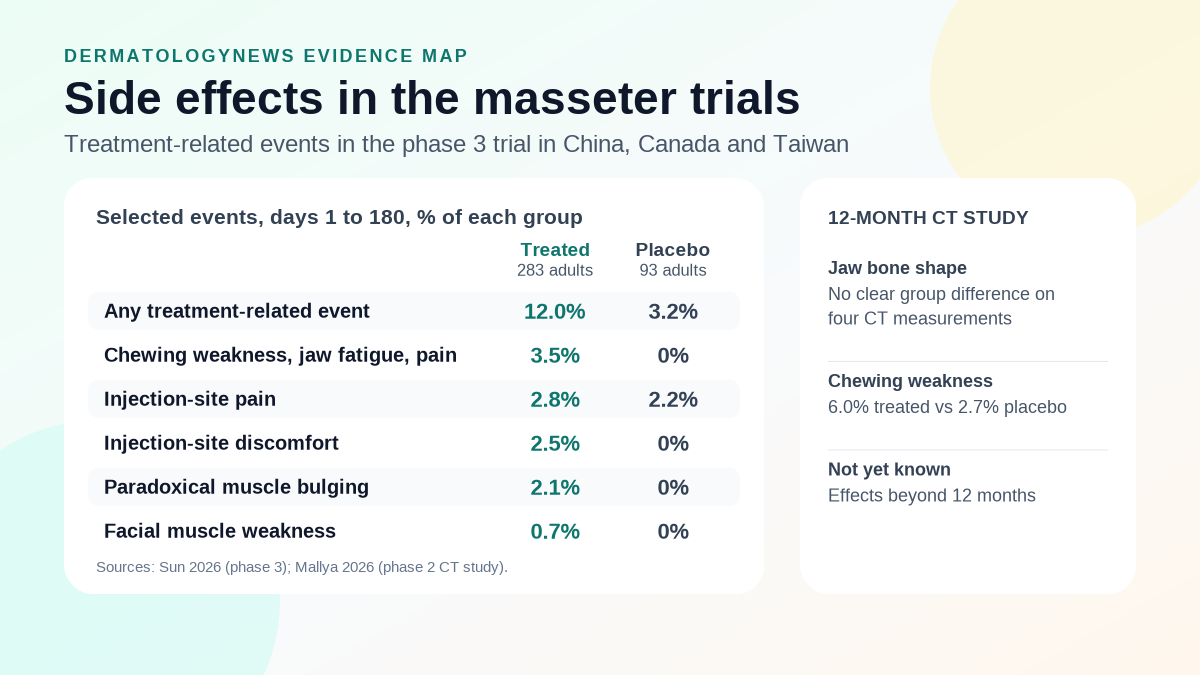
In the multiregional trial, treatment-related side effects occurred in 12.0% of treated participants and 3.2% of those on placebo during the first 180 days [1]. The most frequent was a chewing problem, reported as jaw fatigue, jaw pain or chewing weakness (3.5%, against none on placebo), followed by injection-site pain (2.8% against 2.2%) and injection-site discomfort (2.5% against none) [1]. Six treated participants (2.1%) had paradoxical bulging of the masseter, and bulging led one participant to leave the study. Two (0.7%) had facial muscle weakness (facial paresis) [1]. Events reviewed as possible distant spread of toxin occurred in 8 treated participants and 1 on placebo; all were mild, resolved without intervention and were judged on review to be local or unrelated to the toxin [1].
Treatment can also change the smile. In the US phase 2b trial, 3 of 102 treated participants had a weak or altered smile, which resolved after 60, 79 and 101 days, and no distant spread of toxin was reported [4]. The authors link the smile effect to the risorius, a smile muscle next to the masseter [4]. In the phase 2 dose-ranging trial, 4 of 38 participants in the group given 96 units in total had a local effect on the smile [5][6].
Reports on how long chewing problems last are limited. In the US phase 2b trial, they resolved within a month of onset [4]. In the phase 2 trial, all cases were mild and resolved without intervention, and most side effects in that trial resolved within about 5 months [6].
Because the masseter loads the jawbone, researchers have asked whether weakening it could change the mandible. In the phase 2 trial, 187 adults were to have CT scans at baseline, day 90 and day 360, and 167 completed all three [6]. Summarized descriptively, four measurements of jaw shape (the width of the jaw at its angles, cortical thickness, mandibular flare and gonial angle) showed no clear differences from placebo after one or two treatments [6]. In a prespecified subgroup of 123 participants, bone density in the condyle, premolar area and ramus showed no clinically significant change over 12 months [7]. Chewing weakness was reported by 6.0% of treated participants and 2.7% on placebo, and jaw pain by 2.7% and none [6]. In one treated participant, signs of jaw-joint osteoarthritis present at baseline progressed by the end of the study; because of prior procedures, medical history and other medicines, the authors could not attribute this to treatment. They state that late effects beyond 12 months cannot be excluded [6].
The label's boxed warning covers all botulinum toxin products: effects may spread from the injection site and cause symptoms such as generalized muscle weakness, double vision, drooping eyelids and difficulty swallowing, speaking or breathing, hours to weeks after injection, and swallowing and breathing difficulties can be life-threatening [2]. Get medical help immediately if you have trouble swallowing, speaking or breathing after an injection [2]. The label lists allergy to any botulinum toxin preparation or to any ingredient in the formulation, and infection at the injection site, as contraindications [2].
Injections for jaw clenching, teeth grinding or temporomandibular disorders are a separate use with separate evidence; the multiregional trial excluded people with conditions that interfere with chewing, and the US trial excluded people with temporomandibular joint disorder [1][4].
Who was studied, and who paid for the trials?
Most participants were women, from 81.8% to 93% across the four placebo-controlled trials [1][4][8][10]. Two trials enrolled mainly Asian adults: 87.3% of those analyzed in the multiregional trial and 79.7% in the phase 2 trial [1][8]. Two enrolled mainly White adults: 75.9% in the US phase 2b trial and 95% in the European trial [4][10]. The authors of the multiregional and US trials each name their population as a limit on how far the results apply [1][4]. The multiregional trial's authors add that its findings may reflect cultural nuances worth exploring in a broader population [1].
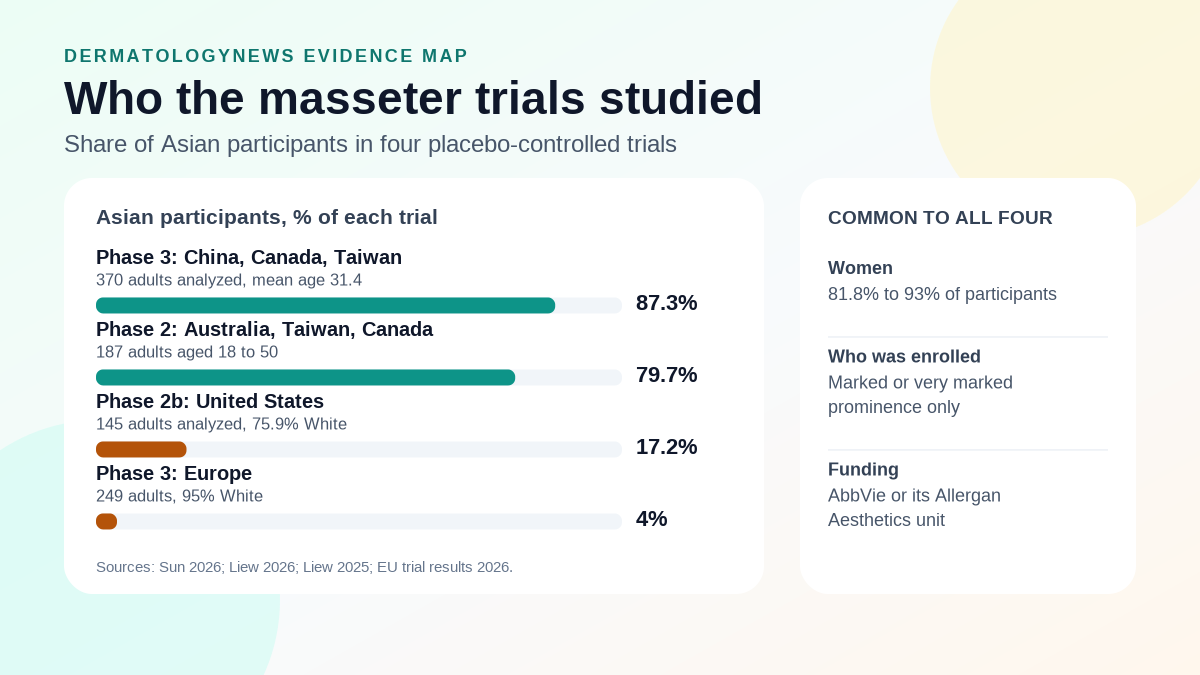
Allergan Aesthetics, the AbbVie company that makes BOTOX Cosmetic, paid for the multiregional, US phase 2b and phase 2 trials and took part in their design, analysis and approval of the publications [1][4][7][8]. AbbVie was the sponsor of the European trial, and AbbVie employees are among the authors of its report and of the CT analysis [3][6][10].
Limitations and realistic expectations
- Six months of controlled comparison. Both phase 3 reports compared one treatment with placebo for six months. The multiregional trial then continued open-label to day 540 and the European trial to day 360, with further treatment for eligible participants; the phase 2 trial and its bone studies covered 12 months and up to two treatments [1][5][6][7][10].
- Selected participants. Only adults with marked or very marked prominence were enrolled, so the results say little about milder prominence [1][3][4].
- Rating scales. In the US trial, the placebo group improved relatively often, which the authors attribute partly to rating a three-dimensional change on a two-dimensional scale [4].
- Incomplete follow-up. In the multiregional trial, 35 of 376 treated participants did not complete the six-month blinded period, and 28 participants missed a study visit because of COVID-19 travel restrictions [1].
- A modest average change. The average decrease in lower-face width at mouth level was about 5 mm at day 90, and about half of treated participants in the multiregional trial were satisfied at that point [1].
Questions to ask before treatment
- Is the width of my lower face mainly from the masseter muscle? The trial scale assessed the muscle by sight and touch, at rest and clenched [1].
- Which product and total dose do you use, and how does that compare with what was studied?
- Which side effects should I watch for, and how do I reach you if they occur?
- When would a repeat treatment be considered, and on what basis?
Bottom line
Placebo-controlled trials show that onabotulinumtoxinA injected into the masseters narrows the lower face, with a peak around 3 months and a smaller effect at 6 months [1][4]. The average decrease in lower-face width was about 5 mm, and side effects were mostly local and temporary: chewing weakness, injection-site pain or discomfort, paradoxical bulging and, less often, facial muscle weakness or a changed smile [1][4]. In the US the use is off-label while the FDA reviews an application to add it to the BOTOX Cosmetic label [2][9]. The manufacturer paid for the trials, which enrolled mostly women and followed bone health for 1 year [1][4][6][8][10].
Common questions
- Does masseter Botox actually slim the jaw?
- In placebo-controlled trials, yes. In a phase 3 trial of adults with marked or very marked masseter prominence, 51.2% of treated participants improved by at least two grades on a jaw-prominence scale at day 90, against 2.2% on placebo, and the width of the lower face at mouth level decreased by an average of 5.24 mm, against 0.04 mm on placebo [1]. In a European phase 3 trial, the two-grade figures were 34.8% and 11.8% [3].
- How long does masseter Botox last?
- In the trials, improvement was seen by day 30, peaked around day 90 and was still ahead of placebo at day 180, though smaller [1][4]. In a 12-month trial, participants whose prominence was still marked at 6 months could have a second treatment, which gave similar results [5].
- Is masseter Botox FDA approved?
- No. The current BOTOX Cosmetic label covers the temporary improvement in the appearance of moderate to severe frown lines between the brows, crow's feet, forehead lines and platysma bands of the neck, not the masseter [2]. On August 4, 2026, Allergan Aesthetics announced that the FDA had accepted for review an application to add masseter muscle prominence; the company gave no expected decision date [9].
- What are the side effects of masseter Botox?
- In a phase 3 trial, 12.0% of treated participants had treatment-related side effects against 3.2% on placebo. The most frequent were chewing weakness or jaw fatigue, injection-site pain or discomfort and paradoxical bulging of the muscle; 0.7% had facial muscle weakness [1]. In a US trial, 3 of 102 treated participants had a weak or altered smile [4]. Get medical help immediately if you have trouble swallowing, speaking or breathing after an injection [2].
- Does masseter Botox weaken the jawbone?
- In a CT study within a 12-month trial, 167 of 187 adults completed all scans, and researchers detected no clear difference from placebo on four CT measurements of jaw shape after one or two treatments [6]. A subgroup analysis found no clinically significant change in bone density in the regions measured [7]. Neither study measured bone strength, and the authors note that effects beyond 12 months cannot be excluded [6].
References
- Sun J, Wang L, Wu Y, et al. OnabotulinumtoxinA Treatment for Masseter Muscle Prominence: 6-Month Safety and Efficacy Results, Including Patient-Reported Outcomes, From a Phase 3, Randomized, Placebo-Controlled, Multiregional Trial. — Aesthetic Surgery Journal, 2026;46(5):486-494 (industry-funded) · PMID: 41092464 · DOI: 10.1093/asj/sjaf204
- BOTOX Cosmetic (onabotulinumtoxinA) for injection: US prescribing information, including the boxed warning on distant spread of toxin effect. — Allergan, Inc.; DailyMed label version 54, published January 8, 2026 (revised October 2024); checked November 24, 2026
- García-Gavín J, da Mota R, Bertossi D, et al. Improvement in the Appearance of Masseter Muscle Prominence After a Single Treatment with OnabotulinumtoxinA: Results from a Phase 3, Double-blind, Randomized, Placebo-controlled Study Period in Europe. — Aesthetic Surgery Journal, published online November 23, 2026 (NCT06068855) · PMID: 43070783 · DOI: 10.1093/asj/sjag260
- Liew S, Jones D, Dayan S, et al. A Controlled Phase 2b Trial to Assess the Efficacy and Safety of a Single Intervention of OnabotulinumtoxinA for Treating Masseter Muscle Prominence. — Aesthetic Surgery Journal, 2025;45(10):1043-1050 (industry-funded) · PMID: 40111171 · DOI: 10.1093/asj/sjaf042
- Carruthers J, Liew S, Rivers JK, et al. Reduction of masseter muscle prominence after treatment with onabotulinumtoxinA: Primary results from a randomized phase 2 study. — Journal of the American Academy of Dermatology, 2025;92(3):464-472 (industry-funded) · PMID: 39522729 · DOI: 10.1016/j.jaad.2024.10.064
- Mallya SM, Kostenuik P, Hopfinger R, et al. Longitudinal Computed Tomographic Evaluation of Mandibular Bone Morphology Following OnabotulinumtoxinA Treatment of Masseter Muscle Prominence: Results of a 12-Month, Repeat-Treatment, Placebo-Controlled Study in Healthy Adults. — Aesthetic Surgery Journal, 2026;46(12):NP169-NP183 · PMID: 42035242 · DOI: 10.1093/asj/sjag080
- Kostenuik P, Mallya SM, Hopfinger R, et al. Longitudinal Computed Tomography Indicates No Negative Impact of OnabotulinumtoxinA on Mandibular Bone Density in a 12-Month, Double-Blind, Randomized, Repeat Treatment, Placebo-Controlled Study in Healthy Adults With Masseter Muscle Prominence. — Aesthetic Surgery Journal, 2026;46(1):76-85 (industry-funded) · PMID: 40843518 · DOI: 10.1093/asj/sjaf167
- Liew S, Rivers JK, Humphrey S, et al. Improvement of Lower Facial Shape after Treatment with OnabotulinumtoxinA: Secondary Results from a Phase 2 Dose Escalation Study. — Plastic and Reconstructive Surgery, 2026;157(2):258-269 (industry-funded) · PMID: 40801407 · DOI: 10.1097/PRS.0000000000012345
- Allergan Aesthetics Announces U.S. FDA Acceptance of Supplemental Biologics License Application for BOTOX Cosmetic for Masseter Muscle Prominence. — AbbVie news release, August 4, 2026 (company announcement of the FDA filing acceptance)
- AbbVie. BOTOX (Botulinum Toxin Type A) for the Reduction of Masseter Muscle Prominence (M23-123): laypersons summary of results, English. — EU Clinical Trials Information System, EU CT 2022-500568-37-00; summary dated October 22, 2026, posted November 12, 2026